The Bui National Park is one of the few areas where the common hippopotamus resides in Ghana. The combined resources of the Black Volta River and the abundance of grasses make the area very suitable for hippopotamus. However, in an attempt to solve the electricity crisis the country faced in 2007, the government of Ghana constructed a hydroelectric dam in the heart of their home.
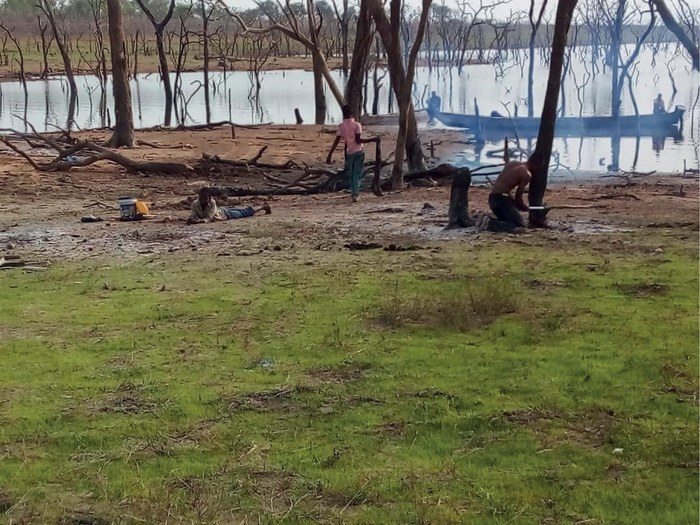
Credit: Bempah et al.
The Bui National Park is one of the few areas where the common hippopotamus resides in Ghana. The combined resources of the Black Volta River and the abundance of grasses make the area very suitable for hippopotamus. However, in an attempt to solve the electricity crisis the country faced in 2007, the government of Ghana constructed a hydroelectric dam in the heart of their home.
Knowing the consequence of dam creation on aquatic species, scientists Godfred Bempah, Martin Kobby Grant, Changhu Lu, and Amaël Borzée from Nanjing Forestry University, China, wanted to understand how the hippopotamus, a mega semi-aquatic species, was impacted by this project. The results have been published in the journal Nature Conservation. Assessing the impact of the dam construction can advise policy and decision making in future projects like this.
The researchers spent 24 days (2 days per month for 12 months) at the Bui National Park to estimate the number of hippopotamus individuals and understand local migratory activities, as well as to assess changes in land cover in the area after the dam was constructed. They then compared this information with historical data to understand the ecological changes within the area.
To complement the field surveys, the researchers spoke to local people familiar with the reserve before and after the dam construction. These included fishermen, canoe operators and park rangers. During the interactive discussion, all of them stated that the numbers of hippopotamus have declined compared to periods before the dam construction. They attributed the decline to poaching and habitat destruction.
The results indicated a decline in hippo numbers of about 70%: from 209 individuals in 2003 to 64 individuals in 2021.
The study revealed noticeable changes in land cover after the dam construction, and, most importantly, a decline in forest cover, as well as destruction of riparian grasses, the habitat preferred by the hippopotamus. The increase in water levels flooded the areas where the animals used to reside, forcing them to disperse to other suitable areas. As they dispersed, the animals became vulnerable to poaching, which combined with habitat loss eventually led to a decline in hippopotamus numbers. It is possible that some of the animals might have successfully moved to other areas outside the reserve.
The hippopotamus is listed as Vulnerable to extinction by the IUCN Red List of Threatened Species.
In conclusion, the authors note that the number of common hippopotamus individuals in the park has declined following the dam construction, in connection with habitat destruction and poaching. Once these threats are removed, the hippopotamus can survive in the medium to long term, when effective management plans are implemented.
Original source:
Bempah G, Kobby Grant M, Lu C, Borzée A (2022) The direct and indirect effects of damming on the Hippopotamus amphibius population abundance and distribution at Bui National Park, Ghana. Nature Conservation 50: 175-201. https://doi.org/10.3897/natureconservation.50.87411
DOI
10.3897/natureconservation.50.87411
Article Title
The direct and indirect effects of damming on the Hippopotamus amphibius population abundance and distribution at Bui National Park, Ghana
Article Publication Date
15-Nov-2022