• HOME
  • NEWS
  • EXPLORE
    • CAREER
      • Companies
      • Jobs
    • EVENTS
    • iGEM
      • News
      • Team
    • PHOTOS
    • VIDEO
    • WIKI
  • BLOG
  • COMMUNITY
    • FACEBOOK
    • INSTAGRAM
    • TWITTER
Saturday, February 7, 2026
BIOENGINEER.ORG
No Result
View All Result
  • Login
  • HOME
  • NEWS
  • EXPLORE
    • CAREER
      • Companies
      • Jobs
        • Lecturer
        • PhD Studentship
        • Postdoc
        • Research Assistant
    • EVENTS
    • iGEM
      • News
      • Team
    • PHOTOS
    • VIDEO
    • WIKI
  • BLOG
  • COMMUNITY
    • FACEBOOK
    • INSTAGRAM
    • TWITTER
  • HOME
  • NEWS
  • EXPLORE
    • CAREER
      • Companies
      • Jobs
        • Lecturer
        • PhD Studentship
        • Postdoc
        • Research Assistant
    • EVENTS
    • iGEM
      • News
      • Team
    • PHOTOS
    • VIDEO
    • WIKI
  • BLOG
  • COMMUNITY
    • FACEBOOK
    • INSTAGRAM
    • TWITTER
No Result
View All Result
Bioengineer.org
No Result
View All Result
Home NEWS Science News Chemistry

Research into the chemistry of environmentally friendly power generation at the ELTE Eötvös Loránd University

Bioengineer by Bioengineer
December 16, 2022
in Chemistry
Reading Time: 3 mins read
0
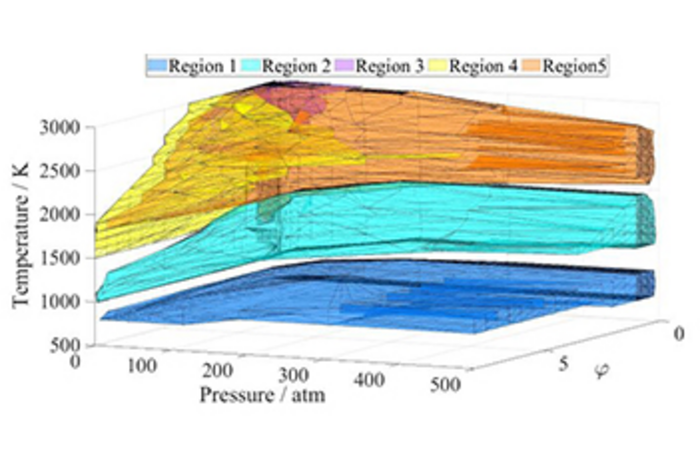
Location of the regions in the (T, p, φ) space;
Share on FacebookShare on TwitterShare on LinkedinShare on RedditShare on Telegram


Location of the regions in the (T, p, φ) space;

Credit: Photo: ELTE Eötvös Loránd University


Researchers of the Faculty of Science at the ELTE Eötvös Loránd University investigate the properties of methane, the most important component of natural gas. Accurate knowledge of the ignition of methane–air mixtures will help to increase the efficiency and reduce the environmental impact of heating and power generation, and could also lead to further developments in industrial safety, chemical and energy engineering.

In Hungary, the majority of households use natural gas for heating:

it is one of the most environmentally friendly ways of keeping our homes warm.

However, natural gas also plays an important role in electricity generation. Solar and wind power generations have high fluctuations, and an effective way to compensate for this is to use gas turbines and gas engines based on natural gas combustion, which can quickly make up for the missing electricity.

A significant proportion of natural gas is methane to varying degrees depending on the area; in Hungary natural gas contains nearly ninety-seven per cent methane. In order utilize this colourless, odourless, flammable substance more efficiently in environmentally friendly power generation, it is important to study the explosion of methane-air mixtures, the spread of flame in gas engines, and the formation of harmful pollutants during the combustion of natural gas.

The Chemical Kinetics Laboratory of the Institute of Chemistry and the Department of Applied Analysis and Computational Mathematics of the Institute of Mathematics at ELTE – Éva Valkó, Máté Papp, Peng Zhang and Tamás Turányi – investigated the ignition of methane-air mixtures based on a detailed reaction kinetics model. The sensitivity vector of the ignition time was calculated by varying the initial temperature (T), pressure (p) and methane-to-air equivalence ratio (ϕ) over a wide range. A cluster analysis of the resulting more than 14 thousand sensitivity vectors showed that five domains can be identified in the (T, p, ϕ) space, and that in each domain a different set of chemical reactions leads to methane ignition. The results were published in the Proceedings of the Combustion Institute.

For a visual summary of the research results please look at Youtube video https://www.youtube.com/watch?v=CGliv6JbzWc

“Operation of gas engines include compressing a mixture of natural gas and air rapidly to reach a given temperature and pressure. The time to explosion for this high-pressure, hot gas mixture is critical.

If a reliable computer model based on a detailed reaction mechanism is available, it can be used to determine whether or not an explosion will occur,”

says Prof. Tamás Turányi, the head of the research.

For years, Tamás Turányi’s research group has also been investigating the so-called e-fuels, which can overcome the above mentioned limitation of renewable energy production, namely the large fluctuations in the amount of electricity produced. In e-fuels, the energy content of excess electricity can be stored and then converted back into electricity. One such fuel is ammonia, which has the advantage of being produced using mature technology and is easy to transport and store.

More details on this research can be found in the group’s website: https://chemkinlab.elte.hu/.


Journal

Proceedings of the Combustion Institute

DOI

10.1016/j.proci.2022.07.186

Article Title

Identification of homogeneous chemical kinetic regimes of methane-air ignition

Share12Tweet8Share2ShareShareShare2

Related Posts

blank

Breakthrough in Environmental Cleanup: Scientists Develop Solar-Activated Biochar for Faster Remediation

February 7, 2026
blank

Cutting Costs: Making Hydrogen Fuel Cells More Affordable

February 6, 2026

Scientists Develop Hand-Held “Levitating” Time Crystals

February 6, 2026

Observing a Key Green-Energy Catalyst Dissolve Atom by Atom

February 6, 2026

POPULAR NEWS

  • Robotic Ureteral Reconstruction: A Novel Approach

    Robotic Ureteral Reconstruction: A Novel Approach

    82 shares
    Share 33 Tweet 21
  • Digital Privacy: Health Data Control in Incarceration

    63 shares
    Share 25 Tweet 16
  • Study Reveals Lipid Accumulation in ME/CFS Cells

    57 shares
    Share 23 Tweet 14
  • Breakthrough in RNA Research Accelerates Medical Innovations Timeline

    53 shares
    Share 21 Tweet 13

About

We bring you the latest biotechnology news from best research centers and universities around the world. Check our website.

Follow us

Recent News

Evaluating Pediatric Emergency Care Quality in Ethiopia

TPMT Expression Predictions Linked to Azathioprine Side Effects

Improving Dementia Care with Enhanced Activity Kits

Subscribe to Blog via Email

Success! An email was just sent to confirm your subscription. Please find the email now and click 'Confirm' to start subscribing.

Join 73 other subscribers
  • Contact Us

Bioengineer.org © Copyright 2023 All Rights Reserved.

Welcome Back!

Login to your account below

Forgotten Password?

Retrieve your password

Please enter your username or email address to reset your password.

Log In
No Result
View All Result
  • Homepages
    • Home Page 1
    • Home Page 2
  • News
  • National
  • Business
  • Health
  • Lifestyle
  • Science

Bioengineer.org © Copyright 2023 All Rights Reserved.