“Our study provides several insights into human skeletal muscle aging.”
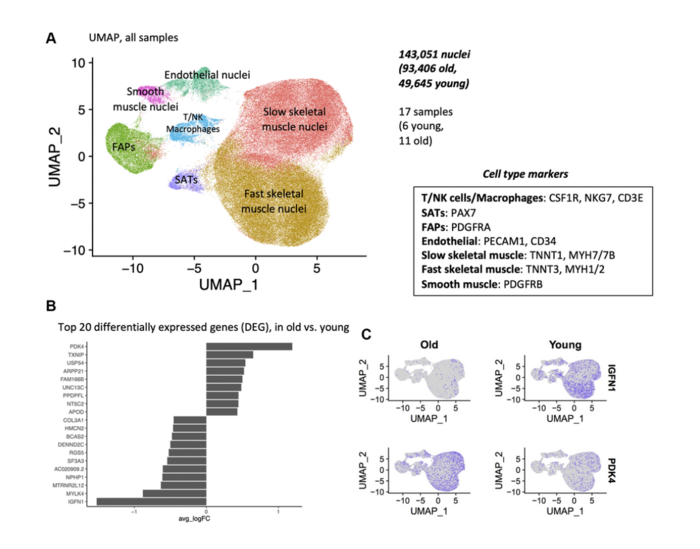
Credit: 2022 Perez et al.
“Our study provides several insights into human skeletal muscle aging.”
BUFFALO, NY- December 15, 2022 – A new research paper was published on the cover of Aging (listed as “Aging (Albany NY)” by Medline/PubMed and “Aging-US” by Web of Science) Volume 14, Issue 23, entitled, “Single nuclei profiling identifies cell specific markers of skeletal muscle aging, frailty, and senescence.”
Aging is accompanied by a loss of muscle mass and function, termed sarcopenia, which causes numerous morbidities and economic burdens in human populations. Mechanisms implicated in age-related sarcopenia or frailty include inflammation, muscle stem cell depletion, mitochondrial dysfunction, and loss of motor neurons, but whether there are key drivers of sarcopenia are not yet known.
In this new study, researchers Kevin Perez, Serban Ciotlos, Julia McGirr, Chandani Limbad, Ryosuke Doi, Joshua P. Nederveen, Mats I. Nilsson, Daniel A. Winer, William Evans, Mark Tarnopolsky, Judith Campisi, and Simon Melov, from Buck Institute for Research on Aging, Astellas Pharma, McMaster University, Exerkine Corporation, and the University of California, Berkeley, performed transcriptome profiling on lower limb muscle biopsies from 72 young, elderly, and frail human subjects using bulk RNA-seq (N = 72) and single-nuclei RNA-seq (N = 17) to gain deeper insights into age-related muscle loss.
“This combined approach revealed changes in gene expression that occur with age and frailty in multiple cell types comprising mature skeletal muscle.”
Notably, the researchers found increased expression of the genes MYH8 and PDK4, and decreased expression of the gene IGFN1, in aged muscle. They validated several key genes changes in fixed human muscle tissue using digital spatial profiling. The researchers also identified a small population of nuclei that express CDKN1A, present only in aged samples, consistent with p21cip1-driven senescence in this subpopulation.
“Overall, our findings identify unique cellular subpopulations in aged and sarcopenic skeletal muscle, which will facilitate the development of new therapeutic strategies to combat age-related frailty.”
DOI: https://doi.org/10.18632/aging.204435
Corresponding Author: Simon Melov – [email protected]
Keywords: aging, transcriptomics, muscle, senescence, sarcopenia
Sign up for free Altmetric alerts about this article: https://aging.altmetric.com/details/email_updates?id=10.18632%2Faging.204435
About Aging-US:
Launched in 2009, Aging (Aging-US) publishes papers of general interest and biological significance in all fields of aging research and age-related diseases, including cancer—and now, with a special focus on COVID-19 vulnerability as an age-dependent syndrome. Topics in Aging go beyond traditional gerontology, including, but not limited to, cellular and molecular biology, human age-related diseases, pathology in model organisms, signal transduction pathways (e.g., p53, sirtuins, and PI-3K/AKT/mTOR, among others), and approaches to modulating these signaling pathways.
Please visit our website at www.Aging-US.com and connect with us:
- SoundCloud – https://soundcloud.com/Aging-Us
- Facebook – https://www.facebook.com/AgingUS/
- Twitter – https://twitter.com/AgingJrnl
- Instagram – https://www.instagram.com/agingjrnl/
- YouTube – https://www.youtube.com/agingus
- LinkedIn – https://www.linkedin.com/company/aging/
- Reddit – https://www.reddit.com/user/AgingUS
- Pinterest – https://www.pinterest.com/AgingUS/
For media inquiries, please contact [email protected].
Aging (Aging-US) Journal Office
6666 E. Quaker Str., Suite 1B
Orchard Park, NY 14127
Phone: 1-800-922-0957, option 1
###
Journal
Aging-US
DOI
10.18632/aging.204435
Method of Research
Observational study
Subject of Research
Human tissue samples
Article Title
Single nuclei profiling identifies cell specific markers of skeletal muscle aging, frailty, and senescence
Article Publication Date
7-Dec-2022