Key points:
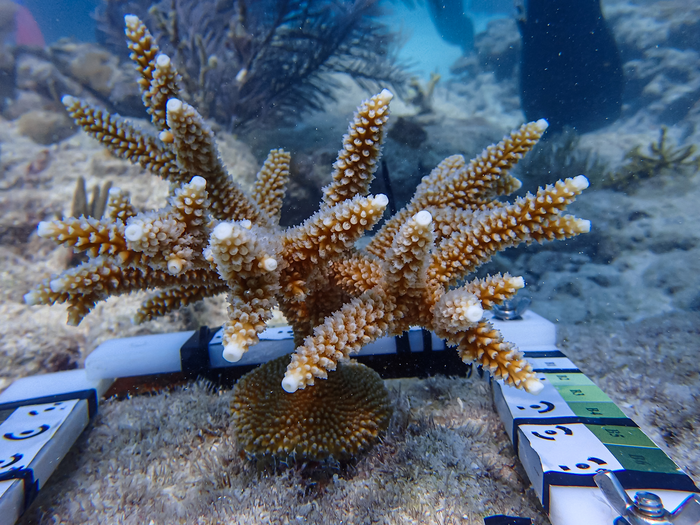
Credit: Wyatt Million/USC Dornsife College of Letters, Arts and Sciences
Key points:
- Climate change is decimating the worlds’ reefs.
- Transplanting healthy coral onto dying reefs may save them.
- Some transplanted corals seem to thrive while others fail, but researchers weren’t sure why.
- A new study led by USC Dornsife scientists solves the mystery, revealing a path to successful transplants and rejuvenated reefs.
As the health of coral reefs continues to decline under the stress of climate change, researchers aim to rejuvenate failing reefs by transplanting healthy coral. Unfortunately, they’ve found mixed results, as some transplanted coral wither and die while others take root and thrive.
Why some transplanted coral, called “outplants,” flourish and others struggle or perish has remained a mystery, until now. A new study led by researchers at the USC Dornsife College of Letters, Arts and Sciences and published in the Proceedings of the National Academy of Sciences reveals the key to successful coral transplantation.
Solving the mystery is critical to restoring dying reefs with transplanted coral, says Carly Kenkel, Gabilan Assistant Professor of Biological Sciences at USC Dornsife and a corresponding author on the study. And saving reefs remains a global imperative.
According to a 2021 study, Earth has lost half of its coral reefs since 1950. This global devastation holds tragic potential: A billion people benefit from reef ecosystems, and the U.S. economy alone gains $3.4 billion per year from them through industries like fishing and tourism, according to the National Oceanic and Atmospheric Administration.
Is it the one or the many?
Kenkel’s transplant research centers on the critically endangered Caribbean staghorn coral, Acropora cervicornis.
Before the current study, scientists used different individual staghorn coral at various transplant sites and found some outplants fared better at some locations than others. But because they used different coral at different sites, they were unable to narrow down the reason for success or failure: Was it the environment, the coral or a combination of both?
“We didn’t know if the coral were performing poorly at some sites because the environment was poor, because the individual coral were poor performers, or because those individual coral just happened to be poor performers in that particular environment,” said Kenkel.
To find the answer, Kenkel and Wyatt Million, formerly a PhD student in Kenkel’s lab at USC Dornsife and first author on the study, reduced the number of variables involved. They used clones of just 10 staghorn individuals and transplanted specimens of each at nine well-understood reef sites in the Florida Keys. They then tracked the outplants’ survival, growth, shape and size at each location.
They found that both the coral and the environment mattered. No single clone proved strong across all environments; each site saw a different clone step up and adapt for success.
“This is very important information for reef restoration,” said Kenkel. “It means that the genetic diversity of coral transplants is going to be important for hedging our bets.” As researchers aim to restore reefs, they’ll want to use a variety of individuals to ensure at least one can adapt to the new home.
She likened the idea to investing: “Diversifying your portfolio is safer than betting big on one particular company because even if some companies lose money, others will win.”
Maximizing genetic diversity — rather than looking for one standout coral to save the day, as has been the trend among researchers — is a wiser approach, she said.
“On these reefs, diversifying coral outplants is safer than betting on one ’super coral’ to succeed. There will be winners and losers in every environment. And reefs are really dynamic; each environment can be really different from a coral’s perspective, and they’re going to be even more different as the climate continues to change.”
“Plastic coral”
The findings also mean scientists will want to focus on how adaptable individual coral can be to various environments, meaning how much an individual can change its shape, size and other characteristics in response to changing environmental factors on the reef.
This “plasticity” could affect the chances of long-term success of outplants over many generations as climate change continues.
“We found that some coral were more plastic than others, and the most plastic coral — those that were able to grow biggest when it made sense to be big at a particular site or stay smallest when that was a benefit — were actually the ones who survived the best on average,” Kenkel said.
Study first author Wyatt Million — formerly a PhD student in Kenkel’s lab and now a postdoc at Germany’s Justus Liebig University Giessen — warns that coral plasticity isn’t a substitute for addressing climate change at its roots, however.
“I’d like to emphasize that adaptive plasticity is not a magic bullet for coral and cannot replace the goal of reversing the effects of climate change if we hope to ensure the ultimate persistence of coral,” he said.
What’s next?
Kenkel’s team now aims to dig deeper into what gives coral its plasticity and how it might affect future transplant efforts.
“We’re going to be asking questions like, ‘Are there any downsides to a coral being more plastic?’ Maybe it doesn’t show up in their lifetime — maybe it affects their offspring or their ability to produce offspring,” Kenkel said.
They’ll also study how coral plasticity impacts the function of the whole reef as well as what’s happening at a cellular and molecular level to enable the coral to grow, an avenue Million finds particularly interesting.
“Perhaps the most pertinent next steps include identifying the genetic basis of this plasticity and whether it belongs to the animal host or the algal symbiont,” he said.
Coral have microscopic algae living within them in a relationship known as “symbiosis.” The algae provide the coral with food and other benefits in exchange for nutrients and a safe place to live.
Understanding the genetics of both organisms will help scientists predict how a coral’s plasticity might evolve over generations with changing climate conditions.
About the study
In addition to Kenkel and Million, researchers on the study include Maria Ruggeri and Sibelle O’Donnell of USC Dornsife; Erich Bartels of Mote Marine Laboratory; Trinity Conn of The Pennsylvania State University; and Cory Krediet of Eckerd College.
This research was supported by NOAA Coral Reef Conservation Program grant NA17NOS4820084 and private funding from the Alfred P. Sloan Foundation and Rose Hills Foundation.
Journal
Proceedings of the National Academy of Sciences
DOI
10.1073/pnas.2203925119
Method of Research
Experimental study
Subject of Research
Not applicable
Article Title
Evidence for adaptive morphological plasticity in the Caribbean coral, Acropora cervicornis
Article Publication Date
28-Nov-2022
COI Statement
The authors declare no competing interest.