Necroptosis is a form of regulated cell death (RCD) similar to apoptosis, the most commonly studied type of RCD. In contrast to apoptosis, plasma membrane rupture in necroptotic cells occurs at early time points. For this reason, scientists think that necroptosis elicits strong inflammation in surrounding tissues and plays a role in inflammation-associated diseases. However, it is not well understood where and when necroptosis occurs in physiological and pathological conditions in vivo.
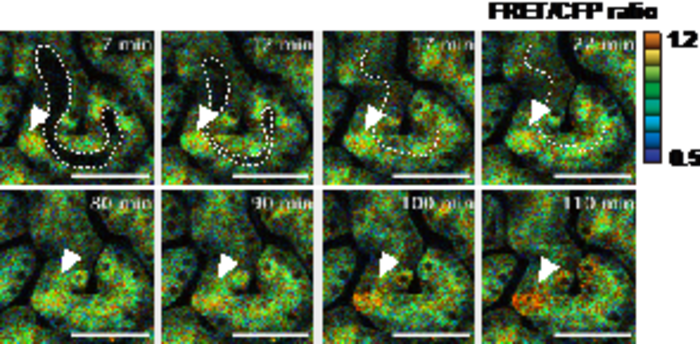
Credit: Hiroyasu Nakano
Necroptosis is a form of regulated cell death (RCD) similar to apoptosis, the most commonly studied type of RCD. In contrast to apoptosis, plasma membrane rupture in necroptotic cells occurs at early time points. For this reason, scientists think that necroptosis elicits strong inflammation in surrounding tissues and plays a role in inflammation-associated diseases. However, it is not well understood where and when necroptosis occurs in physiological and pathological conditions in vivo.
To address this issue, Prof. Nakano’s group previously developed a biosensor for necroptosis called SMART (Sensor for MLKL activation by RIPK3 based on FRET). This biosensor is designed based on fluorescence resonance energy transfer (FRET). In a Nature Communications paper published in 2018, they successfully characterized necroptosis in vitro using this FRET biosensor. Now, they went one step further; they developed transgenic mice with the FRET biosensor SMART for in vivo observation of necroptosis. “The goal of our project is to see when and where necroptosis occurs in vivo, and to understand its role in pathological contexts,” said Dr. Murai, the lead author of the study.
In their experiments, they first confirmed that necroptosis can be monitored in primary macrophages or murine embryonic fibroblasts that were derived from SMART Tg mice. Then, they applied a cisplatin-induced acute kidney injury model to SMART Tg mice.
“After many trials and errors, we were finally able to monitor the execution of necroptosis in proximal tubular epithelial cells in cisplatin-injected SMART Tg mice. In contrast to apoptosis, it was rather difficult to induce massive necroptosis in particular tissues at relatively short periods, which is essential for efficiently monitoring cell death using two-photon microscopy in vivo. We believe that SMART Tg mice serve as a promising tool to visualize necroptosis in vivo and help us to better understand the role of this relatively newly discovered form of cell death, necroptosis in pathophysiology of diseases,” said Prof. Nakano, the senior author of the study.
These results were published in Communications Biology on December 5, 2022 (10.1038/s42003-022-04300-0). This research was conducted in collaboration with Professor Michiyuki Matsuda of Kyoto University, team leader Kenta Sumiyama of RIKEN, Professor Yoshifumi Yamaguchi of Hokkaido University, Professor Kimi Araki of Kumamoto University, and Professor Masaki Ohmuraya of Hyogo College of Medicine.
Journal
Communications Biology
DOI
10.1038/s42003-022-04300-0
Method of Research
Experimental study
Subject of Research
Animals
Article Title
Generation of transgenic mice expressing a FRET biosensor, SMART, that responds to necroptosis
Article Publication Date
5-Dec-2022
COI Statement
There is no COI related to this news release.