Researchers report new results from the NASA Deep Space Optical Communications (DSOC) technology demonstration project, which develops and tests new advanced laser sources for deep-space optical communication. The ability to perform free-space optical communication throughout the solar system would go beyond the capabilities of the radio communication systems used now and provide the bandwidth necessary for future space missions to transmit large amounts of data, including high-definition images and video.
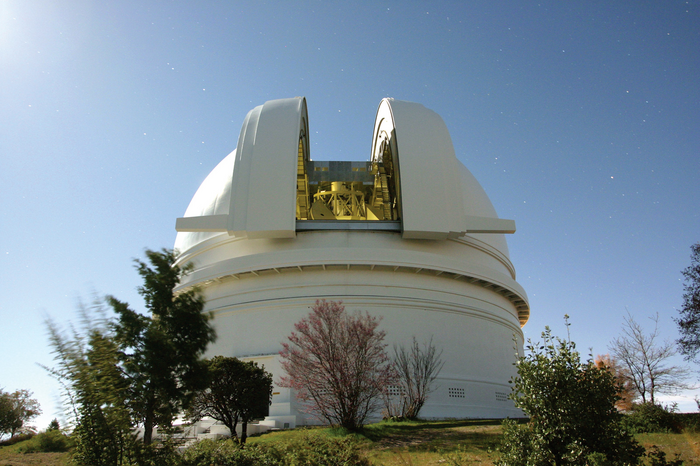
Credit: Caltech/Palomar Observatory
Researchers report new results from the NASA Deep Space Optical Communications (DSOC) technology demonstration project, which develops and tests new advanced laser sources for deep-space optical communication. The ability to perform free-space optical communication throughout the solar system would go beyond the capabilities of the radio communication systems used now and provide the bandwidth necessary for future space missions to transmit large amounts of data, including high-definition images and video.
The demonstration system consists of a flight laser transceiver, a ground laser transmitter and a ground laser receiver. The downlink transmitter has been installed on the Psyche spacecraft, which will travel to a unique metal asteroid also called Psyche, which orbits the Sun between Mars and Jupiter.
Malcolm. W. Wright, from the Jet Propulsion Laboratory, California Institute of Technology, will present the functional and environmental test results of the DSOC downlink flight laser transmitter assembly and ground uplink transmitter assembly at the Optica Laser Congress, 11 – 15 December 2022.
Validating deep space optical communications will allow streaming back high-definition imagery during robotic and manned exploration of planetary bodies, utilizing resources comparable to state-of-art radio-frequency telecommunications.
Transmitting into deep space
Although free-space optical communications from space to ground have been demonstrated at distances as far away as the moon, extending such links to deep space ranges requires new types of laser transmitters. The downlink flight laser must have a high photon efficiency while supporting near kilowatt peak power. The uplink laser requires multi-kilowatt average powers with narrow linewidth, good beam quality and low modulation rates.
The flight laser transmitter assembly uses a 5 W average power Er-Yb co-doped fiber-based master oscillator power amplifier laser with discrete pulse widths from 0.5 to 8 ns in a polarized output beam at 1550 nm with an extinction ratio of more than 33 dB. The laser passed verification and environmental tests before being integrated into spacecraft. End-to-end testing of the flight laser transmitter with the ground receiver assembly also validated the optical link performance for a variety of pulse formats and verified the interface to the DSOC electronics assembly.
Launching a new approach
The ground uplink transmitter assembly can support optical links with up to 5.6 kW average power at 1064 nm. It includes ten kilowatt-class continuous wavelength fiber-based laser transmitters modified to support the modulation formats. A remotely placed chiller provides thermal management for the lasers and power supplies. The uplink laser will also provide a light beacon onto which the flight transceiver can lock.
“Using multiple individual laser sources that propagate through sub-apertures on the telescope’s primary mirror relieves the power requirement from a single source,” said Wright. “It also allows atmospheric turbulence mitigation and reduces the power density on the telescope mirrors.”
Now that spacecraft-level testing is complete, the Psyche spacecraft — with the flight laser transceiver aboard — will be integrated into a launch vehicle. The DSOC technology demonstration will begin shortly after launch and continue for one year as the spacecraft travels away from Earth and eventually performs a flyby of Mars.
Find more information about the NASA Deep Space Optical Communications technology demonstration project at https://www.nasa.gov/mission_pages/tdm/dsoc/index.html.
About the 2022 Optica Laser Congress and Exhibition
The Laser Congress provides a comprehensive view of the latest advances in solid-state laser development along with recent new applications. This year’s meeting will be presented 11 – 15 December 2022 in a hybrid meeting format to accommodate virtual (online) participation as well as in-person attendance at the Barcelona International Convention Center. Learn more.
About Optica
Optica (formerly OSA), Advancing Optics and Photonics Worldwide, is the society dedicated to promoting the generation, application, archiving and dissemination of knowledge in the field. Founded in 1916, it is the leading organization for scientists, engineers, business professionals, students and others interested in the science of light. Optica’s renowned publications, meetings, online resources and in-person activities fuel discoveries, shape real-life applications and accelerate scientific, technical and educational achievement. Discover more at: Optica.org