• HOME
  • NEWS
  • EXPLORE
    • CAREER
      • Companies
      • Jobs
    • EVENTS
    • iGEM
      • News
      • Team
    • PHOTOS
    • VIDEO
    • WIKI
  • BLOG
  • COMMUNITY
    • FACEBOOK
    • INSTAGRAM
    • TWITTER
Saturday, February 7, 2026
BIOENGINEER.ORG
No Result
View All Result
  • Login
  • HOME
  • NEWS
  • EXPLORE
    • CAREER
      • Companies
      • Jobs
        • Lecturer
        • PhD Studentship
        • Postdoc
        • Research Assistant
    • EVENTS
    • iGEM
      • News
      • Team
    • PHOTOS
    • VIDEO
    • WIKI
  • BLOG
  • COMMUNITY
    • FACEBOOK
    • INSTAGRAM
    • TWITTER
  • HOME
  • NEWS
  • EXPLORE
    • CAREER
      • Companies
      • Jobs
        • Lecturer
        • PhD Studentship
        • Postdoc
        • Research Assistant
    • EVENTS
    • iGEM
      • News
      • Team
    • PHOTOS
    • VIDEO
    • WIKI
  • BLOG
  • COMMUNITY
    • FACEBOOK
    • INSTAGRAM
    • TWITTER
No Result
View All Result
Bioengineer.org
No Result
View All Result
Home NEWS Science News Biology

Ancient amphibians had their bones cooked

Bioengineer by Bioengineer
December 7, 2022
in Biology
Reading Time: 3 mins read
0
A photograph of the Jarrow amphibian Keraterpeton galvani on top and a CT-image of K. galvani below showing the alteration in the bones
Share on FacebookShare on TwitterShare on LinkedinShare on RedditShare on Telegram

Scientists have solved a decades-long mystery as to why ancient tetrapods – amphibian-like creatures that lived over 300 million years ago – preserved in one of Ireland’s most important fossil sites seemingly had their bones cooked after they died.
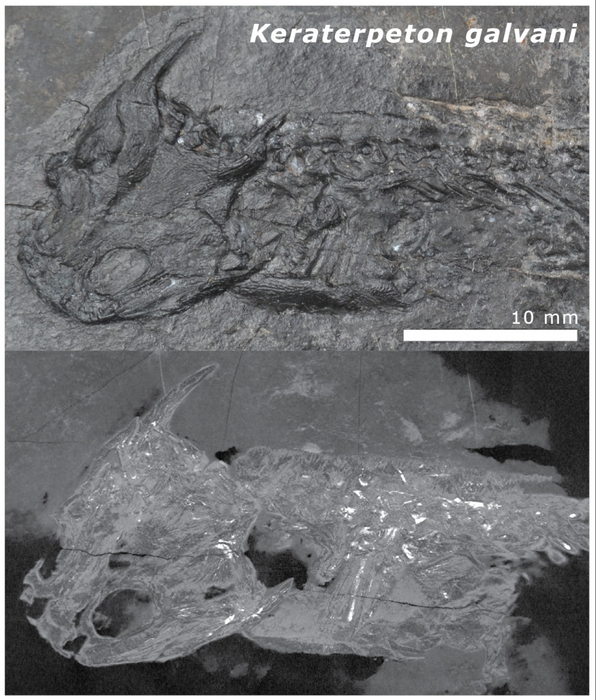
A photograph of the Jarrow amphibian Keraterpeton galvani on top and a CT-image of K. galvani below showing the alteration in the bones

Credit: Dr Aodhan O’Gogain, Trinity College Dublin

Scientists have solved a decades-long mystery as to why ancient tetrapods – amphibian-like creatures that lived over 300 million years ago – preserved in one of Ireland’s most important fossil sites seemingly had their bones cooked after they died.

The Jarrow Assemblage is one of Ireland’s most important fossil sites and preserves some of the oldest amphibians to live in terrestrial environments. These fossils are found in a coal seam in Co. Kilkenny.

Fossils from this site have one unique feature: their original internal bone morphology has been altered so that now it is difficult to make out detail from the fossils. The cause of this alteration has baffled scientists, with explanations for this alteration usually thought to be due to acid dissolving the bones when the animals were first buried. That is until now.

A team of scientists from Trinity College Dublin, University College Dublin, National University of Ireland, Galway, the University of Birmingham and the Gemological Institute of America used a combination of computed tomography, to produce X-Ray images of the fossil, and laser ablation, to analysis the chemistry of the bones to investigate the causes of this alteration. 

Dr Aodhán Ó Gogáin, from Trinity’s School of Natural Sciences, is the lead-author of the study. He said:

“Normally in fossil bone we see that the internal original structure is preserved. But when we looked at the X-Ray images of fossils from Jarrow we see that no internal bone morphology has been preserved and that bones have been partially replaced by the surrounding coal.”

The team also found apatite preserved in the bones. Dr Gary O’Sullivan, a co-author in the study said:

“The chemistry of the apatite crystals can tell us a lot about how it formed, whether it grew organically in the animal, formed when the animal was being buried or whether some other factors influenced its growth. Apatite is a major constitute of living bone so it is no surprise we find some preserved in these bones. However, when we look at the chemistry of apatite in the bones from Jarrow we find that this apatite was formed by heated fluids within the Earth

Dr Aodhán Ó Gogáin added: 

“We have also been able to radiometrically date the apatite which shows it formed during a time when all the continents on Earth were coming together and colliding to form the supercontinent Pangaea. As these continents collided, they formed mountain belts with super-heated subterranean fluids flowing of them. It is these super-heated fluids, which flowed throughout Ireland that cooked and melted the bones of these fossils causing the alteration we see today.”

Trinity’s Dr Patrick Wyse Jackson, another co-author said:

 “The Jarrow assemblage is of major scientific importance and is a significant element of Ireland’s geoheritage. It is great that finally the question of what altered the fossil bones of these animals has been resolved.”


Journal

Palaeontology

DOI

10.1111/pala.12628

Method of Research

Experimental study

Share12Tweet8Share2ShareShareShare2

Related Posts

Florida Cane Toad: Complex Spread and Selective Evolution

Florida Cane Toad: Complex Spread and Selective Evolution

February 7, 2026
New Study Uncovers Mechanism Behind Burn Pit Particulate Matter–Induced Lung Inflammation

New Study Uncovers Mechanism Behind Burn Pit Particulate Matter–Induced Lung Inflammation

February 6, 2026

DeepBlastoid: Advancing Automated and Efficient Evaluation of Human Blastoids with Deep Learning

February 6, 2026

Navigating the Gut: The Role of Formic Acid in the Microbiome

February 6, 2026

POPULAR NEWS

  • Robotic Ureteral Reconstruction: A Novel Approach

    Robotic Ureteral Reconstruction: A Novel Approach

    82 shares
    Share 33 Tweet 21
  • Digital Privacy: Health Data Control in Incarceration

    63 shares
    Share 25 Tweet 16
  • Study Reveals Lipid Accumulation in ME/CFS Cells

    57 shares
    Share 23 Tweet 14
  • Breakthrough in RNA Research Accelerates Medical Innovations Timeline

    53 shares
    Share 21 Tweet 13

About

We bring you the latest biotechnology news from best research centers and universities around the world. Check our website.

Follow us

Recent News

Phage-Antibiotic Combo Beats Resistant Peritoneal Infection

Boosting Remote Healthcare: Stepped-Wedge Trial Insights

Barriers and Boosters of Seniors’ Physical Activity in Karachi

Subscribe to Blog via Email

Enter your email address to subscribe to this blog and receive notifications of new posts by email.

Join 73 other subscribers
  • Contact Us

Bioengineer.org © Copyright 2023 All Rights Reserved.

Welcome Back!

Login to your account below

Forgotten Password?

Retrieve your password

Please enter your username or email address to reset your password.

Log In
No Result
View All Result
  • Homepages
    • Home Page 1
    • Home Page 2
  • News
  • National
  • Business
  • Health
  • Lifestyle
  • Science

Bioengineer.org © Copyright 2023 All Rights Reserved.