FRANKFURT. Sometimes it is interest in a student exchange, more often than not a joint research project that provides the impetus for an international university partnership. In the case of the new partnership between the University of Saskatchewan and Goethe University, it was a shared interest in water research: biologist Prof. Henner Hollert from Goethe University’s Institute of Ecology, Evolution and Diversity, and his Canadian colleagues Prof. Markus Brinkmann and Prof. Markus Hecker, both at the Toxicology Centre within the University of Saskatchewan’s School of Environment and Sustainability, have been conducting research together for many years. Fast forward to today, and the natural scientists are planning a transnational college for young scientists to focus on water safety and the health of an aquatic ecosystem. A few months ago, the three scientists’ universities agreed on a comprehensive partnership that will tie the two institutions together in areas above and beyond sustainability research.
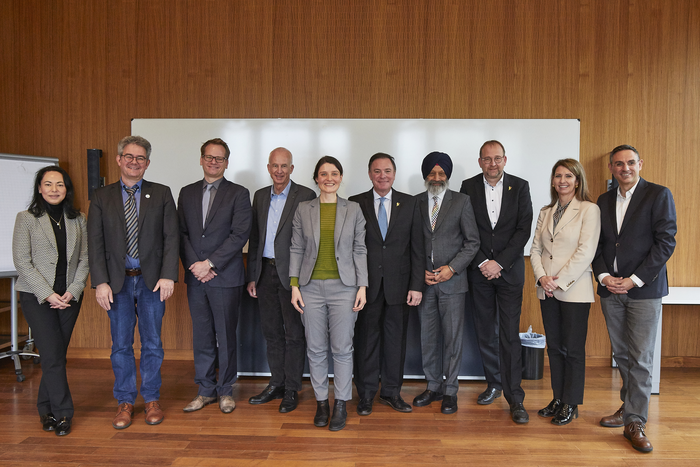
Credit: Jürgen Lecher / Goethe University
FRANKFURT. Sometimes it is interest in a student exchange, more often than not a joint research project that provides the impetus for an international university partnership. In the case of the new partnership between the University of Saskatchewan and Goethe University, it was a shared interest in water research: biologist Prof. Henner Hollert from Goethe University’s Institute of Ecology, Evolution and Diversity, and his Canadian colleagues Prof. Markus Brinkmann and Prof. Markus Hecker, both at the Toxicology Centre within the University of Saskatchewan’s School of Environment and Sustainability, have been conducting research together for many years. Fast forward to today, and the natural scientists are planning a transnational college for young scientists to focus on water safety and the health of an aquatic ecosystem. A few months ago, the three scientists’ universities agreed on a comprehensive partnership that will tie the two institutions together in areas above and beyond sustainability research.
Continuing this comprehensive cooperation was the main topic at yesterday’s inaugural visit by University of Saskatchewan’s Vice President for Research Prof. Baljit Singh and biologist Prof. Markus Brinkmann, who also serves as his university’s special advisor for German university partnerships. The scientists were accompanied by Gordon Wyant, Minister of Education in the Canadian province of Saskatchewan, as well as other members of his ministry.
“We are very much looking forward to this new transatlantic partnership,” said Goethe University President Prof. Enrico Schleiff. “Our connection with the research-intensive University of Saskatchewan is not limited to the joint research excellent scientists from both universities have been conducting in the fields of ecotoxicology and biodiversity for many years. We are also united by the conviction that as universities, we are called upon to develop creative interdisciplinary solutions for the world’s societal challenges. We want to strengthen and inspire each other in the long term!”
Dr. Baljit Singh, University of Saskatchewan’s Vice President for Research, emphasized: “The University of Saskatchewan is excited to formalize our longstanding partnership with Goethe University, with whom we share common values and a commitment to academic and research excellence. We look forward to the collaboration between University of Saskatchewan and Goethe University researchers to develop solutions to complex global challenges.”
Further collaboration will include student, faculty and staff exchanges and internships, as well as the expansion of research projects and the development of joint academic programs. The agreement focuses on additional projects in water research, especially water security and water health, projects on the interactions between chemical pollution and biodiversity loss, as well as further inter- and transdisciplinary research in sustainability, biodiversity and planetary health.
The Canadian guests also showed particular interest in Goethe University’s new Sustainability Office, whose team informed the visitors about current and planned projects.
Located in Saskatoon, the province’s largest city, the University of Saskatchewan is one of Canada’s leading research universities and, with about 25,000 students, one of the country’s largest. It is a member of the U15 group of Canadian research universities and offers bachelor’s and master’s programs in more than 150 fields of study. It is also a member of the University of the Arctic (UArctic), a network of universities and institutes in the North Polar region. The University of Saskatchewan is one of the world’s leading universities in the field of interdisciplinary water research, and is supported by the Global Institute for Water Security (GIWS) and the Global Water Futures (GWF) program.
Goethe University is the third German partner university of the University of Saskatchewan, along with Greifswald and TU Darmstadt.