• HOME
  • NEWS
  • EXPLORE
    • CAREER
      • Companies
      • Jobs
    • EVENTS
    • iGEM
      • News
      • Team
    • PHOTOS
    • VIDEO
    • WIKI
  • BLOG
  • COMMUNITY
    • FACEBOOK
    • INSTAGRAM
    • TWITTER
Wednesday, July 8, 2026
BIOENGINEER.ORG
No Result
View All Result
  • Login
  • HOME
  • NEWS
  • EXPLORE
    • CAREER
      • Companies
      • Jobs
        • Lecturer
        • PhD Studentship
        • Postdoc
        • Research Assistant
    • EVENTS
    • iGEM
      • News
      • Team
    • PHOTOS
    • VIDEO
    • WIKI
  • BLOG
  • COMMUNITY
    • FACEBOOK
    • INSTAGRAM
    • TWITTER
  • HOME
  • NEWS
  • EXPLORE
    • CAREER
      • Companies
      • Jobs
        • Lecturer
        • PhD Studentship
        • Postdoc
        • Research Assistant
    • EVENTS
    • iGEM
      • News
      • Team
    • PHOTOS
    • VIDEO
    • WIKI
  • BLOG
  • COMMUNITY
    • FACEBOOK
    • INSTAGRAM
    • TWITTER
No Result
View All Result
Bioengineer.org
No Result
View All Result
Home NEWS Science News Biology

Systems analysis of kidney metabolism reveals unexpected links to viral protection

Bioengineer by Bioengineer
December 2, 2022
in Biology
Reading Time: 3 mins read
0
Schematic summary from the Scientific article
Share on FacebookShare on TwitterShare on LinkedinShare on RedditShare on Telegram

Our kidney filters 180 liters of blood every day and retains nutrients through a process called ‘endocytosis’ and through active transport in the kidney cells. In a new international study, an international team of researchers, led by Markus Rinschen from Aarhus Institute of Advanced Studies and the Department of Biomedicine at Aarhus University, investigated how this process of ‘endocytosis’ is regulated by a very central enzyme, the ‘lipid kinase’ VPS34, in mice. This lipid kinase is involved in vesicular trafficking and endocytic sorting of membrane proteins. A process that is crucial for the body to obtain the right nutrients, but also to block out the unhealthy ones, such a viruses.
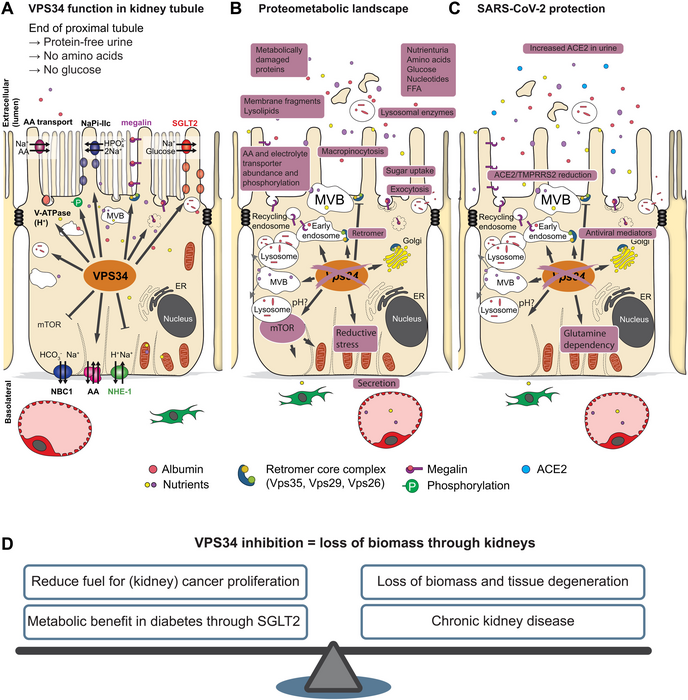
Schematic summary from the Scientific article

Credit: Science Signaling: DOI: 10.1126/scisignal.abo7940

Our kidney filters 180 liters of blood every day and retains nutrients through a process called ‘endocytosis’ and through active transport in the kidney cells. In a new international study, an international team of researchers, led by Markus Rinschen from Aarhus Institute of Advanced Studies and the Department of Biomedicine at Aarhus University, investigated how this process of ‘endocytosis’ is regulated by a very central enzyme, the ‘lipid kinase’ VPS34, in mice. This lipid kinase is involved in vesicular trafficking and endocytic sorting of membrane proteins. A process that is crucial for the body to obtain the right nutrients, but also to block out the unhealthy ones, such a viruses.

Multiomics – combining multiple datasets
The researchers have applied a new method of ‘multiomics,’ an approach where multiple data sets are combined during analysis to provide a comprehensive view of cell physiology. This approach is hypothesis-free but can quantify the functions of many transporters and enzymes as well as their interactions – the entire system. This multiomics analysis of the study showed that a lack of lipid kinase in proximal tubule cells in mice lowered the abundance of nutrient transporters on the cell surface, which was associated with increased urinary loss of lipids, amino acids, sugars and proteins. In addition, the number of viral entry receptors on the cell surface was reduced. Accordingly, treatment with a lipid kinase inhibitor reduced the entry of the virus SARS-CoV-2 in cultured proximal tubular cells and human kidney organoids.

A gatekeeper for viral infections – Lipid kinase
The results of the study show that blocking of the enzyme lipid kinase could be used to treat diseases in which limiting the retention of nutrients gives clinical benefit, such as kidney cancer or diabetes, or to block a viral infection of the kidney.

‘Our primary goal in this study was to gather and organize novel knowledge of the fundamental processes of cell physiology. Although this is hypothesis-free, these comprehensive large-scale datasets can be central to understand medical problems. In this case, we ultimately improved targeted drug treatment for instance for kidney related diseases or infections,’ said Markus Rinschen, first-author of the study and Associate Professor at the Aarhus Institute of Advanced Studies and the Department of Biomedicine at Aarhus University. ‘Of course, more knowledge needs to be gathered before any conclusions regarding human relevance can be made.’

The study was a collaboration between researchers at Aarhus University, the University Hospital Hamburg Eppendorf, University of Kiel and University of Michigan.


Journal

Science Signaling

DOI

10.1126/scisignal.abo7940

Method of Research

Experimental study

Subject of Research

Animals

Article Title

VPS34-dependent control of apical membrane function of proximal tubule cells and nutrient recovery by the kidney

Article Publication Date

29-Nov-2022

Share12Tweet8Share2ShareShareShare2

Related Posts

Here are a few rewritten headlines for a science magazine post, each with a slightly different tone: Intriguing & poetic: How do organs sculpt themselves? Sea stars hold the secret Direct & research-focused: Sea stars reveal the hidden rules of organ formation Metaphorical & inviting: Tiny architects beneath the waves: What sea stars teach us about building organs Short & punchy: Star-shaped clues to how our organs take shape Question-led: Could a sea star show us how organs form? Elegant & feature-style: The body’s blueprint, glimpsed in a sea star’s arm

July 6, 2026
Bacteria evolve faster with unconventional gene copies — Biology

Bacteria evolve faster with unconventional gene copies

July 6, 2026

Neighbours rewire soil feedback via root microbiome shifts

July 6, 2026

Evolution-Inspired Biosensors Revolutionize Lipid Tracking in Real Time

July 2, 2026

POPULAR NEWS

  • Detection of EDCs in Breast Milk and Infant Urine Up to Six Months Highlights Early Exposure Risks

    77 shares
    Share 31 Tweet 19
  • New Drug Candidate Developed at McMaster Shows Potential for Treating Brain Cancer

    58 shares
    Share 23 Tweet 15
  • Saying Goodbye to PGY-6: Pediatric Fellowship Realities

    103 shares
    Share 41 Tweet 26
  • KTU Researchers Explore Ultrasound’s Role in Enhancing Blood Flow Beyond Diagnostics

    53 shares
    Share 21 Tweet 13

About

We bring you the latest biotechnology news from best research centers and universities around the world. Check our website.

Follow us

Recent News

Flame retardant BDE-209 targets molecularly linked to ulcerative colitis

Ultra-high frequency particle impacts mimic rockbursts to shatter hard rock

Kidney transplant outcomes in older adults studied by German researchers

Subscribe to Blog via Email

Success! An email was just sent to confirm your subscription. Please find the email now and click 'Confirm' to start subscribing.

Join 83 other subscribers
  • Contact Us

Bioengineer.org © Copyright 2023 All Rights Reserved.

Welcome Back!

Login to your account below

Forgotten Password?

Retrieve your password

Please enter your username or email address to reset your password.

Log In
No Result
View All Result
  • Homepages
    • Home Page 1
    • Home Page 2
  • News
  • National
  • Business
  • Health
  • Lifestyle
  • Science

Bioengineer.org © Copyright 2023 All Rights Reserved.