• HOME
  • NEWS
  • EXPLORE
    • CAREER
      • Companies
      • Jobs
    • EVENTS
    • iGEM
      • News
      • Team
    • PHOTOS
    • VIDEO
    • WIKI
  • BLOG
  • COMMUNITY
    • FACEBOOK
    • INSTAGRAM
    • TWITTER
Wednesday, July 8, 2026
BIOENGINEER.ORG
No Result
View All Result
  • Login
  • HOME
  • NEWS
  • EXPLORE
    • CAREER
      • Companies
      • Jobs
        • Lecturer
        • PhD Studentship
        • Postdoc
        • Research Assistant
    • EVENTS
    • iGEM
      • News
      • Team
    • PHOTOS
    • VIDEO
    • WIKI
  • BLOG
  • COMMUNITY
    • FACEBOOK
    • INSTAGRAM
    • TWITTER
  • HOME
  • NEWS
  • EXPLORE
    • CAREER
      • Companies
      • Jobs
        • Lecturer
        • PhD Studentship
        • Postdoc
        • Research Assistant
    • EVENTS
    • iGEM
      • News
      • Team
    • PHOTOS
    • VIDEO
    • WIKI
  • BLOG
  • COMMUNITY
    • FACEBOOK
    • INSTAGRAM
    • TWITTER
No Result
View All Result
Bioengineer.org
No Result
View All Result
Home NEWS Science News Biology

Underwater footage reveals sharks’ flexible feeding skills

Bioengineer by Bioengineer
December 1, 2022
in Biology
Reading Time: 2 mins read
0
Nurse shark using pectoral positioning
Share on FacebookShare on TwitterShare on LinkedinShare on RedditShare on Telegram

Underwater cameras have revealed the impressive range of skills nurse sharks use when feeding.
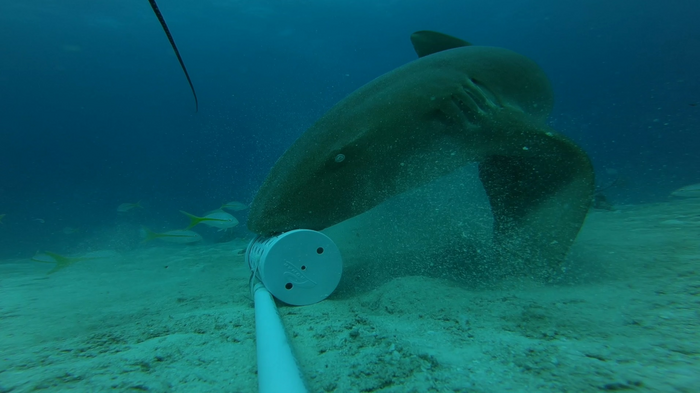
Nurse shark using pectoral positioning

Credit: Kristian Parton

Underwater cameras have revealed the impressive range of skills nurse sharks use when feeding.

The new study, by the University of Exeter and NGO Beneath the Waves, used baited remote underwater video (BRUV) cameras off the Turks and Caicos Islands.

The researchers identified a range of different feeding behaviours used by the sharks.

These included vertical feeding (head down), ventral feeding (belly up) and “pectoral positioning” – sharks flexing their pectoral fins in a motion similar to “walking” on the sea floor.

“These feeding behaviours show that nurse sharks are adapted to feed on different prey across a variety of habitats,” said lead author Kristian Parton, of the Centre for Ecology and Conservation on Exeter’s Penryn Campus in Cornwall.

While most shark species have little movement in their pectoral fins, nurse sharks are related to epaulette sharks, which can “walk” on dry land using these fins.

“Our footage suggests nurse sharks may do something similar on the sea floor,” Parton said.

“This work illustrates the immense behavioural adaptability of coastal shark species,” noted Dr Oliver Shipley, Senior Research Scientist at Beneath The Waves.

“Despite their widespread nature, we know comparatively little about nurse shark behaviour relative to other coastal species, so this study provides an important step to further understanding their ecological role.”

Previous research on nurse sharks has mostly focused on their reproductive behaviour. However, this new research helps shine a light on the important role nurse sharks play on tropical reefs around the world.

The study was supported by Big Blue Collective (www.bigbluecollective.com).

The paper, published in the journal Environmental Biology of Fishes, is entitled: “Opportunistic camera surveys provide insight into discrete foraging behaviours in nurse sharks (Ginglymostoma cirratum).”


Journal

Environmental Biology of Fishes

DOI

10.1007/s10641-022-01366-x

Method of Research

Observational study

Subject of Research

Animals

Article Title

Opportunistic camera surveys provide insight into discrete foraging behaviours in nurse sharks (Ginglymostoma cirratum)

Article Publication Date

9-Nov-2022

Share12Tweet8Share2ShareShareShare2

Related Posts

Here are a few rewritten headlines for a science magazine post, each with a slightly different tone: Intriguing & poetic: How do organs sculpt themselves? Sea stars hold the secret Direct & research-focused: Sea stars reveal the hidden rules of organ formation Metaphorical & inviting: Tiny architects beneath the waves: What sea stars teach us about building organs Short & punchy: Star-shaped clues to how our organs take shape Question-led: Could a sea star show us how organs form? Elegant & feature-style: The body’s blueprint, glimpsed in a sea star’s arm

July 6, 2026
Bacteria evolve faster with unconventional gene copies — Biology

Bacteria evolve faster with unconventional gene copies

July 6, 2026

Neighbours rewire soil feedback via root microbiome shifts

July 6, 2026

Evolution-Inspired Biosensors Revolutionize Lipid Tracking in Real Time

July 2, 2026

POPULAR NEWS

  • Detection of EDCs in Breast Milk and Infant Urine Up to Six Months Highlights Early Exposure Risks

    77 shares
    Share 31 Tweet 19
  • New Drug Candidate Developed at McMaster Shows Potential for Treating Brain Cancer

    58 shares
    Share 23 Tweet 15
  • Saying Goodbye to PGY-6: Pediatric Fellowship Realities

    103 shares
    Share 41 Tweet 26
  • KTU Researchers Explore Ultrasound’s Role in Enhancing Blood Flow Beyond Diagnostics

    53 shares
    Share 21 Tweet 13

About

We bring you the latest biotechnology news from best research centers and universities around the world. Check our website.

Follow us

Recent News

Flame retardant BDE-209 targets molecularly linked to ulcerative colitis

Ultra-high frequency particle impacts mimic rockbursts to shatter hard rock

Kidney transplant outcomes in older adults studied by German researchers

Subscribe to Blog via Email

Success! An email was just sent to confirm your subscription. Please find the email now and click 'Confirm' to start subscribing.

Join 83 other subscribers
  • Contact Us

Bioengineer.org © Copyright 2023 All Rights Reserved.

Welcome Back!

Login to your account below

Forgotten Password?

Retrieve your password

Please enter your username or email address to reset your password.

Log In
No Result
View All Result
  • Homepages
    • Home Page 1
    • Home Page 2
  • News
  • National
  • Business
  • Health
  • Lifestyle
  • Science

Bioengineer.org © Copyright 2023 All Rights Reserved.