• HOME
  • NEWS
  • EXPLORE
    • CAREER
      • Companies
      • Jobs
    • EVENTS
    • iGEM
      • News
      • Team
    • PHOTOS
    • VIDEO
    • WIKI
  • BLOG
  • COMMUNITY
    • FACEBOOK
    • INSTAGRAM
    • TWITTER
Saturday, February 7, 2026
BIOENGINEER.ORG
No Result
View All Result
  • Login
  • HOME
  • NEWS
  • EXPLORE
    • CAREER
      • Companies
      • Jobs
        • Lecturer
        • PhD Studentship
        • Postdoc
        • Research Assistant
    • EVENTS
    • iGEM
      • News
      • Team
    • PHOTOS
    • VIDEO
    • WIKI
  • BLOG
  • COMMUNITY
    • FACEBOOK
    • INSTAGRAM
    • TWITTER
  • HOME
  • NEWS
  • EXPLORE
    • CAREER
      • Companies
      • Jobs
        • Lecturer
        • PhD Studentship
        • Postdoc
        • Research Assistant
    • EVENTS
    • iGEM
      • News
      • Team
    • PHOTOS
    • VIDEO
    • WIKI
  • BLOG
  • COMMUNITY
    • FACEBOOK
    • INSTAGRAM
    • TWITTER
No Result
View All Result
Bioengineer.org
No Result
View All Result
Home NEWS Science News Biology

Queen Mary University of London acquires first Cell DIVE multiplexed imager for a university outside of North America

Bioengineer by Bioengineer
November 30, 2022
in Biology
Reading Time: 2 mins read
0
An example of the Cell DIVE's insight into cells
Share on FacebookShare on TwitterShare on LinkedinShare on RedditShare on Telegram

Queen Mary University of London has become the first university outside of North America to acquire a Cell DIVE imager, providing access to the latest technology and ensuring that we remain world-leading in the fast-moving area of single-cell approaches.
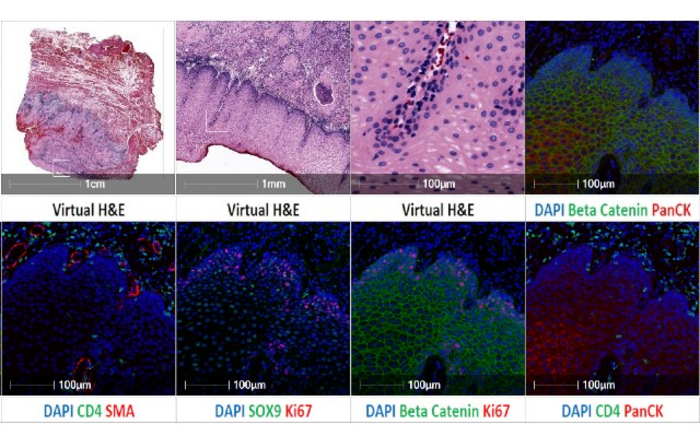
An example of the Cell DIVE's insight into cells

Credit: Queen Mary University of London/Dr Adrian Biddle

Queen Mary University of London has become the first university outside of North America to acquire a Cell DIVE imager, providing access to the latest technology and ensuring that we remain world-leading in the fast-moving area of single-cell approaches.

The Cell DIVE provides multiplexed imaging of tissue sections enables high-dimensional tissue imaging for quantitative analysis of at least 60 biomarkers, visualising the inner workings of single cells on a level that was previously unattainable.

What makes this technology platform significant is the integration of biology, precision imaging, sophisticated analysis software to enable deep insights at the single cell level. This offers a powerful approach to understanding the molecular and cellular processes driving tissue pathology in human disease.

The Cell DIVE is the latest addition to the Phenotypic Screening Facility at Queen Mary which is open to all staff across the University and external users and is fully supported by dedicated staff.

Prof. Cleo Bishop, Director of the Queen Mary University of London Phenotypic Screening Facility, said: “We’re excited to have this new technology available for use at the University following a successful Wellcome Trust multi-user equipment grant. The equipment will help us further our understanding of health tissues and heterogeneity within disease.”

“In the past researchers have been able to study how two to three different proteins relate to one another, but the Cell DIVE enables us to visualise more than 60 different proteins on a ‘cell-by-cell’ basis. We can directly relate each of these proteins to one and another within an individual cell, between cells and within the tissue microenvironment. This powerful approach can be used to shed new light on any area of medical research.”

As part of its 2030 strategy, the University is providing a world-class virtual and physical research infrastructure, which is available to all researchers, supported by internal and significant external funding to support academics to pioneer research and innovation.

Queen Mary has been ranked joint seventh in the UK for the quality of its research, according to the Research Excellence Framework 2021; and across the University, 92 per cent of Queen Mary’s research has been assessed as internationally excellent or world-leading according to the REF21 results.


Subject of Research

Cells

Share12Tweet8Share2ShareShareShare2

Related Posts

Florida Cane Toad: Complex Spread and Selective Evolution

Florida Cane Toad: Complex Spread and Selective Evolution

February 7, 2026
New Study Uncovers Mechanism Behind Burn Pit Particulate Matter–Induced Lung Inflammation

New Study Uncovers Mechanism Behind Burn Pit Particulate Matter–Induced Lung Inflammation

February 6, 2026

DeepBlastoid: Advancing Automated and Efficient Evaluation of Human Blastoids with Deep Learning

February 6, 2026

Navigating the Gut: The Role of Formic Acid in the Microbiome

February 6, 2026

POPULAR NEWS

  • Robotic Ureteral Reconstruction: A Novel Approach

    Robotic Ureteral Reconstruction: A Novel Approach

    82 shares
    Share 33 Tweet 21
  • Digital Privacy: Health Data Control in Incarceration

    63 shares
    Share 25 Tweet 16
  • Study Reveals Lipid Accumulation in ME/CFS Cells

    57 shares
    Share 23 Tweet 14
  • Breakthrough in RNA Research Accelerates Medical Innovations Timeline

    53 shares
    Share 21 Tweet 13

About

We bring you the latest biotechnology news from best research centers and universities around the world. Check our website.

Follow us

Recent News

Decoding Prostate Cancer Origins via snFLARE-seq, mxFRIZNGRND

Digital Health Perspectives from Baltic Sea Experts

Florida Cane Toad: Complex Spread and Selective Evolution

Subscribe to Blog via Email

Enter your email address to subscribe to this blog and receive notifications of new posts by email.

Join 73 other subscribers
  • Contact Us

Bioengineer.org © Copyright 2023 All Rights Reserved.

Welcome Back!

Login to your account below

Forgotten Password?

Retrieve your password

Please enter your username or email address to reset your password.

Log In
No Result
View All Result
  • Homepages
    • Home Page 1
    • Home Page 2
  • News
  • National
  • Business
  • Health
  • Lifestyle
  • Science

Bioengineer.org © Copyright 2023 All Rights Reserved.