• HOME
  • NEWS
  • EXPLORE
    • CAREER
      • Companies
      • Jobs
    • EVENTS
    • iGEM
      • News
      • Team
    • PHOTOS
    • VIDEO
    • WIKI
  • BLOG
  • COMMUNITY
    • FACEBOOK
    • INSTAGRAM
    • TWITTER
Thursday, January 8, 2026
BIOENGINEER.ORG
No Result
View All Result
  • Login
  • HOME
  • NEWS
  • EXPLORE
    • CAREER
      • Companies
      • Jobs
        • Lecturer
        • PhD Studentship
        • Postdoc
        • Research Assistant
    • EVENTS
    • iGEM
      • News
      • Team
    • PHOTOS
    • VIDEO
    • WIKI
  • BLOG
  • COMMUNITY
    • FACEBOOK
    • INSTAGRAM
    • TWITTER
  • HOME
  • NEWS
  • EXPLORE
    • CAREER
      • Companies
      • Jobs
        • Lecturer
        • PhD Studentship
        • Postdoc
        • Research Assistant
    • EVENTS
    • iGEM
      • News
      • Team
    • PHOTOS
    • VIDEO
    • WIKI
  • BLOG
  • COMMUNITY
    • FACEBOOK
    • INSTAGRAM
    • TWITTER
No Result
View All Result
Bioengineer.org
No Result
View All Result
Home NEWS Science News Biology

Study explains formation of rich mammal diversity in Asia

Bioengineer by Bioengineer
November 28, 2022
in Biology
Reading Time: 2 mins read
0
Biogeographic units and mammal richness in Asia.
Share on FacebookShare on TwitterShare on LinkedinShare on RedditShare on Telegram

Asia is home to a great many species as well as 14 of the globe’s 36 biodiversity hotspots. Its present biodiversity is assumed to be linked to diverse Cenozoic events, including very active mountain building and climatic changes. However, previous studies exploring the origin and timing of Asian faunas have mainly come from analysis at taxonomic or geographic scales and are too limited to offer a comprehensive view of biological evolution in this complex region.
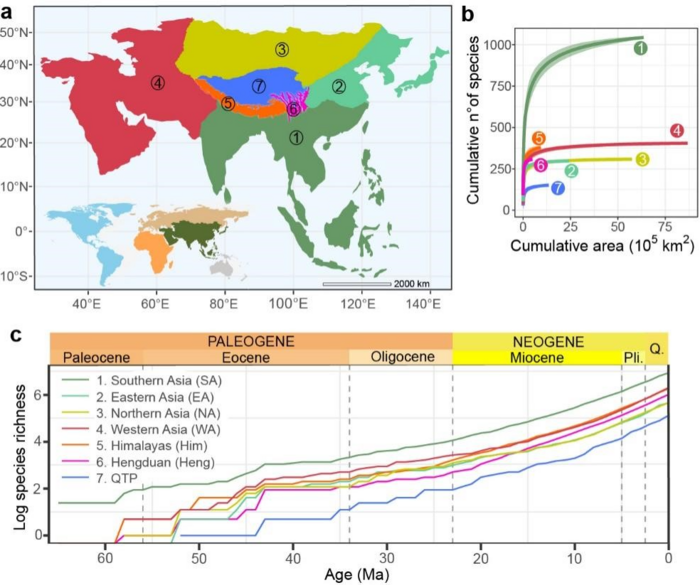
Biogeographic units and mammal richness in Asia.

Credit: Anderson Feijó

Asia is home to a great many species as well as 14 of the globe’s 36 biodiversity hotspots. Its present biodiversity is assumed to be linked to diverse Cenozoic events, including very active mountain building and climatic changes. However, previous studies exploring the origin and timing of Asian faunas have mainly come from analysis at taxonomic or geographic scales and are too limited to offer a comprehensive view of biological evolution in this complex region.

In a study published in PNAS on Nov. 28, researchers from the Institute of Zoology of the Chinese Academy of Sciences (CAS) and the Field Museum of Natural History in Chicago have investigated the range evolutionary history of 3,114 mammal species across Asia and adjacent continents to reveal how and when its rich biodiversity assembled across the continent’s regions and the montane hotspots flanking the Qinghai-Tibetan Plateau (QTP).

The researchers found that the tropical forests of South Asia, the main cradle of mammalian diversity in Asia, are a major center of diversity. The current high diversity in this region is mainly derived from in situ speciation, with limited influence from other Asian regions.

On the other hand, the Himalayas and the Hengduan Mountains, two hotspots surrounding the QTP, are mainly accumulation centers, suggesting that their modern biota is dominated by lineages that migrated from other regions.

This study also revealed that periods of active tectonic events, mountain building, and dramatic climate change (e.g., aridification of the Asian interior, sea retreat, intensification of Asian monsoons) have amplified the regional diversity of Asian mammals and intensified migrations across the continent.

Overall, the Neogene was marked by great diversification and migration across Asia and the surrounding continents, but Paleogene environments already hosted rich mammal assemblages.

This work was supported by the Second Tibetan Plateau Scientific Expedition and Research Program, the National Natural Science Foundation of China, the President’s International Fellowship Initiative of CAS, and the National Science and Technology Basic Resources Survey Program of China.


Journal

Proceedings of the National Academy of Sciences

DOI

10.1073/pnas.2207845119

Method of Research

Meta-analysis

Subject of Research

Not applicable

Article Title

Mammalian diversification bursts and biotic turnovers are synchronous with Cenozoic geoclimatic events in Asia

Article Publication Date

28-Nov-2022

Share12Tweet8Share2ShareShareShare2

Related Posts

blank

Trade-off in Egg Recognition Affects Fungal Acceptance

January 8, 2026
Elytral Chemistry Disrupts, But Doesn’t Halt Ladybird Mating

Elytral Chemistry Disrupts, But Doesn’t Halt Ladybird Mating

January 8, 2026

Uncovering Double Flower Genes in Brassica napus

January 8, 2026

Unlocking the Health Benefits of Enterococcus from Marine Snails

January 8, 2026

POPULAR NEWS

  • Enhancing Spiritual Care Education in Nursing Programs

    153 shares
    Share 61 Tweet 38
  • PTSD, Depression, Anxiety in Childhood Cancer Survivors, Parents

    143 shares
    Share 57 Tweet 36
  • Impact of Vegan Diet and Resistance Exercise on Muscle Volume

    46 shares
    Share 18 Tweet 12
  • SARS-CoV-2 Subvariants Affect Outcomes in Elderly Hip Fractures

    44 shares
    Share 18 Tweet 11

About

We bring you the latest biotechnology news from best research centers and universities around the world. Check our website.

Follow us

Recent News

Author Correction: Are Oysters Truly Sustainable Bluefood?

Neuro-Epithelial Circuits Boost Gut Immunity

Superradiant Terahertz Laser Powered by Electron Microbunches

Subscribe to Blog via Email

Success! An email was just sent to confirm your subscription. Please find the email now and click 'Confirm' to start subscribing.

Join 71 other subscribers
  • Contact Us

Bioengineer.org © Copyright 2023 All Rights Reserved.

Welcome Back!

Login to your account below

Forgotten Password?

Retrieve your password

Please enter your username or email address to reset your password.

Log In
No Result
View All Result
  • Homepages
    • Home Page 1
    • Home Page 2
  • News
  • National
  • Business
  • Health
  • Lifestyle
  • Science

Bioengineer.org © Copyright 2023 All Rights Reserved.