An international team of astronomers have turned a new technique onto a group of galaxies and the faint light between them – known as ‘intra-group light’ – to characterise the stars that dwell there.
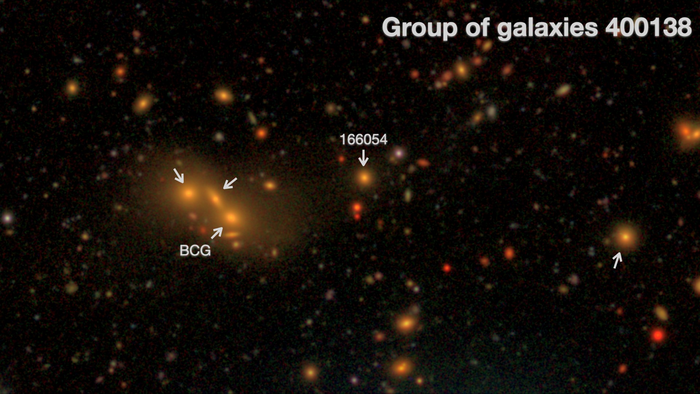
Credit: Martínez-Lombilla et al./UNSW Sydney
An international team of astronomers have turned a new technique onto a group of galaxies and the faint light between them – known as ‘intra-group light’ – to characterise the stars that dwell there.
Lead author of the study published in MNRAS, Dr Cristina Martínez-Lombilla from the School of Physics at UNSW Science, said “We know almost nothing about intra-group light.
“The brightest parts of the intra-group light are ~50 times fainter than the darkest night sky on Earth. It is extremely hard to detect, even with the largest telescopes on Earth – or in space.”
Using their sensitive technique, which eliminates light from all objects except that from the intra-group light, the researchers not only detected the intra-group light but were able to study and tell the story of the stars that populate it.
“We analysed the properties of the intra-group stars – those stray stars between the galaxy groups. We looked at the age and abundance of the elements that composed them and then we compared those features with the stars still belonging to galaxy groups,” Dr Martínez-Lombilla said.
“We found that the intra-group light is younger and less metal-rich than the surrounding galaxies.”
Rebuilding the story of intra-group light
Not only were the orphan stars in the intra-group light ‘anachronistic’ but they appeared to be of a different origin to their closest neighbours. The researchers found the character of the intra-group stars appeared similar to the nebulous ‘tail’ of a further away galaxy.
The combination of these clues allowed the researchers to rebuild the history – the story – of the intra-group light and how its stars came to be gathered in their own stellar orphanage.
“We think these individual stars were at some points stripped from their home galaxies and now they float freely, following the gravity of the group,” said Dr Martínez-Lombilla. “The stripping, called tidal stripping, is caused by the passage of massive satellite galaxies – similar to the Milky Way – that pull stars in their wake.”
This is the first time the intra-group light of these galaxies has been observed.
“Unveiling the quantity and origin of the intra-group light provides a fossil record of all the interactions a group of galaxies has undergone and provides a holistic view of the system’s interaction history,” Dr Martínez-Lombilla said.
“Also, these events occurred a long time ago. The galaxies [we’re looking at] are so far away, that we’re observing them as they were 2.5 billion years ago. That is how long it takes for their light to reach us.”
By observing events from a long time ago, in galaxies so far away, the researchers are contributing vital datapoints to the slow-burning evolution of cosmic events.
Tailored image treatment procedure
The researchers pioneered a unique technique to achieve this penetrating view.
“We have developed a tailored image treatment procedure that allows us to analyse the faintest structures in the Universe,” said Dr Martínez-Lombilla.
“It follows the standard steps for the study of faint structures in astronomical images – which implies 2D modelling and the removal of all light except that coming from the intra-group light. This includes all the bright stars in the images, the galaxies obscuring the intra-group light and a subtraction of the continuum emission from the sky.
“What makes our technique different is that it is fully Python-based so it is very modular and easily applicable to different sets of data from different telescopes rather than being just useful for these images.
“The most important outcome is that when studying very faint structures around galaxies, every step in the process counts and every undesirable light should be accounted for and removed. Otherwise, your measurements will be wrong.
The techniques presented in this study are a pilot, encouraging future analyses of intra-group light, Dr Martínez-Lombilla said.
“Our main long-term goal is to extend these results to a large sample of group of galaxies. Then we can look at statistics and find out the typical properties regarding the formation and evolution of the intra-group light and these extremely common systems of groups of galaxies.
“This is key work for preparing the next generation of deep all-sky surveys such as those to be performed with the Euclid space telescope and the LSST with the Vera C. Rubin Observatory.”
—ENDS—
Media Contact:
Jesse Hawley
UNSW Science | News and Content Coordinator
0422 537 392
Dr Cristina Martínez Lombilla, Postdoctoral Research Associate School of Physics, UNSW Sydney. Contact: Jesse Hawley
Journal
Monthly Notices of the Royal Astronomical Society
DOI
10.1093/mnras/stac3119
Method of Research
Imaging analysis
Subject of Research
Not applicable
Article Title
Galaxy and Mass Assembly (GAMA): Extended intra-group light in a group at = 0.2 from deep hyper-suprime cam images
Article Publication Date
24-Nov-2022