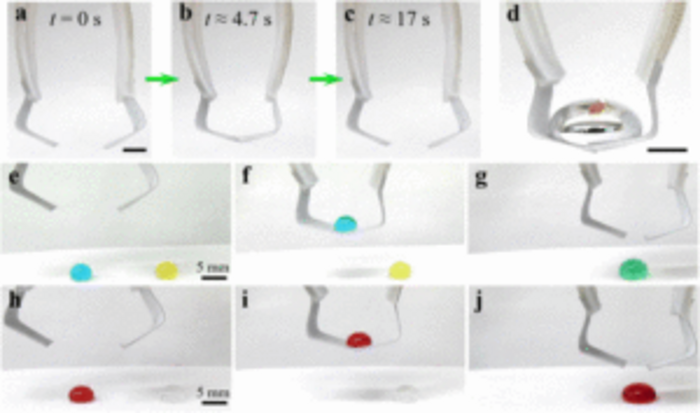
CSU researchers have created the first successful soft robotic gripper capable of manipulating individual droplets of liquid, according to a recent article in the Royal Society of Chemistry journal Materials Horizons.
Credit: Jiefeng Sun/Colorado State University
CSU researchers have created the first successful soft robotic gripper capable of manipulating individual droplets of liquid, according to a recent article in the Royal Society of Chemistry journal Materials Horizons.
The breakthrough is the product of a collaboration between two different laboratories in CSU’s Department of Mechanical Engineering. It was accomplished by combining two applied technologies, soft robotics and super-omniphobic coatings.
The soft robotic manipulator is made of inexpensive materials like nylon fibers and adhesive tape. It’s powered by an electrically activated artificial muscle. The combination can be used to produce lightweight, inexpensive grippers capable of delicate work, yet 100x stronger than human muscle for the same weight.
The result is something that flies in the face of our cultural concept of what a robot is, and what it can do.
Conventional robots are made of components that are heavy, rigid, and expensive. That makes them poorly suited for some tasks.
Soft robots, on the other hand, can be lightweight and provide a gentle touch that’s difficult to achieve with conventional robots. They are far lighter and can be produced at a a fraction of the cost of their rigid cousins.
“A single gripper as large as my finger is one or two grams, including the artificial muscle embedded. And it’s inexpensive – just one or two dollars,” said Jiefeng Sun, a postdoctoral fellow in the Department of Mechanical Engineering’s Adaptive Robotics Laboratory and co-first author on the paper.
The soft robotic grippers are treated with a novel superomniphobic coating that makes the droplet manipulator possible. The superomniphobic coating resists wetting by nearly all types of liquids, even in dynamic situations where the contact surfaces are tilting or moving. When applied to the soft robotic manipulator, the coating enables it to interact with droplets without breaking their surface tension, so that it can grasp, transport, and release individual droplets as if they were flexible solids.
The superomniphobic coatings employed in the droplet manipulator were developed at CSU by associate professor Arun Kota (now at North Carolina State University) and postdoctoral fellow Wei Wang (now an assistant professor at the University of Tennessee). Wang and Kota also contributed to the article.
“It’s a very nice synergy between these two kinds of research. Dr. Kota was working on this very good coating, and we were working on this soft robot, to manipulate droplets, so we figured out this might be a good combination,” said co-author Jianguo Zhao, associate professor of mechanical engineering at CSU and director of the Adaptive Robotics Laboratory.
In the early stages of their research, the team had difficulty attracting the attention of journal editors. The COVID-19 pandemic presented an opportunity to point out the potential of their invention.
“Because of the pandemic, handling dangerous infective materials is a hot topic. So we added a blood manipulation experiment after the first revision,” said Sun. “That kind of helped us to get through the review process.”
The combination of inexpensive materials and innovative capabilities has exciting applications. In many liquid spill scenarios, human cleanup can be dangerous due to toxicity, risk of contagion, or other hazards in the surroundings. These droplet manipulators are inexpensive enough to be disposable, but capable enough to do precise, lossless liquid cleanup work no other robot has ever done.
“It’s a first, but it’s also a very unusual example of a high tech product that is not terribly expensive,” said Zhao.
Journal
Materials Horizons
DOI
10.1039/D2MH00695B
Method of Research
Experimental study
Subject of Research
Not applicable
Article Title
On-demand, remote and lossless manipulation of biofluid droplets
Article Publication Date
7-Sep-2022