Plastic pollution is overwhelming landfills, littering Earth’s coastlines, and affecting the health of animals, including humans, while also contributing to environmental degradation and climate change. As public expectations for corporate responsibility grow and an increasing number of businesses pledge to reduce plastic use, researchers publishing in the journal One Earth on November 18 detail how the world’s largest and most powerful companies’ focus on recycling rather than virgin plastic reduction makes their commitments less meaningful.
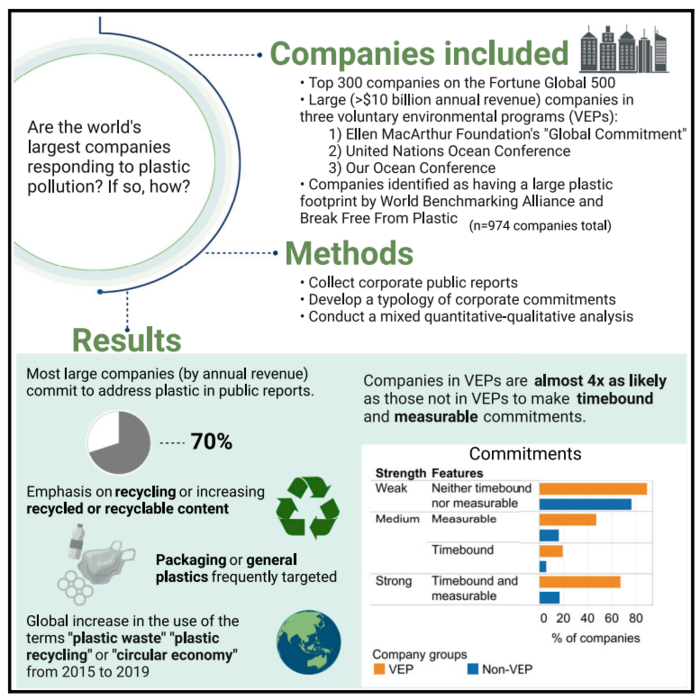
Credit: Diana et al./One Earth
Plastic pollution is overwhelming landfills, littering Earth’s coastlines, and affecting the health of animals, including humans, while also contributing to environmental degradation and climate change. As public expectations for corporate responsibility grow and an increasing number of businesses pledge to reduce plastic use, researchers publishing in the journal One Earth on November 18 detail how the world’s largest and most powerful companies’ focus on recycling rather than virgin plastic reduction makes their commitments less meaningful.
The study focused on the top 300 Fortune 500 companies and found that 72% had made a commitment to reducing plastic pollution. “Most of the commitments emphasize plastic recycling and commonly target general plastics,” write the authors, led by Zoie Taylor Diana, an environmental researcher at the Duke University Marine Laboratory. “They are important, but partial, solutions if we are to comprehensively address the plastic pollution problem.”
“Between 1950 and 2017, plastics production increased 174-fold and is forecast to double again by 2040,” the authors write. “As of 2015, an estimated 79% of global plastic waste was in landfills or ended up in the natural environment, 12% was incinerated, and 9% was recycled. Plastics in the environment have negative repercussions at all levels of biological organization.”
The paper highlights the companies’ overwhelming focus on changing their consumption and production patterns, often by including more recycled content in their products and “lightweighting”—the practice of marginally reducing the volume of plastic used to package a particular product.
“From our literature review, we found that multiple companies, such as the Coca-Cola Company and Walmart, are producing lighter and smaller plastic products (e.g., bottles and bags),” write the authors. “This ‘lightweighting’ of plastic is considered an insufficient response because companies may reinvest this savings into markets that involve new plastic products and/or increase the total mass of plastic produced.” Because the number of plastic products increases each year, the use of this practice does not result in a net reduction of plastic.
Going forward, the authors say that the scientific community should continue to monitor the plastic practices of major companies and the effects that plastics are having on the planet. “Scientists (including natural, life, and social scientists) have an important role in monitoring and defining environmental issues, which may aid in holding companies accountable.”
###
This study was funded by the Pew Charitable Trusts. The authors declare no competing interests.
One Earth, Diana et al. “Voluntary commitments made by the world’s largest companies focus on general plastic and recycling over other actions to address the plastics crisis” https://www.cell.com/one-earth/fulltext/S2590-3322(22)00534-6
One Earth (@OneEarth_CP), published by Cell Press, is a monthly journal that features papers from the fields of natural, social, and applied sciences. One Earth is the home for high-quality research that seeks to understand and address today’s environmental Grand Challenges, publishing across the spectrum of environmental change and sustainability science. A sister journal to Cell, Chem, and Joule, One Earth aspires to break down barriers between disciplines and stimulate the cross-pollination of ideas with a platform that unites communities, fosters dialogue, and encourages transformative research. Visit http://www.cell.com/one-earth. To receive Cell Press media alerts, contact [email protected].
For the latest sustainability research and ideas from Cell Press, follow @CellPressSust on Twitter.
Journal
One Earth
DOI
10.1016/j.oneear.2022.10.008
Method of Research
Observational study
Subject of Research
People
Article Title
Voluntary commitments made by the world’s largest companies focus on general plastic and recycling over other actions to address the plastics crisis
Article Publication Date
18-Nov-2022
COI Statement
The authors declare no competing interests.