An innovative proposal to tackle the global plastic pollution crisis with a combination of DNA-like encoding of plastics and international law has been put forward by a transdisciplinary team of QUT researchers.
Credit: QUT
An innovative proposal to tackle the global plastic pollution crisis with a combination of DNA-like encoding of plastics and international law has been put forward by a transdisciplinary team of QUT researchers.
Plastic pollution has been identified as an environmental problem similar in scope and complexity as global challenges like climate change.
The QUT research team, from chemistry and law, have published their multi-pronged approach in Polymer Chemistry.
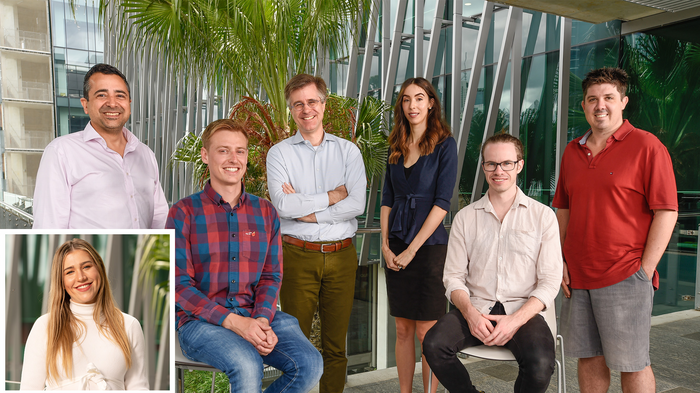
The researchers are Dr Hope Johnson, Dr Lewis Chambers, Dr Joshua Holloway, Annastasia Bousgas, Professor Afshin Akhtar-Khavari, Associate Professor James Blinco, and ARC Laureate Fellow Professor Christopher Barner-Kowollik, and they are part of QUT’s Centre for Materials Science and Centre for a Waste Free World.
Professor Barner-Kowollik said one of the biggest challenges in addressing plastic pollution was tracing the polluting plastic back to the source.
“Tracing plastic resolves the anonymity of plastic waste,” Professor Barner-Kowollik said.
“If a technology existed that allowed to give unique ‘DNA’ to each batch of plastic that was produced, plastic waste could be traced back to the producer, given the information stored in the ‘DNA’ could be simply read-out.”
Professor Barner-Kowollik said there were several emerging advances in polymer chemistry that could play a part in identifying plastic.
One solution could be chemically labelling batches of plastic production using sequence-defined polymers, that could be decoded in a way similar to DNA, although at this point reading information from sequence-defined polymers is challenging. However, new and simple technologies for reading information from such sequence-defined polymers embedded into plastics are emerging.
If polymer science can develop the means of uniquely identifying plastics and tracing each piece back to its producer, there still remains the issue of enforcing responsibility – which is where the legal researchers around Dr Hope Johnson come in.
“One of the first challenges with an international problem such as this is the obvious one of jurisdiction, and also where in the regulatory process we can best intervene to create sustainable change” Professor Afshin Akhtar-Khavari said.
“A considerable challenge is the implementation in international frameworks so that malicious actors cannot identify loopholes
“A careful and coordinated international approach is of the essence, yet establishing it will require initial careful research into the underpinning international governance principles and subsequent coordinated approaches for implementation.”
The researchers describe their paper as a “discussion starter”, not only on the plausibility of using sequence-defined polymers for coding and reading ‘DNA’ embedded in plastics and the associated governance challenges, but also for a broader conversation.
“Research is done with focus, but sometimes there needs to be a broader lens,” Professor Barner-Kowollik said.
“There is a critical need for the social and natural sciences to work more closely together in the future, breaking currently still prevailing siloed structures.”
The combined approach, of polymer science and international law, is looking at the single outcome of enforcing responsibility on polluters.
The paper says that identifying the people responsible for the plastic pollution could lead to a phasing out of plastics.
Journal
Polymer Chemistry
DOI
10.1039/D2PY01180H
Method of Research
Commentary/editorial
Article Title
Using precision polymer chemistry for plastics traceability and governance
Article Publication Date
18-Oct-2022
COI Statement
The authors have submitted a priority patent application in the realm of plastic tracing technology, owned by their employer QUT.