• HOME
  • NEWS
  • EXPLORE
    • CAREER
      • Companies
      • Jobs
    • EVENTS
    • iGEM
      • News
      • Team
    • PHOTOS
    • VIDEO
    • WIKI
  • BLOG
  • COMMUNITY
    • FACEBOOK
    • INSTAGRAM
    • TWITTER
Monday, July 6, 2026
BIOENGINEER.ORG
No Result
View All Result
  • Login
  • HOME
  • NEWS
  • EXPLORE
    • CAREER
      • Companies
      • Jobs
        • Lecturer
        • PhD Studentship
        • Postdoc
        • Research Assistant
    • EVENTS
    • iGEM
      • News
      • Team
    • PHOTOS
    • VIDEO
    • WIKI
  • BLOG
  • COMMUNITY
    • FACEBOOK
    • INSTAGRAM
    • TWITTER
  • HOME
  • NEWS
  • EXPLORE
    • CAREER
      • Companies
      • Jobs
        • Lecturer
        • PhD Studentship
        • Postdoc
        • Research Assistant
    • EVENTS
    • iGEM
      • News
      • Team
    • PHOTOS
    • VIDEO
    • WIKI
  • BLOG
  • COMMUNITY
    • FACEBOOK
    • INSTAGRAM
    • TWITTER
No Result
View All Result
Bioengineer.org
No Result
View All Result
Home NEWS Science News Biology

Persistent hematuria associated with strong risks of chronic kidney disease

Bioengineer by Bioengineer
November 15, 2022
in Biology
Reading Time: 2 mins read
0
Persistent hematuria is associated with strong risks of chronic kidney disease
Share on FacebookShare on TwitterShare on LinkedinShare on RedditShare on Telegram

Data, recently published in the American Journal of Kidney Disease (AJKD), from a large South Korean cohort show a five-fold increased risk of incident CKD for adults with persistent hematuria compared to those with no hematuria but associations were significantly stronger in men vs. women.
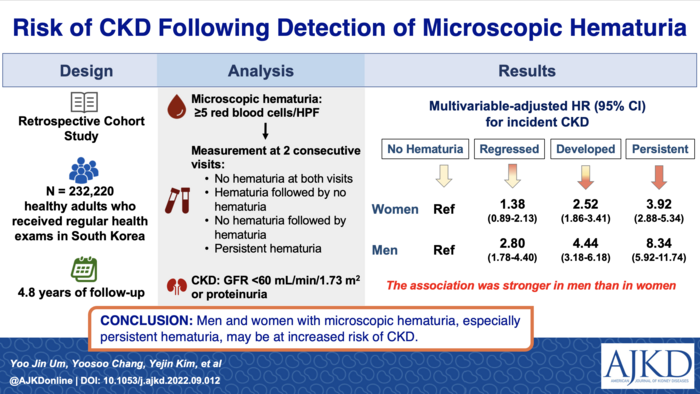
Persistent hematuria is associated with strong risks of chronic kidney disease

Credit: Visual Abstract for Yoo Jin Um et al, AJKD, 2022

Data, recently published in the American Journal of Kidney Disease (AJKD), from a large South Korean cohort show a five-fold increased risk of incident CKD for adults with persistent hematuria compared to those with no hematuria but associations were significantly stronger in men vs. women.

Hematuria, which refers to the presence of blood in the urine, has been reported to be associated with increased risk of chronic kidney disease (CKD). However, the relationship between hematuria that persists over time and kidney function is not clear. In this large study consisting of relatively young and healthy Korean adults, researchers investigated the association between episodes of microscopic hematuria and the development of CKD. They found that microscopic hematuria, especially when persistent, was associated with worse kidney function. These associations were stronger in men compared with women but were readily apparent in both sex groups. This study, recently published in the American Journal of Kidney Disease (AJKD), suggests that individuals with prolonged hematuria should be monitored, and that they may be candidates for early preventive strategies to decrease the risk of subsequent CKD.

Title: Risk of CKD Following Detection of Microscopic Hematuria: A Retrospective Cohort Study

Authors: Yoo Jin Um, MD, Yoosoo Chang, MD, Yejin Kim, MHS, Min-Jung Kwon, MD, Hyun-Suk Jung, MD, Kyu-Beck Lee, MD, Kwan Joong Joo, MD, In Young Cho, MD, Sarah H. Wild, MB BChir, Christopher D. Byrne, MB BCh, and Seungho Ryu, MD

DOI: https://doi.org/10.1053/j.ajkd.2022.09.012


Journal

American Journal of Kidney Diseases

DOI

10.1053/j.ajkd.2022.09.012

Article Title

Risk of CKD Following Detection of Microscopic Hematuria: A Retrospective Cohort Study

Article Publication Date

15-Nov-2022

Share12Tweet8Share2ShareShareShare2

Related Posts

Here are a few rewritten headlines for a science magazine post, each with a slightly different tone: Intriguing & poetic: How do organs sculpt themselves? Sea stars hold the secret Direct & research-focused: Sea stars reveal the hidden rules of organ formation Metaphorical & inviting: Tiny architects beneath the waves: What sea stars teach us about building organs Short & punchy: Star-shaped clues to how our organs take shape Question-led: Could a sea star show us how organs form? Elegant & feature-style: The body’s blueprint, glimpsed in a sea star’s arm

July 6, 2026
Bacteria evolve faster with unconventional gene copies — Biology

Bacteria evolve faster with unconventional gene copies

July 6, 2026

Neighbours rewire soil feedback via root microbiome shifts

July 6, 2026

Evolution-Inspired Biosensors Revolutionize Lipid Tracking in Real Time

July 2, 2026

POPULAR NEWS

  • Detection of EDCs in Breast Milk and Infant Urine Up to Six Months Highlights Early Exposure Risks

    77 shares
    Share 31 Tweet 19
  • New Drug Candidate Developed at McMaster Shows Potential for Treating Brain Cancer

    58 shares
    Share 23 Tweet 15
  • Saying Goodbye to PGY-6: Pediatric Fellowship Realities

    103 shares
    Share 41 Tweet 26
  • KTU Researchers Explore Ultrasound’s Role in Enhancing Blood Flow Beyond Diagnostics

    53 shares
    Share 21 Tweet 13

About

We bring you the latest biotechnology news from best research centers and universities around the world. Check our website.

Follow us

Recent News

Flame retardant BDE-209 targets molecularly linked to ulcerative colitis

Ultra-high frequency particle impacts mimic rockbursts to shatter hard rock

Kidney transplant outcomes in older adults studied by German researchers

Subscribe to Blog via Email

Enter your email address to subscribe to this blog and receive notifications of new posts by email.

Join 83 other subscribers
  • Contact Us

Bioengineer.org © Copyright 2023 All Rights Reserved.

Welcome Back!

Login to your account below

Forgotten Password?

Retrieve your password

Please enter your username or email address to reset your password.

Log In
No Result
View All Result
  • Homepages
    • Home Page 1
    • Home Page 2
  • News
  • National
  • Business
  • Health
  • Lifestyle
  • Science

Bioengineer.org © Copyright 2023 All Rights Reserved.