• HOME
  • NEWS
  • EXPLORE
    • CAREER
      • Companies
      • Jobs
    • EVENTS
    • iGEM
      • News
      • Team
    • PHOTOS
    • VIDEO
    • WIKI
  • BLOG
  • COMMUNITY
    • FACEBOOK
    • INSTAGRAM
    • TWITTER
Saturday, February 7, 2026
BIOENGINEER.ORG
No Result
View All Result
  • Login
  • HOME
  • NEWS
  • EXPLORE
    • CAREER
      • Companies
      • Jobs
        • Lecturer
        • PhD Studentship
        • Postdoc
        • Research Assistant
    • EVENTS
    • iGEM
      • News
      • Team
    • PHOTOS
    • VIDEO
    • WIKI
  • BLOG
  • COMMUNITY
    • FACEBOOK
    • INSTAGRAM
    • TWITTER
  • HOME
  • NEWS
  • EXPLORE
    • CAREER
      • Companies
      • Jobs
        • Lecturer
        • PhD Studentship
        • Postdoc
        • Research Assistant
    • EVENTS
    • iGEM
      • News
      • Team
    • PHOTOS
    • VIDEO
    • WIKI
  • BLOG
  • COMMUNITY
    • FACEBOOK
    • INSTAGRAM
    • TWITTER
No Result
View All Result
Bioengineer.org
No Result
View All Result
Home NEWS Science News Chemistry

Atomically dispersed bimetallic iron–cobalt electrocatalysts developed for green production of ammonia

Bioengineer by Bioengineer
November 14, 2022
in Chemistry
Reading Time: 3 mins read
0
Schematic diagram of ammonia synthesis by electrocatalysis with bimetallic Fe–Co single-atom catalyst
Share on FacebookShare on TwitterShare on LinkedinShare on RedditShare on Telegram

Scientists from the Hefei Institutes of Physical Science of the Chinese Academy of Sciences have demonstrated the use of controllably synthesized single-atom catalysts (SACs) to depict the relationship between electrocatalytic nitrogen reduction reaction (NRR) performance and single-atom (SA) loading.
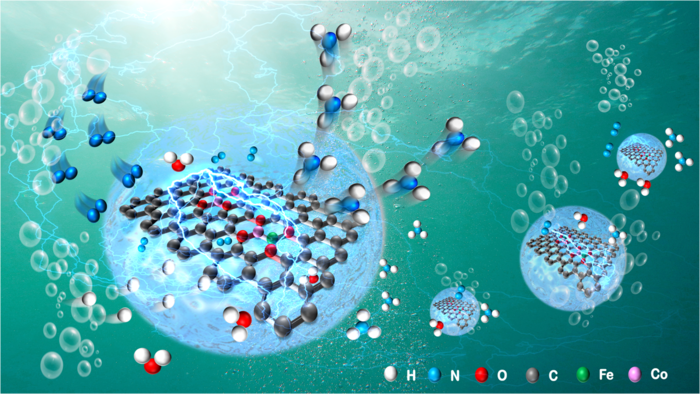
Schematic diagram of ammonia synthesis by electrocatalysis with bimetallic Fe–Co single-atom catalyst

Credit: ZHANG Shengbo

Scientists from the Hefei Institutes of Physical Science of the Chinese Academy of Sciences have demonstrated the use of controllably synthesized single-atom catalysts (SACs) to depict the relationship between electrocatalytic nitrogen reduction reaction (NRR) performance and single-atom (SA) loading.

Electrosynthesis of ammonia from NRR at ambient conditions has been widely regarded as a “green ammonia synthesis” technology to replace the traditional energy- and capital-intensive Haber-Bosch process.

Scientists agree that the intriguing features of SACs may create a new catalytic paradigm. However, one of the key challenges hindering the rational design and development of SACs is the lack of insight into the relationship between performance and SA loading, due mainly to the inability to precisely control the synthesis of SACs with desired SA loading densities and active site coordination forms.

In this study, the researchers demonstrated an adsorption-regulated synthetic method that uses bacterial cellulose as an adsorption regulator to control Fe3+/Co2+ impregnation on bacterial cellulose through carbothermal reduction. Fe­–Co SAs were then fixed to bacterial cellulose-derived carbon via bimetallic [(O–C2)3Fe–Co(O–C2)3] coordination.

Importantly, the scientists unveiled a suite of relationships that quantitatively define Fe3+/Co2+ distribution between bacterial cellulose and the adsorption solution, and the percentage conversion of impregnated Fe3+/Co2+ on bacterial cellulose to Fe/Co SAs on bacterial cellulose-derived carbon. They then demonstrated the use of such quantitative relationships to guide the controllable synthesis of bimetallic Fe–Co SACs with desired Fe/Co contents and atomic ratios.

They showed that controllably synthesized SACs can depict the electrocatalytic relationship between NRR performance and SA loading. Single-atom electrocatalysts (SAECs) with a unity Fe/Co atomic ratio possess the highest site density and NRR performance for bimetallic Fe–Co SAs, making them capable of achieving a superb ammonia yield rate with exceptional faradaic efficiency.

The catalytic activity of SACs, in contrast with other types of catalysts, is determined by the nature of the SA, the physiochemical properties of the support and, importantly, the coordination bonds that anchor the SA to the support.

Under electrocatalytic NRR conditions, [(O–C2)3Fe–Co(O–C2)3] in the as-synthesized bimetallic Fe–Co SAECs is operando transformed into the more stable coordination configuration [(O–C2)3Fe–Co(O–C)C2], thus promoting and sustaining NRR performance.

The researchers suggest that these new findings will be of great interest to the broad catalysis community.


Journal

Nature Sustainability

DOI

10.1038/s41893-022-00993-7

Method of Research

Experimental study

Subject of Research

Not applicable

Article Title

Atomically dispersed bimetallic Fe–Co electrocatalysts for green production of ammonia

Article Publication Date

14-Nov-2022

Share12Tweet8Share2ShareShareShare2

Related Posts

blank

Breakthrough in Environmental Cleanup: Scientists Develop Solar-Activated Biochar for Faster Remediation

February 7, 2026
blank

Cutting Costs: Making Hydrogen Fuel Cells More Affordable

February 6, 2026

Scientists Develop Hand-Held “Levitating” Time Crystals

February 6, 2026

Observing a Key Green-Energy Catalyst Dissolve Atom by Atom

February 6, 2026

POPULAR NEWS

  • Robotic Ureteral Reconstruction: A Novel Approach

    Robotic Ureteral Reconstruction: A Novel Approach

    82 shares
    Share 33 Tweet 21
  • Digital Privacy: Health Data Control in Incarceration

    63 shares
    Share 25 Tweet 16
  • Study Reveals Lipid Accumulation in ME/CFS Cells

    57 shares
    Share 23 Tweet 14
  • Breakthrough in RNA Research Accelerates Medical Innovations Timeline

    53 shares
    Share 21 Tweet 13

About

We bring you the latest biotechnology news from best research centers and universities around the world. Check our website.

Follow us

Recent News

Improving Dementia Care with Enhanced Activity Kits

Decoding Prostate Cancer Origins via snFLARE-seq, mxFRIZNGRND

Digital Health Perspectives from Baltic Sea Experts

Subscribe to Blog via Email

Enter your email address to subscribe to this blog and receive notifications of new posts by email.

Join 73 other subscribers
  • Contact Us

Bioengineer.org © Copyright 2023 All Rights Reserved.

Welcome Back!

Login to your account below

Forgotten Password?

Retrieve your password

Please enter your username or email address to reset your password.

Log In
No Result
View All Result
  • Homepages
    • Home Page 1
    • Home Page 2
  • News
  • National
  • Business
  • Health
  • Lifestyle
  • Science

Bioengineer.org © Copyright 2023 All Rights Reserved.