Pollinators are less likely to land on flowers sprayed with fertilisers or pesticides as they can detect electric field changes around the flower, researchers at the University of Bristol have found.
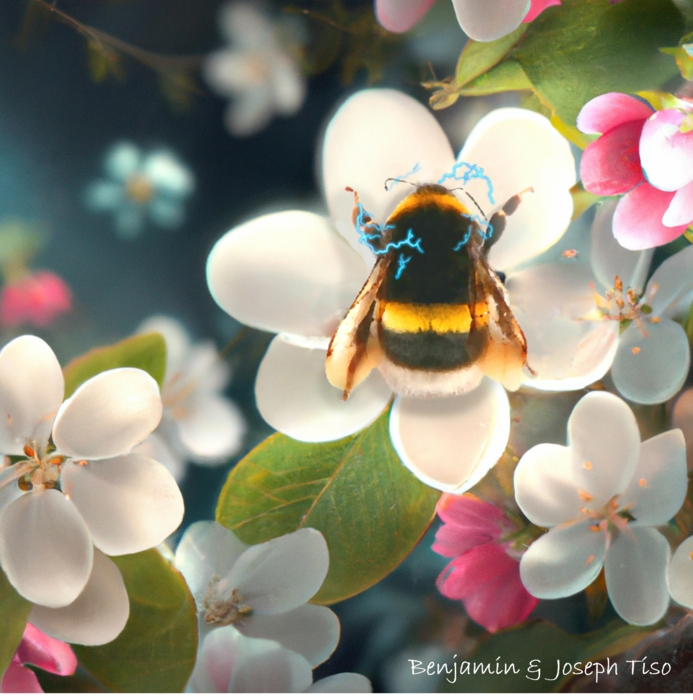
Credit: Benjamin and Joseph Tiso
Pollinators are less likely to land on flowers sprayed with fertilisers or pesticides as they can detect electric field changes around the flower, researchers at the University of Bristol have found.
The study, published in PNAS Nexus today, shows that chemical sprays alter the electric field around flowers for up to 25 minutes after exposure. This impact lasts substantially longer than natural fluctuations, such as those caused by wind, and causes a reduction in bee feeding effort in nature.
Dr Ellard Hunting of Bristol’s School of Biological Sciences and his team noted that fertilisers did not affect vision and smell, and set out to mimic the electrical changes caused by fertilisers and pesticides in the field by electrically manipulating flowers. This showed that bumblebees were able to detect and discriminate against the small and dynamic electric field alterations that are caused by the chemicals.
Dr. Ellard Hunting said: “We know that chemicals are toxic, but we know little about how they affect the immediate interaction between plants and pollinators.
“Flowers have a range of cues that attract bees to promote feeding and pollination. For instance, bees use cues like flower odour and colour, but they also use electric fields to identify plants.
“A big issue is thus – agrochemical application can distort floral cues and modify behaviour in pollinators like bees.”
Furthermore, various other airborne particles such as nanoparticles, exhaust gasses, nano-plastics, and viral particles may have similar impacts, affecting a wide array of organisms that use the electric fields that are virtually everywhere in the environment.
Co-author, Bristol’s Sam England, explained: “What makes this study important is that it’s the first known example of anthropogenic ‘noise’ interfering with a terrestrial animal’s electrical sense.
”It’s much like motorboat noise that hinders the ability of fish to detect their predators, or artificial light at night that confuses moths; the fertilisers are a source of noise to bees trying to detect floral electrical cues.
“This widens our understanding of the multifaceted ways in which human activity is negatively impacting the natural world, which can seem quite depressing, but it will hopefully allow is to introduce or invent solutions to prevent the adverse effects that these chemicals may be having on bees.”
Dr Ellard Hunting added: “The fact that fertilisers affect pollinator behavior by interfering with the way an organism perceives its physical environment offers a new perspective on how human-made chemicals disturb the natural environment.”
The project was funded by the European Research Council and the Swiss National Science Foundation.
Paper:
‘Synthetic fertilizers alter floral biophysical cues and bumblebee foraging behaviour’ by E Hunting, S England et al in PNAS Nexus.
Journal
PNAS Nexus
Method of Research
Experimental study
Subject of Research
Animals
Article Title
Synthetic fertilizers alter floral biophysical cues and bumblebee foraging behaviour’
Article Publication Date
9-Nov-2022