Call it a CRISPR conundrum.
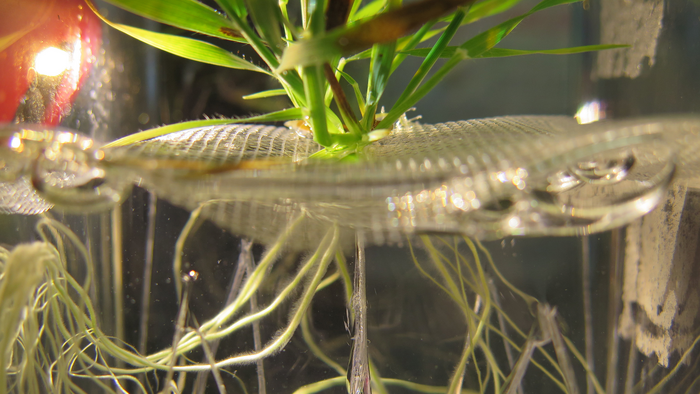
Credit: Photo courtesy of Marta Torres, m-CAFEs postdoctoral researcher, Deutschbauer lab, Environmental Genomics and Systems Biology “© The Regents of the University of California, Lawrence Berkeley National Laboratory.”
Call it a CRISPR conundrum.
Bacteria use CRISPR-Cas systems as adaptive immune systems to withstand attacks from enemies like viruses. These systems have been adapted by scientists to remove or cut and replace specific genetic code sequences in a variety of organisms.
But in a new study, North Carolina State University researchers show that viruses engineered with a CRISPR-Cas system can thwart bacterial defenses and make selective changes to a targeted bacterium – even when other bacteria are in close proximity.
“Viruses are very good at delivering payloads. Here, we use a bacterial virus, a bacteriophage, to deliver CRISPR to bacteria, which is ironic because bacteria normally use CRISPR to kill viruses,” said Rodolphe Barrangou, the Todd R. Klaenhammer Distinguished Professor of Food, Bioprocessing and Nutrition Sciences at NC State and corresponding author of a paper describing the research published today in Proceedings of the National Academy of Sciences. “The virus in this case targets E. coli by delivering DNA to it. It’s like using a virus as a syringe.”
The NC State researchers deployed two different engineered bacteriophages to deliver CRISPR-Cas payloads for targeted editing of E. coli, first in a test tube and then within a synthetic soil environment created to mimic soil – a complex environment that can harbor many types of bacteria.
Both the engineered bacteriophages, called T7 and lambda, successfully found and then delivered payloads to the E. coli host on the lab bench. These payloads expressed bacterial florescent genes and manipulated the bacterium’s resistance to an antibiotic.
The researchers then used lambda to deliver a so-called cytosine base editor to the E. coli host. Rather than CRISPR’s sometimes harsh cleaving of DNA sequences, this base editor changed just one letter of E. coli’s DNA, showing the sensitivity and precision of the system. These changes inactivated certain bacterial genes without making other changes to E. coli.
“We used a base editor here as a kind of programmable on-off switch for genes in E. coli. Using a system like this, we can make highly precise single-letter changes to the genome without the double-strand DNA breakage commonly associated with CRISPR-Cas targeting,” said Matthew Nethery, a former NC State Ph.D. student and lead author of the study.
Finally, the researchers demonstrated on-site editing through the use of a fabricated ecosystem (EcoFAB) loaded with a synthetic soil medium of sand and quartz, along with liquid, to mimic a soil environment. The researchers also included three different types of bacteria to test if the phage could specifically locate E. coli within the system.
“In a lab, scientists can oversimplify things,” Barrangou said. “It’s preferable to model environments, so rather than soup in a test tube, we wanted to examine real-life environments.”
The researchers inserted lambda into the fabricated ecosystem. It showed good efficiency in finding E. coli and making the targeted genetic changes.
“This technology is going to enable our team and others to discover the genetic basis of key bacterial interactions with plants and other microbes within highly controlled laboratory environments such as EcoFABs,” said Trent Northen, a scientist at the Department of Energy’s Lawrence Berkeley National Laboratory (Berkeley Lab) who collaborates with Barrangou.
“We see this as a mechanism to aid the microbiome. We can make a change to a particular bacterium and the rest of the microbiome remains unscathed,” Barrangou said. “This is a proof of concept that could be employed in any complex microbial community, which could translate into better plant health and better gastrointestinal tract health – environments of importance to food and health.
“Ultimately this study represents the next chapter of CRISPR delivery – using viruses to deliver CRISPR machinery in a complex environment.”
The researchers plan to further this work by testing the phage CRISPR technique with other soil-associated bacteria. Importantly, this illustrates how soil microbial communities can be manipulated to control the composition and function of bacteria associated with plants in fabricated ecosystems to understand how to enhance plant growth and promote plant health, which is of broad interest for sustainable agriculture.
Funding was provided by m-CAFEs Microbial Community Analysis & Functional Evaluation in Soils, a Science Focus Area led by Lawrence Berkeley National Laboratory and supported by the U.S. Dept. of Energy under contract no. DE-AC02-05CH11231, with collaborative efforts including UC Berkeley and the Innovative Genomics Institute. Co-authors of the paper include Nethery, former NC State post-doctoral researcher Claudio Hidalgo-Cantabrana and NC State graduate student Avery Roberts.
-kulikowski-
Note to editors: The abstract of the paper follows.
“CRISPR-based engineering of phages for in situ bacterial base editing”
Authors: Matthew A. Nethery, Claudio Hidalgo-Cantabrana, Avery Roberts, Rodolphe Barrangou, NC State University
Published: Nov. 7, 2022 in Proceedings of the National Academy of Sciences
DOI: 10.1073/pnas.2206744119
Abstract: Investigation of microbial gene function is essential to the elucidation of ecological roles and complex genetic interactions that take place in microbial communities. While microbiome studies have increased in prevalence, the lack of viable in situ editing strategies impedes experimental design and progress, rendering genetic knowledge and manipulation of microbial communities largely inaccessible. Here, we demonstrate the utility of phage-delivered CRISPR-Cas payloads to perform targeted genetic manipulation within a community context deploying a fabricated ecosystem (EcoFAB) as an analog for the soil microbiome. First, we detail the engineering of two classical phages for community editing using recombination to replace non-essential genes through Cas9-based selection. We show efficient engineering of T7, then demonstrate expression of antibiotic resistance and fluorescent genes from an engineered lambda prophage within an Escherichia coli host. Expanding on this, we modify lambda to express an APOBEC-1-based cytosine base editor (CBE), which we leverage to perform C to T point mutations guided by a Cas9 modified to contain only a single active nucleolytic domain (nCas9). We strategically introduced these base substitutions to create premature stop codons in-frame, inactivating both chromosomal (lacZ) and plasmid-encoded genes (mCherry and ampicillin resistance) without perturbation of the surrounding genomic regions. Further, using a multi-genera synthetic soil community, we employed phage-assisted base editing to induce host-specific phenotypic alterations in a community context both in vitro and within the EcoFAB, observing editing efficiencies from 10% to 28% across the bacterial population. The concurrent use of a synthetic microbial community, soil matrix, and EcoFAB device provides a controlled and reproducible model to more closely approximate in situ editing of the soil microbiome.
Journal
Proceedings of the National Academy of Sciences
DOI
10.1073/pnas.2206744119
Method of Research
Experimental study
Subject of Research
Cells
Article Title
CRISPR-based engineering of phages for in situ bacterial base editing
Article Publication Date
11-Nov-2022
COI Statement
R.B. is a co-founder of Intellia Therapeutics, Locus Biosciences, TreeCo, CRISPR Biotechnologies and Ancilia Biosciences, and a shareholder of Caribou Biosciences, Inari Ag, Felix Biotechnologies, and Provaxus. C.H.-C. is a co-founder of Microviable Therapeutics and shareholder of CRISPR Biotechnologies.