• HOME
  • NEWS
  • EXPLORE
    • CAREER
      • Companies
      • Jobs
    • EVENTS
    • iGEM
      • News
      • Team
    • PHOTOS
    • VIDEO
    • WIKI
  • BLOG
  • COMMUNITY
    • FACEBOOK
    • INSTAGRAM
    • TWITTER
Wednesday, January 7, 2026
BIOENGINEER.ORG
No Result
View All Result
  • Login
  • HOME
  • NEWS
  • EXPLORE
    • CAREER
      • Companies
      • Jobs
        • Lecturer
        • PhD Studentship
        • Postdoc
        • Research Assistant
    • EVENTS
    • iGEM
      • News
      • Team
    • PHOTOS
    • VIDEO
    • WIKI
  • BLOG
  • COMMUNITY
    • FACEBOOK
    • INSTAGRAM
    • TWITTER
  • HOME
  • NEWS
  • EXPLORE
    • CAREER
      • Companies
      • Jobs
        • Lecturer
        • PhD Studentship
        • Postdoc
        • Research Assistant
    • EVENTS
    • iGEM
      • News
      • Team
    • PHOTOS
    • VIDEO
    • WIKI
  • BLOG
  • COMMUNITY
    • FACEBOOK
    • INSTAGRAM
    • TWITTER
No Result
View All Result
Bioengineer.org
No Result
View All Result
Home NEWS Science News Biology

Defect in cellular respiration renders sac fungi infertile

Bioengineer by Bioengineer
November 3, 2022
in Biology
Reading Time: 2 mins read
0
Sordaria macrospora
Share on FacebookShare on TwitterShare on LinkedinShare on RedditShare on Telegram

More than 100 mutants
Sordaria macrospora

Credit: © Ines Teichert

More than 100 mutants

Sordaria macrospora is a model system for studying the development of fruiting bodies in sac fungi, so-called filamentous ascomycetes. Using conventional mutagenesis, more than 100 developmental mutants were generated for this fungus in the 1990s.

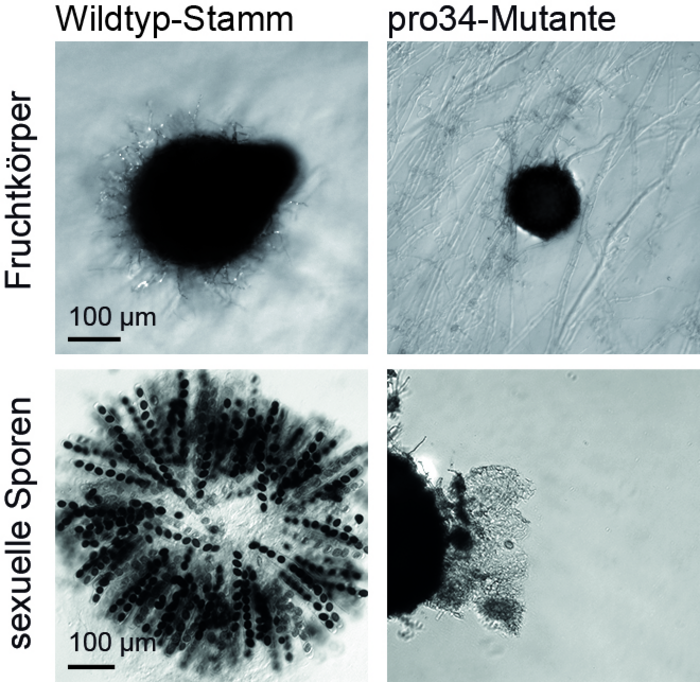
Assistant Professor Dr. Ines Teichert from the General and Molecular Botany group at the Department of Biology and Biotechnology at the Ruhr University Bochum, Germany, in cooperation with Dr. Andrea Hamann and Professor Heinz D. Osiewacz from the Goethe University Frankfurt, has been studying such a mutant: unlike the wild-type strain, the so-called pro34 mutant doesn’t form mature fruiting bodies and sexual spores, and in addition has a slower growth rate. Through genome sequencing, the researchers identified a major gap in a gene, which they named pro34. In the wild-type strain, this gene is affected by RNA editing during fruiting body formation; this means that a new variant of the RNA and protein is generated at this point, which may have a specific function.

Compensating for a defect consumes energy

But what is the function of PRO34 in the first place? “Using fluorescence microscopy, we successfully localised PRO34 in the mitochondria,” explains Ines Teichert. These cell organelles contain the respiratory chain, a series of protein complexes that, to put it simply, help generate energy in the form of adenosine triphosphate (ATP). In the mutant, one of these complexes is missing. The mutant is nevertheless viable; this is because fungi as well as plants possess various alternative pathways in the mitochondrial respiratory chain to compensate for such defects. “However, this compensation is insufficient to cover the high energy demand during fruiting body formation, and thus the mutant remains sterile,” says Ines Teichert.

A surprising discovery was that the so-called alternative oxidase (AOX) is likewise activated in the pro34 mutant. “According to previous findings, AOX usually compensates for other defects and must therefore fulfil additional functions,” points out Ines Teichert. The authors speculate about a protective function of AOX against oxidative stress, since a defect in the mitochondrial respiratory chain leads to increased formation of oxygen radicals. “An explanation could also be that AOX helps in the assembly of certain mitochondrial complexes,” believe the authors. “Consequently, the pro34 mutant is an excellent starting point for subsequent analyses.”


Journal

Journal of Fungi

DOI

10.3390/jof8101015

Method of Research

Experimental study

Subject of Research

Cells

Article Title

Sordaria macrospora sterile mutant pro34 is impaired in respiratory complex I assembly

Article Publication Date

27-Sep-2022

Share12Tweet8Share2ShareShareShare2

Related Posts

Fosfomycin Resistance Rampant in ST11 Klebsiella Pneumoniae

Fosfomycin Resistance Rampant in ST11 Klebsiella Pneumoniae

January 7, 2026
Widespread Rise in Australian Tree Deaths

Widespread Rise in Australian Tree Deaths

January 7, 2026

Comparative Analysis of Human NAT2 Across Species

January 7, 2026

Swift Jasmonate Signals Trigger Plant-Wide Immunity

January 6, 2026

POPULAR NEWS

  • Enhancing Spiritual Care Education in Nursing Programs

    152 shares
    Share 61 Tweet 38
  • PTSD, Depression, Anxiety in Childhood Cancer Survivors, Parents

    142 shares
    Share 57 Tweet 36
  • Impact of Vegan Diet and Resistance Exercise on Muscle Volume

    45 shares
    Share 18 Tweet 11
  • SARS-CoV-2 Subvariants Affect Outcomes in Elderly Hip Fractures

    44 shares
    Share 18 Tweet 11

About

We bring you the latest biotechnology news from best research centers and universities around the world. Check our website.

Follow us

Recent News

Optoretinography Tracks Fast Rod Movement Post-Rhodopsin Activation

DNA Breaks Boost RORγt, Drive Th17 Autoimmunity

Canagliflozin Controls Fat Cell Lipolysis Independently

Subscribe to Blog via Email

Enter your email address to subscribe to this blog and receive notifications of new posts by email.

Join 71 other subscribers
  • Contact Us

Bioengineer.org © Copyright 2023 All Rights Reserved.

Welcome Back!

Login to your account below

Forgotten Password?

Retrieve your password

Please enter your username or email address to reset your password.

Log In
No Result
View All Result
  • Homepages
    • Home Page 1
    • Home Page 2
  • News
  • National
  • Business
  • Health
  • Lifestyle
  • Science

Bioengineer.org © Copyright 2023 All Rights Reserved.