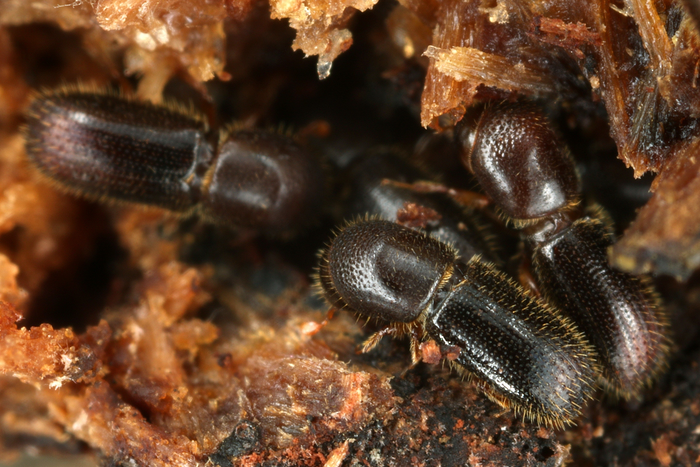
Ambrosia beetles practice active agriculture: A bark beetle species breeds and cultivates food fungi in its nests and ensures that so-called weed fungi spread less. This has now been experimentally demonstrated for the first time by biologist Janina Diehl from Freiburg. She is a doctoral student under Prof. Dr. Peter Biedermann, Professor of Forest Entomology and Forest Protection at the University of Freiburg. Diehl examined laboratory fungal gardens of the fruit-tree pinhole borer (Xyleborinus saxesenii), which belongs to the ambrosia beetles and is found in many native parks and gardens with old trees. She found that the beetles are actively influencing the composition of their fungal gardens. The research findings have just been published in Proceedings of the Royal Society B.
Credit: Gernot Kunz
Ambrosia beetles practice active agriculture: A bark beetle species breeds and cultivates food fungi in its nests and ensures that so-called weed fungi spread less. This has now been experimentally demonstrated for the first time by biologist Janina Diehl from Freiburg. She is a doctoral student under Prof. Dr. Peter Biedermann, Professor of Forest Entomology and Forest Protection at the University of Freiburg. Diehl examined laboratory fungal gardens of the fruit-tree pinhole borer (Xyleborinus saxesenii), which belongs to the ambrosia beetles and is found in many native parks and gardens with old trees. She found that the beetles are actively influencing the composition of their fungal gardens. The research findings have just been published in Proceedings of the Royal Society B.
Fungal coatings in wooden tunnels
Ambrosia beetles feed on special fungal coatings that grow in the tunnels they bore into old wood. To early naturalists, these coverings seemed like divine ambrosia, which is how the beetles got their name. Due to their social and hygienic behavior, it has long been assumed that they actively care for their fungi, but so far, such agricultural abilities have only been demonstrated in some termites and leafcutter ants.
Genetic analysis of fungus gardens
Diehl has now also succeeded in doing this for ambrosia beetles: In the laboratory, she had mother beetles of the little wood borer establish nests with offspring, in which the typical fungal gardens formed. She then removed the nurturing individuals from some of the nests and left them in others. Genetic analysis of bacterial and fungal communities of the fungal gardens after 40 days showed that the presence of the beetles had greatly altered the fungal community.
“You might have expected there to be fewer food fungi in the nests with beetles because they were being eaten, but in fact, the opposite was true; here the fungal composition was clearly shifted toward food fungi,” says Diehl. In the nests without nurturing beetles, on the other hand, the proportion of weed fungi was significantly higher. The composition of the bacteria also differed.
Beetles probably use antibiotic-forming bacteria
“These results support the existence of active farming in ambrosia beetles, although the exact mechanisms controlling the fungal community need further investigation,” adds Biedermann. He says there is evidence that the beetles use specific bacteria that produce antibiotic substances. These, in turn, could inhibit the growth of the weed fungi.
Social behavior probably also plays an important role; the entire group of beetles in the nest, including the larvae, work together to care for the fungi. This creates a close symbiosis between beetles and fungi: “Each ambrosia beetle species has its own food fungus. Neither can survive without the other.”
60 million years of experience
Economically relevant bark beetles, such as the spruce bark beetle (Ips typographus), also have similar symbioses with fungi, and understanding them could help control the beetles better in the future. Further research into how exactly ambrosia beetles suppress the growth of weed fungi could also provide worthwhile insights for human agriculture, which is struggling with resistance, for example, says Biedermann. “It’s highly exciting for us to see how nature has been doing this for 60 million years. Presumably, we humans can still learn something from these mechanisms.”
For more information, visit www.forest-entomology.com
Overview of facts:
- Original publication: Diehl J.M.C., Kowallik V, Keller A, Biedermann P.H.W. (2022), First experimental evidence for active farming in ambrosia beetles and strong heredity of garden microbiomes. Proceedings of the Royal Society B. 289: 20221458. DOI: https://doi.org/10.1098/rspb.2022.1458
- Janina Diehl’s study was supported by the Emmy Noether Programme through the German Research Foundation (DFG).
- Prof. Dr. Peter Biedermann is Professor of Forest Entomology and Forest Protection at the University of Freiburg. His research interests include bark beetles, symbioses between insects and microorganisms, especially fungi, and the social behavior of insects. Janina Diehl is a PhD student at the University of Freiburg
Film: Social behaviour of the ambrosia beetle Xyleborinus saxesenii
https://youtu.be/Jjj_QTRIt2A
Contact:
Prof. Dr. Peter Biedermann
Institute of Forest Sciences
University of Freiburg
Tel.: 0761/203-54112
e-mail: [email protected]
Thomas Goebel
Office of University and Science Communications
University of Freiburg
e-mail: [email protected]
Journal
Proceedings of the Royal Society B Biological Sciences