Can we survive three minutes without air or three days without water? How about without batteries? Imagine not having a battery for three hours. Lightweight, high-capacity lithium-ion batteries are widely used in mobile phones, laptops, and other necessities in today’s world. However, the organic electrolytes in conventional lithium-ion batteries are highly flammable, leading to fatal fires or explosions. As lithium-ion batteries are widely used in our lives, such accidents can cause direct damage to users, which has led to a demand for a safer battery system.
Credit: POSTECH
Can we survive three minutes without air or three days without water? How about without batteries? Imagine not having a battery for three hours. Lightweight, high-capacity lithium-ion batteries are widely used in mobile phones, laptops, and other necessities in today’s world. However, the organic electrolytes in conventional lithium-ion batteries are highly flammable, leading to fatal fires or explosions. As lithium-ion batteries are widely used in our lives, such accidents can cause direct damage to users, which has led to a demand for a safer battery system.
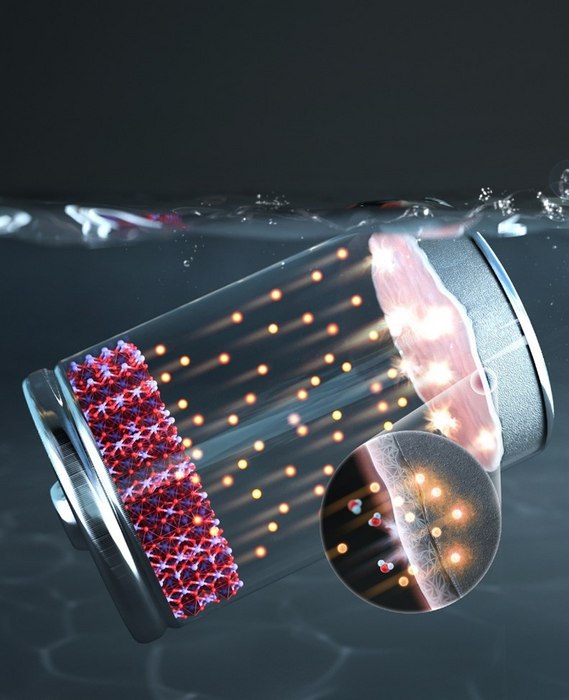
Professor Soojin Park and Gyujin Song (Post-doc fellow) in the Department of Chemistry and PhD candidate Sangyeop Lee of the Division of Advanced Materials Science at POSTECH together developed a stable aqueous zinc-ion battery that uses water as an electrolyte. They employed a protective polymer layer to prevent electrode corrosion and increase the stability of the zinc anode, improving the electrochemical stability of the aqueous zinc-ion battery.
The organic-solvent-based electrolyte, which serves as a medium for ions to move inside the typical battery system, is inherently flammable, posing risk of explosion or fire. To address this issue, aqueous electrolyte batteries are being developed as promising replacements. However, the inferior reversibility of the zinc anode in aqueous electrolytes, which are caused by zinc dendrites and surface side reactions, has prevented zinc-ion batteries from being used.
The POSTECH research team developed a zinc anode coated with a multifunctional protective layer by using a block copolymer. This new polymer layer is elastic and stretchable, enduring volume expansion during battery charging and discharging.
The polymer protective layer is found to induce homogenized ion distribution and suppress dendritic growth, contributing to a long-term zinc anode lifespan. The thin film layer also improves the electrode stability by suppressing unnecessary chemical/electrochemical reactions in the electrolyte on the electrode surface.
Furthermore, the researchers revealed the movement of zinc ions in the coating layer by using time-of-flight secondary ion mass spectrometry (TOF-SIMS) analysis. Imaging the zinc ion movements, which was not successful in previous studies, promises further research on the surface properties of battery anodes.
Recently published in Cell Reports Physical Science, this study was supported by Nano·Material Technology Development Program through the National Research Foundation of Korea.
Journal
Cell Reports Physical Science
DOI
10.1016/j.xcrp.2022.101070
Article Title
Ion-selective and chemical-protective elastic block copolymer interphase for durable zinc metal anode
Article Publication Date
19-Oct-2022