Microorganisms are essential for normal social development in zebrafish via their influence on pruning of neural connections in the developing brain, according to a study publishing November 1st in the open access journal PLOS Biology by Joseph Bruckner at the University of Oregon, US, and colleagues.
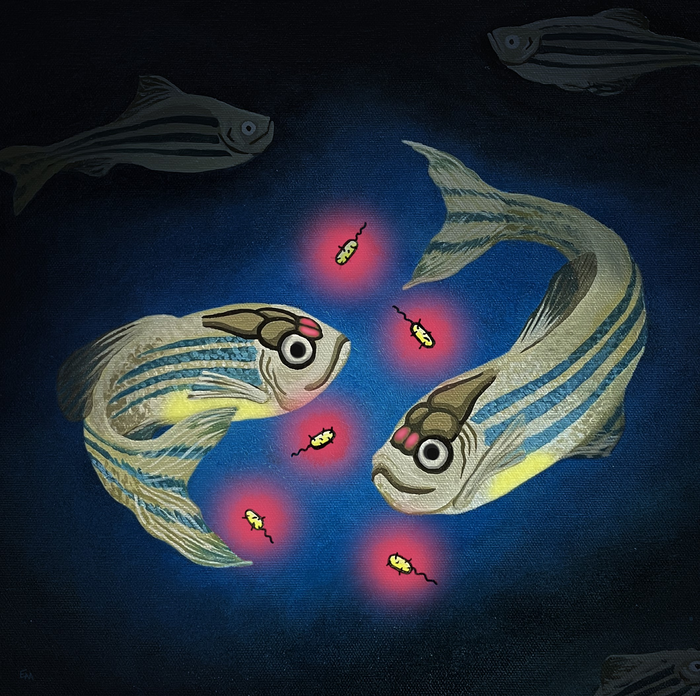
Credit: CREDIT
Microorganisms are essential for normal social development in zebrafish via their influence on pruning of neural connections in the developing brain, according to a study publishing November 1st in the open access journal PLOS Biology by Joseph Bruckner at the University of Oregon, US, and colleagues.
Zebrafish larvae have transparent skin, offering researchers a rare window into neural development. In a series of experiments, the researchers investigated the neuronal and social development of zebrafish larvae reared with or without the presence of their normal microbiota for the first seven days of development.
They found that larval social behavior at day 14 was inhibited by the early absence of microbes, despite the larvae’s normal microbiota being restored a week earlier. Compared to siblings with a normal microbiota, the brains of these germ-free larvae had fewer immune cells called microglia in their forebrains, and denser, more complex neural branching patterns. Single-cell RNA sequencing showed that their microglia also had lower levels of complement c1q, a gene involved in pruning neural connections called synapses. Genetically reducing microglia without affecting the microbiota produced similar results, increasing neural density and branching relative to controls. Normal neural and social development was restored in germ-free larvae by adding any of several different bacterial groups native to the zebrafish intestine, indicating that microglial pruning activity is sensitive to a feature common across many types of bacteria.
The study is the first to demonstrate that microglia are required for pruning of neural connections in zebrafish larvae, and that an intact microbiota is essential for normal pruning and fish social behavior. The results also show that there is a critical developmental window during the first week of larval development, during which the microbiota stimulates microglial localization to the forebrain where they prune neural connections, the authors say.
Eisen adds, “Social interactions are critical for animals and humans. By studying zebrafish social interactions, we discovered that symbiotic bacteria encourage social behavior by promoting the ability of microglia, the brain’s immune cells, to remodel previously identified ‘social’ neurons in the zebrafish brain.”
#####
In your coverage, please use this URL to provide access to the freely available paper in PLOS Biology: http://journals.plos.org/plosbiology/article?id=10.1371/journal.pbio.3001838
Citation: Bruckner JJ, Stednitz SJ, Grice MZ, Zaidan D, Massaquoi MS, Larsch J, et al. (2022) The microbiota promotes social behavior by modulating microglial remodeling of forebrain neurons. PLoS Biol 20(11): e3001838. https://doi.org/10.1371/journal.pbio.3001838
Author Countries: United States, Germany, Canada
Funding: see manuscript
Journal
PLoS Biology
DOI
10.1371/journal.pbio.3001838
Method of Research
Experimental study
Subject of Research
Animals
COI Statement
Competing interests: The authors have declared that no competing interests exist.