

• HOME
  • NEWS
  • EXPLORE
    • CAREER
      • Companies
      • Jobs
    • EVENTS
    • iGEM
      • News
      • Team
    • PHOTOS
    • VIDEO
    • WIKI
  • BLOG
  • COMMUNITY
    • FACEBOOK
    • INSTAGRAM
    • TWITTER
Monday, July 6, 2026
BIOENGINEER.ORG
No Result
View All Result
  • Login
  • HOME
  • NEWS
  • EXPLORE
    • CAREER
      • Companies
      • Jobs
        • Lecturer
        • PhD Studentship
        • Postdoc
        • Research Assistant
    • EVENTS
    • iGEM
      • News
      • Team
    • PHOTOS
    • VIDEO
    • WIKI
  • BLOG
  • COMMUNITY
    • FACEBOOK
    • INSTAGRAM
    • TWITTER
  • HOME
  • NEWS
  • EXPLORE
    • CAREER
      • Companies
      • Jobs
        • Lecturer
        • PhD Studentship
        • Postdoc
        • Research Assistant
    • EVENTS
    • iGEM
      • News
      • Team
    • PHOTOS
    • VIDEO
    • WIKI
  • BLOG
  • COMMUNITY
    • FACEBOOK
    • INSTAGRAM
    • TWITTER
No Result
View All Result
Bioengineer.org
No Result
View All Result
Home NEWS Science News Biology

Stealth-care system: Scientists test ‘smart’ red blood cells to deliver antibiotics that target specific bacteria

Bioengineer by Bioengineer
October 31, 2022
in Biology
Reading Time: 3 mins read
0
Testing a new drug delivery system
Share on FacebookShare on TwitterShare on LinkedinShare on RedditShare on Telegram

Physicists at McMaster University have identified a natural delivery system which can safely carry potent antibiotics throughout the body to selectively attack and kill bacteria by using red blood cells as a vehicle.
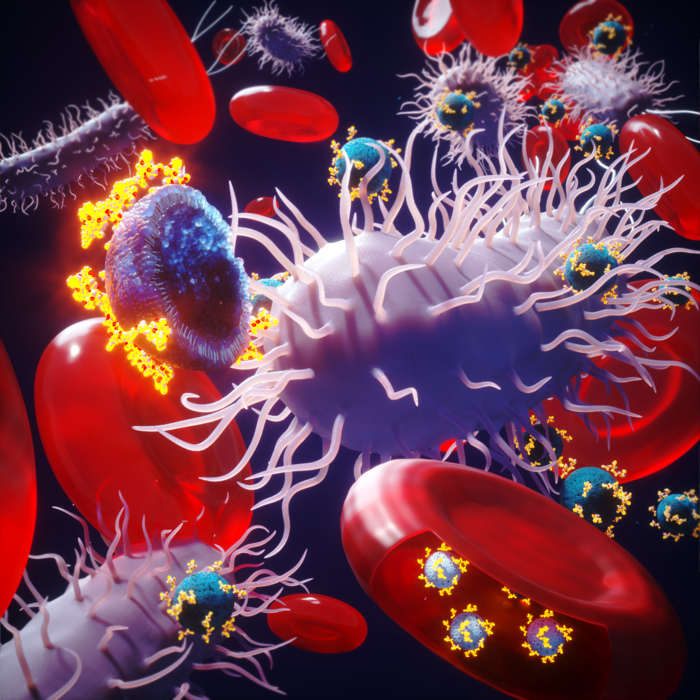
Testing a new drug delivery system

Credit: Ella Marushchenko

Physicists at McMaster University have identified a natural delivery system which can safely carry potent antibiotics throughout the body to selectively attack and kill bacteria by using red blood cells as a vehicle.

The platform, described in a new paper in the journal ACS Infectious Diseases, could help to address the ongoing antibiotic resistance crisis, say the scientists. They modified and then tested red blood cells as a carrier for one of the world’s only remaining resistance-proof antibiotics: Polymyxin B (PmB), widely considered a treatment of last resort due to its toxicity and harmful side effects, which include kidney damage.  

It is used to fight particularly dangerous and often drug-resistant bacteria such as E. coli, which is responsible for many serious conditions such as pneumonia, gastroenteritis and bloodstream infections. 

Researchers have developed a way to open red blood cells and remove the inner components, leaving only a membrane—known as a liposome—which can be loaded with drug molecules and injected back into the body. 

The process also involves coating the outside of the membrane with antibodies, allowing it to stick to bacteria and deliver the antibody safely.

“Essentially, we are using red blood cells to conceal this antibiotic within so it can no longer interact or harm healthy cells as it passes through the body,” explains Hannah Krivic, a graduate student of biophysics at McMaster and lead author of the study. She conducted the work with undergraduate students Ruthie Sun and Michal Feigis, and Thode postdoctoral fellow Sebastian Himbert, all based in the Department of Physics & Astronomy. 


“We designed these red blood cells so they could only target bacteria we want them to target,” says Krivic.

The team, supervised by Maikel Rheinstädter, a professor in the Department of Physics & Astronomy, had also focused on red blood cells in previous work (hyperlink) because they are stable, sturdy and have a naturally long lifespan, approximately 120 days, giving them ample time to reach different target sites. 

“With many traditional drug therapies there are challenges. They tend to degrade rapidly when they enter our circulation system and are randomly distributed throughout our bodies,” Rheinstädter explains.  “We often have to take higher doses or repeated doses, which increases exposure to the drug and heightens the risk of side effects.”

Scientists are working on additional applications of the technology, including its potential as a platform to deliver drugs across the blood-brain barrier and directly to the brain, helping patients who suffer from Alzheimer’s or depression, for example, to receive treatment much more quickly and directly.  


Journal

ACS Infectious Diseases

DOI

10.1021/acsinfecdis.2c00017

Method of Research

Experimental study

Article Title

Erythro-PmBs: A Selective Polymyxin B Delivery System Using Antibody-Conjugated Hybrid Erythrocyte Liposomes

Article Publication Date

29-Sep-2022

COI Statement

The 1005 funders had no role in study design, data collection, analysis, 1006 decision to publish, or preparation of the manuscript.

Share12Tweet8Share2ShareShareShare2

Related Posts

Here are a few rewritten headlines for a science magazine post, each with a slightly different tone: Intriguing & poetic: How do organs sculpt themselves? Sea stars hold the secret Direct & research-focused: Sea stars reveal the hidden rules of organ formation Metaphorical & inviting: Tiny architects beneath the waves: What sea stars teach us about building organs Short & punchy: Star-shaped clues to how our organs take shape Question-led: Could a sea star show us how organs form? Elegant & feature-style: The body’s blueprint, glimpsed in a sea star’s arm

July 6, 2026
Bacteria evolve faster with unconventional gene copies — Biology

Bacteria evolve faster with unconventional gene copies

July 6, 2026

Neighbours rewire soil feedback via root microbiome shifts

July 6, 2026

Evolution-Inspired Biosensors Revolutionize Lipid Tracking in Real Time

July 2, 2026

POPULAR NEWS

  • Detection of EDCs in Breast Milk and Infant Urine Up to Six Months Highlights Early Exposure Risks

    77 shares
    Share 31 Tweet 19
  • New Drug Candidate Developed at McMaster Shows Potential for Treating Brain Cancer

    58 shares
    Share 23 Tweet 15
  • Saying Goodbye to PGY-6: Pediatric Fellowship Realities

    103 shares
    Share 41 Tweet 26
  • KTU Researchers Explore Ultrasound’s Role in Enhancing Blood Flow Beyond Diagnostics

    53 shares
    Share 21 Tweet 13

About

We bring you the latest biotechnology news from best research centers and universities around the world. Check our website.

Follow us

Recent News

Flame retardant BDE-209 targets molecularly linked to ulcerative colitis

Ultra-high frequency particle impacts mimic rockbursts to shatter hard rock

Kidney transplant outcomes in older adults studied by German researchers

Subscribe to Blog via Email

Enter your email address to subscribe to this blog and receive notifications of new posts by email.

Join 83 other subscribers
  • Contact Us

Bioengineer.org © Copyright 2023 All Rights Reserved.

Welcome Back!

Login to your account below

Forgotten Password?

Retrieve your password

Please enter your username or email address to reset your password.

Log In
No Result
View All Result
  • Homepages
    • Home Page 1
    • Home Page 2
  • News
  • National
  • Business
  • Health
  • Lifestyle
  • Science

Bioengineer.org © Copyright 2023 All Rights Reserved.
