Spectrometers are widely used throughout industry and research to detect and analyse light. Spectrometers measure the spectrum of light – its strength at different wavelengths, like the colours in a rainbow – and are an essential tool for identifying and analysing specimens and materials. Integrated on-chip spectrometers would be of great benefit to a variety of technologies, including quality inspection platforms, security sensors, biomedical analysers, healthcare systems, environmental monitoring tools, and space telescopes.
Credit: Aalto University
Spectrometers are widely used throughout industry and research to detect and analyse light. Spectrometers measure the spectrum of light – its strength at different wavelengths, like the colours in a rainbow – and are an essential tool for identifying and analysing specimens and materials. Integrated on-chip spectrometers would be of great benefit to a variety of technologies, including quality inspection platforms, security sensors, biomedical analysers, healthcare systems, environmental monitoring tools, and space telescopes.
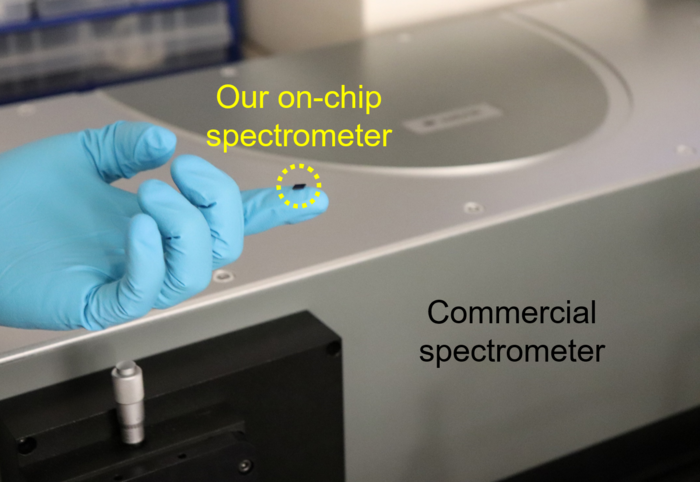
An international research team led by researchers at Aalto University has developed high-sensitivity spectrometers with high wavelength accuracy, high spectral resolution, and broad operation bandwidth, using only a single microchip-sized detector. The research behind this new ultra-miniaturised spectrometer was published today in the journal Science.
‘Our single-detector spectrometer is an all-in-one device. We designed this optoelectronic-lab-on-a-chip with artificial intelligence replacing conventional hardware, such as optical and mechanical components. Therefore, our computational spectrometer does not require separate bulky components or array designs to disperse and filter light. It can achieve a high resolution comparable to benchtop systems but in a much smaller package,’ says Postdoctoral Researcher Hoon Hahn Yoon.
‘With our spectrometer, we can measure light intensity at each wavelength beyond the visible spectrum using a device at our fingertips. The device is entirely electrically controllable, so it has enormous potential for scalability and integration. Integrating it directly into portable devices such as smartphones and drones could advance our daily lives. Imagine that the next generation of our smartphone cameras could be fitted with hyperspectral cameras that outperform colour cameras,’ he adds.
Shrinking computational spectrometers is essential for their use in chips and implantable applications. Professor Zhipei Sun, the head of the research team, says, ‘Conventional spectrometers are bulky because they need optical and mechanical components, so their on-chip applications are limited. There is an emerging demand in this field to improve the performance and usability of spectrometers. From this point of view, miniaturised spectrometers are very important to offer high performance and new functions in all fields of science and industry.’
Professor Pertti Hakonen adds that ‘Finland and Aalto have invested in photonics research in recent years. For example, there has been great support from the Academy of Finland’s Centre of Excellence on quantum technology, Flagship on Photonics Research and Innovation, InstituteQ, and the Otanano Infrastructure. Our new spectrometer is a clear demonstration of the success of these collaborative efforts. I believe that with further improvements in resolution and efficiency, these spectrometers could provide new tools for quantum information processing.’
In addition to Postdoctoral Researcher Hoon Hahn Yoon and Professors Zhipei Sun and Pertti Hakonen, the key Aalto members linked to the work included Postdoctoral Researchers Henry A. Fernandez and Faisal Ahmed, Doctoral Researchers Fedor Nigmatulin, Xiaoqi Cui, Md Gius Uddin, and Professor Harri Lipsanen. Professor Ethan D. Minot, from Oregon State University, joined this work as a visiting scholar at Aalto University for one year. The international research team led by Aalto university also included Professors Weiwei Cai (Shanghai Jiao Tong University), Zongyin Yang (Zhejiang University), Hanxiao Cui (Sichuan University), Kwanpyo Kim (Yonsei University), and Tawfique Hasan (University of Cambridge).
Journal
Science
DOI
10.1126/science.add8544
Article Title
Miniaturized spectrometers with a tunable van der Waals junction
Article Publication Date
21-Oct-2022