

• HOME
  • NEWS
  • EXPLORE
    • CAREER
      • Companies
      • Jobs
    • EVENTS
    • iGEM
      • News
      • Team
    • PHOTOS
    • VIDEO
    • WIKI
  • BLOG
  • COMMUNITY
    • FACEBOOK
    • INSTAGRAM
    • TWITTER
Saturday, February 7, 2026
BIOENGINEER.ORG
No Result
View All Result
  • Login
  • HOME
  • NEWS
  • EXPLORE
    • CAREER
      • Companies
      • Jobs
        • Lecturer
        • PhD Studentship
        • Postdoc
        • Research Assistant
    • EVENTS
    • iGEM
      • News
      • Team
    • PHOTOS
    • VIDEO
    • WIKI
  • BLOG
  • COMMUNITY
    • FACEBOOK
    • INSTAGRAM
    • TWITTER
  • HOME
  • NEWS
  • EXPLORE
    • CAREER
      • Companies
      • Jobs
        • Lecturer
        • PhD Studentship
        • Postdoc
        • Research Assistant
    • EVENTS
    • iGEM
      • News
      • Team
    • PHOTOS
    • VIDEO
    • WIKI
  • BLOG
  • COMMUNITY
    • FACEBOOK
    • INSTAGRAM
    • TWITTER
No Result
View All Result
Bioengineer.org
No Result
View All Result
Home NEWS Science News Biology

Black Canada lynx photographed for the first time

Bioengineer by Bioengineer
October 18, 2022
in Biology
Reading Time: 3 mins read
0
Black-coated Canada lynx
Share on FacebookShare on TwitterShare on LinkedinShare on RedditShare on Telegram

A black-coated Canada lynx was photographed for the first time by a researcher at the University of Alberta, Canada. Thomas Jung, also employed by the Government of Yukon, recorded the animal in a 30 second video on a cell phone.
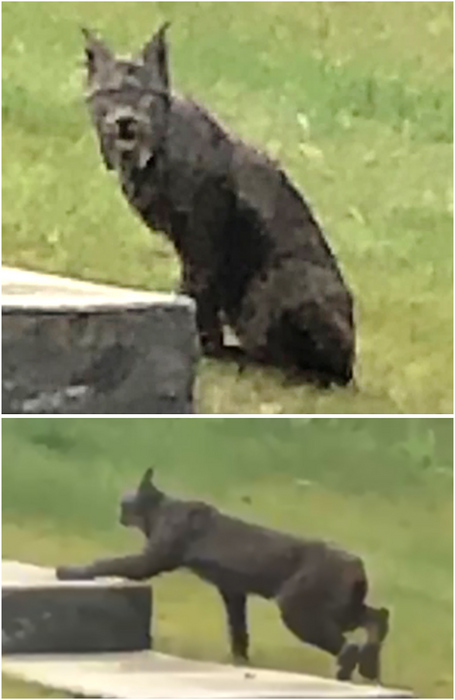
Black-coated Canada lynx

Credit: Source video courtesy of J. Stuckey.

A black-coated Canada lynx was photographed for the first time by a researcher at the University of Alberta, Canada. Thomas Jung, also employed by the Government of Yukon, recorded the animal in a 30 second video on a cell phone.

This unique finding is reported in an article, “Paint it black: first record of melanism in Canada lynx (Lynx canadensis)”, in the journal Mammalia. The video can be viewed in the supplementary material accompanying the article.

The lynx was found on a summer day, 29 August 2020, in a rural residential area near the town of Whitehorse, Yukon, which contains low density housing embedded in mature forest dominated by white spruce. The lynx was viewed from a distance of about 50 meters and was relatively undisturbed by the presence of nearby people and a dog until it left the area, possibly due to the dog’s barking.

Several Canada lynx experts have examined the footage and confirmed that the animal is indeed a lynx. Unfortunately the low resolution images do not permit detailed examination, although some minor features are detectable. “It had a black coat containing whitish gray guard hairs throughout, as well as whitish gray hairs in the facial ruff and the rostrum and dorsal regions,” Jung reports.

Coat color in the entire Lynx genus tends to be stable, with little variation within species compared to that of other members of the cat family (felidae). Specifically, Canada lynx generally have silvery grayish coats in winter, changing to reddish brown in summer but accompanied by dark spots, and black hairs on the tips of their tails and ears.

In addition to being the first recorded case of melanism in Lynx canadensisi, this sighting adds to only a small number of coat color variations found in any member of the genus Lynx.

Variation in coat color within mammal species is of enduring interest, Jung says, partly because, in differing circumstances, it can either be of evolutionary benefit to the affected animals (adaptive) or can confer a disadvantage (maladaptive).

Researchers have been unable to determine whether melanism in any species of lynx is adaptive or maladaptive but Jung suggests that loss of camouflage for the black lynx when hunting in the snow is likely to be maladaptive. He speculates that the dark color might put the animal at a distinct disadvantage when hunting hares during winter.


Journal

Mammalia

DOI

10.1515/mammalia-2022-0025

Method of Research

Observational study

Subject of Research

Animals

Article Title

Paint it black: first record of melanism in Canada lynx (Lynx canadensis)

Article Publication Date

10-Oct-2022

COI Statement

The authors declare no conflicts of interest regarding this article. No animals were handled or disturbed during this work.


Share12Tweet8Share2ShareShareShare2

Related Posts

Florida Cane Toad: Complex Spread and Selective Evolution

Florida Cane Toad: Complex Spread and Selective Evolution

February 7, 2026
New Study Uncovers Mechanism Behind Burn Pit Particulate Matter–Induced Lung Inflammation

New Study Uncovers Mechanism Behind Burn Pit Particulate Matter–Induced Lung Inflammation

February 6, 2026

DeepBlastoid: Advancing Automated and Efficient Evaluation of Human Blastoids with Deep Learning

February 6, 2026

Navigating the Gut: The Role of Formic Acid in the Microbiome

February 6, 2026

POPULAR NEWS

  • Robotic Ureteral Reconstruction: A Novel Approach

    Robotic Ureteral Reconstruction: A Novel Approach

    82 shares
    Share 33 Tweet 21
  • Digital Privacy: Health Data Control in Incarceration

    63 shares
    Share 25 Tweet 16
  • Study Reveals Lipid Accumulation in ME/CFS Cells

    57 shares
    Share 23 Tweet 14
  • Breakthrough in RNA Research Accelerates Medical Innovations Timeline

    53 shares
    Share 21 Tweet 13

About

We bring you the latest biotechnology news from best research centers and universities around the world. Check our website.

Follow us

Recent News

Decoding Prostate Cancer Origins via snFLARE-seq, mxFRIZNGRND

Digital Health Perspectives from Baltic Sea Experts

Florida Cane Toad: Complex Spread and Selective Evolution

Subscribe to Blog via Email

Enter your email address to subscribe to this blog and receive notifications of new posts by email.

Join 73 other subscribers
  • Contact Us

Bioengineer.org © Copyright 2023 All Rights Reserved.

Welcome Back!

Login to your account below

Forgotten Password?

Retrieve your password

Please enter your username or email address to reset your password.

Log In
No Result
View All Result
  • Homepages
    • Home Page 1
    • Home Page 2
  • News
  • National
  • Business
  • Health
  • Lifestyle
  • Science

Bioengineer.org © Copyright 2023 All Rights Reserved.
