October 17, 2022
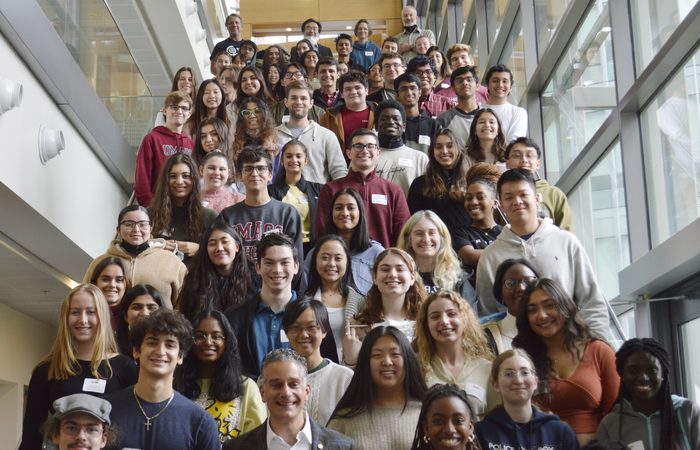
Credit: UMass Amherst
October 17, 2022
AMHERST, Mass. – A recent study, led by the University of Massachusetts Amherst and appearing in the Journal of Higher Education, reveals how undergraduate students engage with interdisciplinary learning throughout their college careers and beyond—and how universities should respond to support such learning.
The number of interdisciplinary undergraduate programs has grown rapidly over the past few decades, and federal agencies such as the National Institutes of Health, the National Science Foundation and the Department of Energy have responded by creating new funding opportunities for interdisciplinary initiatives.
“However,” write the authors, “scant research has explored how students experience and navigate interdisciplinarity.” We quite literally don’t know how undergraduate students make sense of their interdisciplinary programs.
To bridge this gap, the research team decided to study students in UMass Amherst’s Integrated Concentration in STEM (iCons) program, a certificate program devoted to solving real-world problems in biomedicine and renewable energy, and which is open to all students in STEM and business fields.
“No previous study has investigated the perceptions of the students themselves,” says Scott Auerbach, professor of chemistry at UMass Amherst and the Mahoney Family Sponsored executive director of the iCons program. “Our new findings suggest how to design programs that meet student needs in a world that demands more interdisciplinary workers to tackle problems in clean energy, public health, and climate change.”
The researchers collected data from current and former iCons students at all stages in their university and post-university careers. The research revealed three stages of interdisciplinary work: the “choosing” stage for beginning students, the “navigating” stage for advanced students, and the “integrating” stage for alumni.
“We were very surprised by these findings, especially in discovering an interdisciplinary stage for beginning students, before they have amassed enough learning to be considered competent in their fields,” says Genia Bettencourt, lead author of the paper who completed this research as part of her postdoctoral training at UMass Amherst and who is now a professor of higher and adult education in the Department of Leadership at the University of Memphis.
Another surprise was the “navigating stage” for advanced students, whose progress through their majors can in principle provide foundations on which to build interdisciplinary learning. However, the study found students reporting discord between disciplinary and interdisciplinary studies, including scheduling conflicts and cultural clashes.
“The ‘navigating’ stage teaches us that strong advising is critical for the success of an interdisciplinary program,” says Ezekiel Kimball, senior author of the study, professor of higher education and associate dean for Undergraduate and Teacher Education at the University of Maine at Orono. “And the ‘integrating’ stage shows that these students realize the full benefits of interdisciplinary training only after they’ve left college, indicating that keeping in touch with alumni is critical for assessing the broad impacts of interdisciplinary programs.”
The research was funded by the Mahoney Family Sponsorship of the UMass iCons Program, along with the Howard Hughes Medical Institute’s Professors Program. The next step is to investigate how teamwork is implemented within an interdisciplinary program to identify best practices for training cross-functional collaboration skills.
Contacts: Scott Auerbach, [email protected]
Daegan Miller, [email protected]
Journal
The Journal of Higher Education
DOI
10.1080/00221546.2022.2131964
Article Title
How STEM Undergraduates Choose, Navigate, and Integrate Interdisciplinarity in College and Beyond