Key takeaways
Credit: American College of Surgeons
Key takeaways
-
Telemedicine significantly lowers likelihood of no-show clinic visits among surgical patients and follow-up care during the post-surgery period.
-
Telemedicine is a convenient tool that can help improve healthcare for all patients, successfully increasing access among vulnerable populations.
SAN DIEGO: Surgical patients who use telehealth services are much more likely to show up for their initial clinic visit or follow-up appointment during the post-surgery period than those who rely on in-person visits only. Research findings were presented at the Scientific Forum of the American College of Surgeons (ACS) Clinical Congress 2022. During the early months of the COVID pandemic, when everything shut down, telemedicine became an effective tool to reach patients. Building on those successes, more hospitals and clinics are implementing telehealth technology into their patient care practices.
Telehealth consists of an at-home interactive video and audio telecommunications system, allowing real-time connection between patients, nurses, and doctors. One major benefit to patients is that they avoid the trouble of travel to and from an appointment at a distant hospital or clinic.
“Low access to transportation is the number one reason for patient no-show visits.* Telemedicine is a feasible way for us to reach out to patients who would otherwise have a lot of barriers to access the healthcare system,” said lead study author Connie Shao, MD, a general surgery resident at the University of Alabama Birmingham.
“Maintaining routine healthcare such as clinic visits helps prevent emergent visits, which are typically at a point in time when a patient’s condition is much worse. Staying engaged with the healthcare system with timely care before and after surgery improves quality care, reduces costs for the patient, and helps ensure our patients are able to maintain a higher level of health.”
Even so, little is known about telemedicine use among surgical patients.
About the study
For this analysis, researchers evaluated the association between telemedicine use and patient no-show visits. They looked at data collected from seven clinics at the University of Alabama Birmingham among a diverse population of patients, with an average age of 60, undergoing all types of surgery between January 2018 and December 2021.
Researchers divided the patients into three categories:
- a historical control of in-person visits from January 2018 to March 2020
-
a contemporary control of in-person visits from March 2020 to December 2021
- a contemporary group of patients scheduled for telemedicine visits between March 2020 to December 2021
March 2020 was the start of the COVID-19 pandemic and, with that, a ramping up of telemedicine appointments. The three groups were compared for no-show visits.
Key findings
-
Of the 553,475 total visits, 11.3% were no-shows.
-
Most clinic visits were in the historical control (54.1%), compared with contemporary control (41.5%), and telemedicine visits—which included audio only and video (4.4% for both types).
-
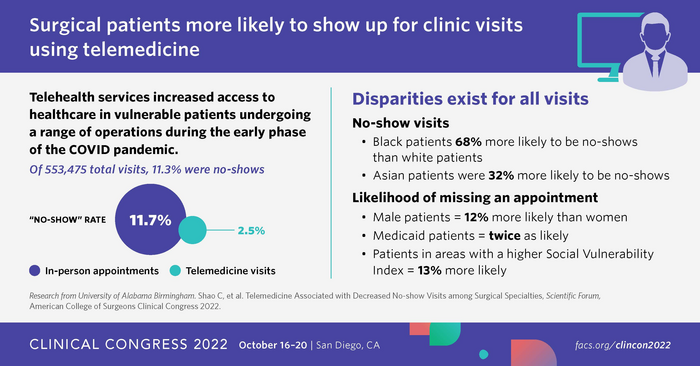
The no-show rate was highest among in-person appointments (11.7%) compared to telemedicine visits (2.5%).
-
Telemedicine was effective at reducing no-show visits. Of the small group of telemedicine visits, a multivariable adjusted analysis found a reduction in odds by 79% of no-show visits.
-
No-show visits were also less common among older patients, those insured with Medicare, and the historical in-person visits from January 2018 to March 2020, compared with the contemporary in-person visits from March 2020 to December 2021.
-
Disparities in no-show visits exist. For all visits, male patients were 12% more likely to not complete the appointments than women. Black patients, compared with white patients, were 68% more likely to be no-shows, and Asian patients were 32% more likely to be no-shows.
-
Compared with private insurance, Medicaid patients were twice as likely to not complete the appointment. And patients from counties with a higher Social Vulnerability Index were 13% more likely to not complete the appointment.
Addressing the digital divide for patients
“Hopefully with the convenience of telemedicine now, the only bridge that we have to cross is the digital divide. We’ve partnered with a grassroots community program to train people in our community, especially older and more vulnerable people, on how to use telemedicine,” Dr. Shao said. “We can help keep these patients engaged in the healthcare system without having to take up their entire day to come and see us in the hospital.”
Giving all patients the option to use telehealth services may be of great benefit to surgical patients in the future. Dr. Shao is also developing best practice guidelines for the use of telemedicine for different surgical specialties during the post-surgery period.
“Telemedicine interventions such as training patients and offering more low-tech options, such as audio only, especially for patients who live far away, is an easier option. Some care is better than no care. And it’s far better for us to get some information at a telemedicine visit to take care of our patients in a timely interval than to wait to see the patient later on when they are sicker and have to be admitted to a hospital,” Dr. Shao said. “There is a time and place to use telemedicine. It certainly is an intervention worth considering to reduce no-show visits and to improve quality care across the board.”
The main limitation of the study is that the populations that are using telehealth technology are more likely, in general, to show up for a clinic visit (patients with better health literacy and access to the healthcare system disproportionately benefit from telemedicine). Future studies that incorporate telemedicine training into patient visits will eliminate this confounding.
The study was supported by the ACS and the University of Alabama Birmingham Health Services and Outcomes Research Group.
Study coauthors are Marshall C. McLeod, PhD; Andy Hare, BS; Isabel C. Marques, MD; Lauren Gleason, MD, MSPH; Burkely P. Smith, MD; Eric L. Wallace, MD, FACS; and Daniel I. Chu, MD, FACS.
Citation: Shao C, et al. Telemedicine Associated with Decreased No-show Visits among Surgical Specialties, Scientific Forum, American College of Surgeons Clinical Congress 2022.
________________________
* Mieloszyk RJ, Rosenbaum JI, Hall CS, et al. Environmental Factors Predictive of No-Show Visits in Radiology: Observations of Three Million Outpatient Imaging Visits Over 16 Years, J Am Coll Radiol, 2016; 16 (4,B) 554-559.
# # #
About the American College of Surgeons
The American College of Surgeons is a scientific and educational organization of surgeons that was founded in 1913 to raise the standards of surgical practice and improve the quality of care for all surgical patients. The College is dedicated to the ethical and competent practice of surgery. Its achievements have significantly influenced the course of scientific surgery in America and have established it as an important advocate for all surgical patients. The College has more than 84,000 members and is the largest organization of surgeons in the world. “FACS” designates that a surgeon is a Fellow of the American College of Surgeons.