New satellite imagery research led by the University of Ottawa is the first to identify a specific endangered Gulf of St. Lawrence North Atlantic right whale from space.
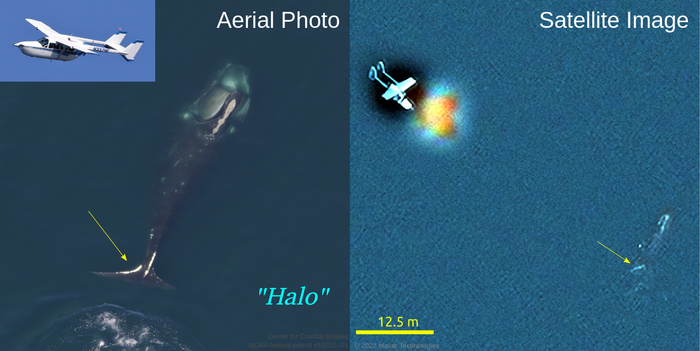
Credit: University of Ottawa / Canadian Space Agency
New satellite imagery research led by the University of Ottawa is the first to identify a specific endangered Gulf of St. Lawrence North Atlantic right whale from space.
Matus Hodul, a Ph. D student in the Department of Geography, Environment and Geomatics of the Faculty of Arts who is co-author of the study with Dr. Anders Knudby, explains how this technology can be used for monitoring the critically endangered whales, know as Eubalaena glacialis, and lead to improved conservation efforts.
Please provide some context on the current state of the right whale population.
Matus Hodul: “The North Atlantic right whale is critically endangered, with about 336 individual whales accounted for. Mortality comes from whales being hit by ships and becoming entangled in fishing gear, so being able to detect and monitor their location is important to conservation efforts. Knowing where the whales are at any given time enables fisheries to open or close to avoid the whales and enables ships to bypass them to prevent collisions.”
What is this technology and how will it help right whales?
M.H.: “This is a new type of satellite imagery which has a spatial resolution of 15 cm, which means each pixel in the image represents 15 cm on the ground. For context, this is much finer than Google Earth satellite images. This imagery allows us to find the endangered North Atlantic right whales and confidently differentiate this species from other kinds of whales, such as fin whales and humpbacks. In some cases, it also allows us to identify individual whales, in circumstances where a whale has sufficiently distinct markings.
“Interestingly, it is not known where approximately 50% of North Atlantic right whales go in the summer and autumn months. Now that we can detect and positively identify right whales using satellite imagery, it will likely have significant implications for conservation efforts.”
Were you able to identify any specific whales?
M.H.: “We were able to identify the whale named “Ruffian,” who was severely injured in an entanglement with fishing gear in 2008 that left him with a distinct, large white scar on his back. In the satellite imagery, we were able to spot a right whale with this exact scar, allowing us to identify the whale as Ruffian.”
How was the study conducted and who led the research?
M.H: “This research was conducted by myself and Dr. Anders Knudby at the University of Ottawa, in collaboration with scientists from the Center for Coastal Studies (CCS). The project was undertaken with the financial support of the Canadian Space Agency and the Department of Fisheries and Oceans in collaboration with Transport Canada, as part of the Canadian Space Agency larger “smartWhales” initiative to explore improved methods for the detection and modeling of North Atlantic right whales using space-based data sources.”
When did the research occur?
M.H.: “The research started in April 2021 and concluded late this summer. Aerial surveying to locate and take photographs of the whales was conducted by the CCS in Cape Cod Bay on the same day as the satellite imagery was being taken. Locating the whales in the satellite imagery was then done in the months following the survey.”
‘Individual North Atlantic right whales identified from space’ is published in Marine Mammal Science. Doi.org/10.1111/mms.12971 The participation of the University of Ottawa in this project has been undertaken as a team member led by Fluvial Systems Research Inc.
Journal
Marine Mammal Science
DOI
10.1111/mms.12971
Method of Research
Data/statistical analysis
Subject of Research
Animals
Article Title
Individual North Atlantic right whales identified from space
Article Publication Date
1-Sep-2022