Enrollment has begun in an early-stage clinical trial evaluating bacteriophage therapy in adults with cystic fibrosis (CF) who carry Pseudomonas aeruginosa (P. aeruginosa) in their lungs. The trial is evaluating whether the bacteriophage, or “phage,” therapy is safe and able to reduce the amount of bacteria in the lungs of volunteers. The trial is being conducted by the Antibacterial Resistance Leadership Group (ARLG), funded by the National Institute of Allergy and Infectious Diseases. Investigators aim to enroll up to 72 adults at 16 CF centers across the United States.
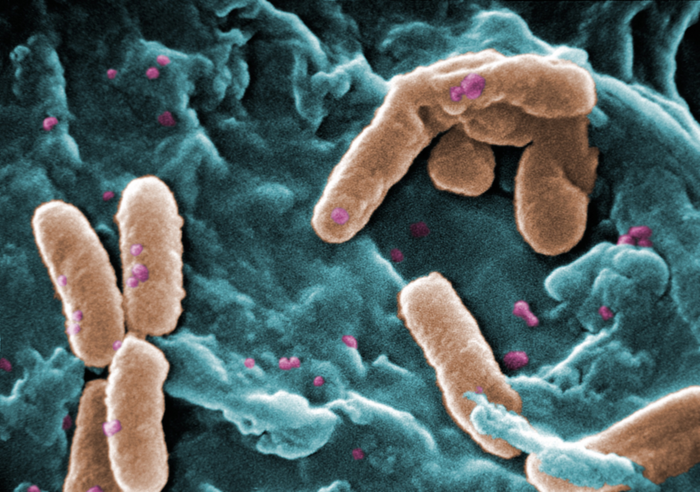
Credit: CDC
Enrollment has begun in an early-stage clinical trial evaluating bacteriophage therapy in adults with cystic fibrosis (CF) who carry Pseudomonas aeruginosa (P. aeruginosa) in their lungs. The trial is evaluating whether the bacteriophage, or “phage,” therapy is safe and able to reduce the amount of bacteria in the lungs of volunteers. The trial is being conducted by the Antibacterial Resistance Leadership Group (ARLG), funded by the National Institute of Allergy and Infectious Diseases. Investigators aim to enroll up to 72 adults at 16 CF centers across the United States.
Phages are viruses that can kill or neutralize specific bacteria while leaving non-target bacteria and human cells unharmed. For more than a century, researchers have considered the potential use of phages as therapeutics, theorizing that mixtures of bacteriophages might be used on their own, or in conjunction with antibiotics, to treat bacterial infections—especially those resistant to antibiotics.
P. aeruginosa, a serious and sometimes deadly bacterium frequently acquired in healthcare settings, is the most common bacterial cause of CF exacerbations. P. aeruginosa can take advantage of the tissue damage caused by CF changes in mucus to infect and colonize the lungs. Multidrug-resistant P. aeruginosa infections are becoming increasingly common, and in recent years, only a handful of new antibiotics have been approved to treat them.
“The prevalence of antibiotic resistance is concerning, and the need for more effective therapeutics for vulnerable populations, such as people with cystic fibrosis, is especially urgent,” said NIAID Director Anthony S. Fauci, M.D. “Although research on bacteriophage therapy may still be in its infancy in the United States, we hope that this study, and others like it, could open the doors to a new type of therapy for difficult-to-treat bacterial infections.”
The experimental phage therapeutic, WRAIR-PAM-CF1, is manufactured by Adaptive Phage Therapeutics, Gaithersburg, Maryland. It contains a cocktail of four bacteriophage species that naturally infect P. aeruginosa and take over its cellular processes, killing the bacterium in the process. The phages in the cocktail are highly specific and do not attack human cells. They have been cultivated, purified, and extensively studied in a lab setting. Genetic analyses of these phages have determined that they do not carry harmful genes that could accidentally be transferred to the bacteria they infect, such as genes that could confer antibiotic resistance.
The trial will enroll CF patients who chronically harbor P. aeruginosa in their respiratory tracts. Participants will receive the phage cocktail as a single IV infusion at one of three dosage levels. Researchers will gather data on safety and microbiological activity; how the phages function in the body; how the cocktail affects the participants’ lung function; whether the therapy works differently on P. aeruginosa from different geographical regions; and whether the therapy changes participants’ overall quality of life.
The trial will begin as a Phase 1b trial and will expand to a Phase 2 trial. First, two participants per dosage level will receive an unblinded infusion of the therapeutic and will be closely monitored for four days thereafter. If no serious safety issues are identified, researchers will begin enrolling additional participants, who will be randomly assigned to receive a single infusion of the therapeutic at one of the three dosage levels, or a placebo infusion. This part of the trial will be double-blinded, so neither the participants nor the investigators will know who is receiving placebo. An assessment of the therapeutic’s safety and microbiological impact will be conducted after eight participants have completed each dosage. The results of this assessment will determine which dosage will be given in the next stage of the trial. The Phase 2 trial will enroll up to 50 participants who will be randomly assigned to receive the selected dose of the phage cocktail or a placebo. Each volunteer will make multiple follow-up visits to monitor their health and reaction to the experimental therapeutic.
The ARLG is a clinical research consortium supported by NIAID which works to combat the antibacterial resistance crisis and improve patient care. ARLG’s mission is to prioritize, design, and execute clinical research that will impact the prevention, diagnosis, and treatment of infections caused by antibiotic-resistant bacteria. For more information about this trial, visit ClinicalTrials.gov and search identifiers NCT05453578.
NIAID conducts and supports research—at NIH, throughout the United States, and worldwide—to study the causes of infectious and immune-mediated diseases, and to develop better means of preventing, diagnosing and treating these illnesses. News releases, fact sheets and other NIAID-related materials are available on the NIAID website.
About the National Institutes of Health (NIH): NIH, the nation’s medical research agency, includes 27 Institutes and Centers and is a component of the U.S. Department of Health and Human Services. NIH is the primary federal agency conducting and supporting basic, clinical, and translational medical research, and is investigating the causes, treatments, and cures for both common and rare diseases. For more information about NIH and its programs, visit https://www.nih.gov/.
NIH…Turning Discovery Into Health®