Researchers from the University of Tennessee Institute of Agriculture have received a grant to study native warm-season perennial grasses for organic livestock feed production. The $750,000 grant from the USDA National Institute of Food and Agriculture will fund four years of research for Sindhu Jagadamma, associate professor of soil science in the Department of Biosystems Engineering and Soil Science.
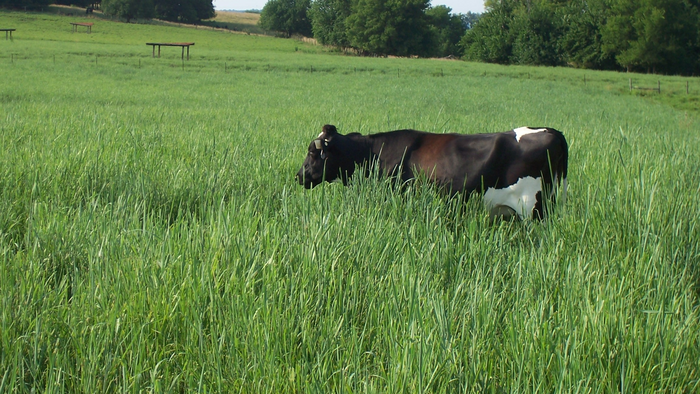
Credit: Patrick Keyser
Researchers from the University of Tennessee Institute of Agriculture have received a grant to study native warm-season perennial grasses for organic livestock feed production. The $750,000 grant from the USDA National Institute of Food and Agriculture will fund four years of research for Sindhu Jagadamma, associate professor of soil science in the Department of Biosystems Engineering and Soil Science.
The project will target the southeastern United States, where tall fescue grass is the dominant cattle feed. While this cool-season grass grows well in the fall and spring, production and quality diminish during the summer. Jagadamma’s project will focus on integrating warm-season grasses organically in the tall fescue systems and studying the agronomic and ecological implications of such organic forage systems. This is built off the research from Patrick Keyser, professor in the Department of Forestry, Wildlife and Fisheries. His research focused on warm-season and cool-season grass integration, and this project will expand on that with organic methods.
“Native warm-season grasses out-perform other grass species in soil organic matter accumulation, nutrient-use efficiency, climate resiliency and many other ways, Jagadamma said, “So, achieving these ancillary benefits in addition to providing high-quality animal feed by introducing them is a win-win strategy, and I am very passionate about investigating these ecological benefits.”
Over the course of four years, Jagadamma’s team will start on-station and on-farm trials in Tennessee and Arkansas to study forage yield and nutritive value, weed suppression, soil health and economic benefits, then work with University of Tennessee and University of Arkansas Extension to inform producers of their findings.
“Due to the increased awareness of issues related to human health, animal welfare and environmental protection, organic dairy and meat production lead the list of the fastest-growing organic industries in the U.S. However, this sector is still the smallest contributor of total organic sales. By directly helping farmers and ranchers produce high-quality animal feed to meet the growing need for domestic production of organic livestock products, this project brings real-life solutions to the organic producers and consumers of the fescue belt region and beyond,” Jagadamma said.
Researchers from the University of Tennessee Institute of Agriculture include: Sindhu Jagadamma, associate professor in the Department of Biosystems Engineering and Soil Science; Patrick Keyser, professor in the Department of Forestry, Wildlife and Fisheries; Saha Debasish, assistant professor in the Department of Biosystems Engineering and Soil Science; and Andrew Griffith, associate professor in the Department of Agricultural and Resource Economics.
In addition to researchers from the University of Tennessee Institute of Agriculture, Song Cui from Middle Tennessee State University, Dirk Philipp from University of Arkansas, and Christine Nieman from USDA-ARS Dale Bumpers Small Farms Research Center are also working on this project.
Through its land-grant mission of research, teaching and extension, the University of Tennessee Institute of Agriculture touches lives and provides Real. Life. Solutions. utia.tennessee.edu.