• HOME
  • NEWS
  • EXPLORE
    • CAREER
      • Companies
      • Jobs
    • EVENTS
    • iGEM
      • News
      • Team
    • PHOTOS
    • VIDEO
    • WIKI
  • BLOG
  • COMMUNITY
    • FACEBOOK
    • INSTAGRAM
    • TWITTER
Saturday, February 7, 2026
BIOENGINEER.ORG
No Result
View All Result
  • Login
  • HOME
  • NEWS
  • EXPLORE
    • CAREER
      • Companies
      • Jobs
        • Lecturer
        • PhD Studentship
        • Postdoc
        • Research Assistant
    • EVENTS
    • iGEM
      • News
      • Team
    • PHOTOS
    • VIDEO
    • WIKI
  • BLOG
  • COMMUNITY
    • FACEBOOK
    • INSTAGRAM
    • TWITTER
  • HOME
  • NEWS
  • EXPLORE
    • CAREER
      • Companies
      • Jobs
        • Lecturer
        • PhD Studentship
        • Postdoc
        • Research Assistant
    • EVENTS
    • iGEM
      • News
      • Team
    • PHOTOS
    • VIDEO
    • WIKI
  • BLOG
  • COMMUNITY
    • FACEBOOK
    • INSTAGRAM
    • TWITTER
No Result
View All Result
Bioengineer.org
No Result
View All Result
Home NEWS Science News Chemistry

First probable impact crater discovered in Spain

Bioengineer by Bioengineer
September 29, 2022
in Chemistry
Reading Time: 2 mins read
0
Location of probable impact crater in Spain
Share on FacebookShare on TwitterShare on LinkedinShare on RedditShare on Telegram

The first probable impact crater in Spain has been identified in the southern province of Almeria. The discovery was presented last week at the Europlanet Science Congress (EPSC) 2022 by Juan Antonio Sánchez Garrido of the University of Almeria.
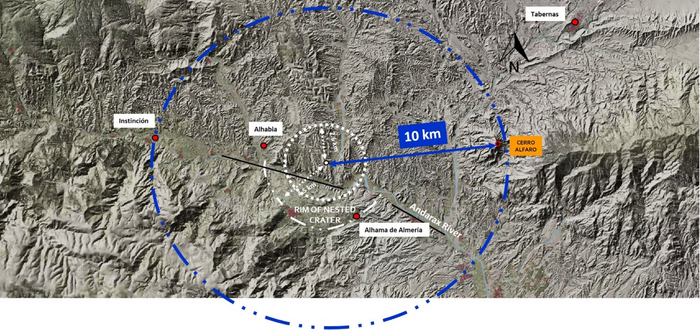
Location of probable impact crater in Spain

Credit: Sánchez-Garrido et al 2022. Basemap: Instituto Geográfico Nacional (IGN).

The first probable impact crater in Spain has been identified in the southern province of Almeria. The discovery was presented last week at the Europlanet Science Congress (EPSC) 2022 by Juan Antonio Sánchez Garrido of the University of Almeria.

While around 200 impact structures have been identified around the world, the study is the first to identify signs of an impact crater on the Iberian Peninsula. The discovery is the result of 15 years of research by an international team of scientists from the University of Almeria, the Astrobiology Center of Madrid, the University of Lund and the University of Copenhagen.

Prof Sánchez Garrido said: “We believe that the impact event occurred around 8 million years ago. We have investigated numerous aspects of the geology, minerology, geochemistry and geomorphology of the region. The basins of Alhabia and Tabernas in the area are filled with sediments dating back between 5 and 23 million years, and they overlie older metamorphic rocks. Much of the impact structure is buried by more modern sediments, but erosion has exposed it and opened up the opportunity for studies.”

The crater itself is thought to be about 4 kilometres in diameter, and it is surrounded by a larger structure about 20 kilometres across, where the impact caused the sedimentary strata to collapse.

Evidence for the impact crater includes several examples of ‘shocked’ quartz grains in breccia – a sedimentary rock type with large fragments cemented into a finer-grained matrix. The grains show signs of being deformed in the enormous pressures of the impact, which were between 10 and 30 gigapascals.

“If the crater discovery is confirmed, it would not only be exciting from a scientific perspective, but would also be a wonderful addition to the scientific and touristic attractions of the province of Almeria,” said Prof Sánchez Garrido.

EPSC2022, which took place last week in Granada, was attended by almost 1200 planetary scientists from around the world, making it one of the largest planetary science meetings to take place in Europe.

The Chair of the Local Organising Committee, Luisa Lara of the Instituto de Astrofisica de Andalucía-CSIC, said: “It was a lot of work to prepare for the meeting and we had to wait two years because of the pandemic. But the emotion of welcoming everyone to EPSC2022 in Granada has been worth everything – all the work is forgotten and the success of the meeting is a wonderful reward.”


DOI

10.5194/epsc2022-217

Share12Tweet8Share2ShareShareShare2

Related Posts

blank

Breakthrough in Environmental Cleanup: Scientists Develop Solar-Activated Biochar for Faster Remediation

February 7, 2026
blank

Cutting Costs: Making Hydrogen Fuel Cells More Affordable

February 6, 2026

Scientists Develop Hand-Held “Levitating” Time Crystals

February 6, 2026

Observing a Key Green-Energy Catalyst Dissolve Atom by Atom

February 6, 2026

POPULAR NEWS

  • Robotic Ureteral Reconstruction: A Novel Approach

    Robotic Ureteral Reconstruction: A Novel Approach

    82 shares
    Share 33 Tweet 21
  • Digital Privacy: Health Data Control in Incarceration

    63 shares
    Share 25 Tweet 16
  • Study Reveals Lipid Accumulation in ME/CFS Cells

    57 shares
    Share 23 Tweet 14
  • Breakthrough in RNA Research Accelerates Medical Innovations Timeline

    53 shares
    Share 21 Tweet 13

About

We bring you the latest biotechnology news from best research centers and universities around the world. Check our website.

Follow us

Recent News

Phage-Antibiotic Combo Beats Resistant Peritoneal Infection

Boosting Remote Healthcare: Stepped-Wedge Trial Insights

Barriers and Boosters of Seniors’ Physical Activity in Karachi

Subscribe to Blog via Email

Enter your email address to subscribe to this blog and receive notifications of new posts by email.

Join 73 other subscribers
  • Contact Us

Bioengineer.org © Copyright 2023 All Rights Reserved.

Welcome Back!

Login to your account below

Forgotten Password?

Retrieve your password

Please enter your username or email address to reset your password.

Log In
No Result
View All Result
  • Homepages
    • Home Page 1
    • Home Page 2
  • News
  • National
  • Business
  • Health
  • Lifestyle
  • Science

Bioengineer.org © Copyright 2023 All Rights Reserved.