A new technique that combines electron microscopy and laser technology enables programmable, arbitrary shaping of electron beams. It can potentially be used for optimizing electron optics and for adaptive electron microscopy, maximizing sensitivity while minimizing beam-induced damage. This fundamental and disruptive technology was now demonstrated by researchers at the University of Vienna, and the University of Siegen. The results are published in PRX.
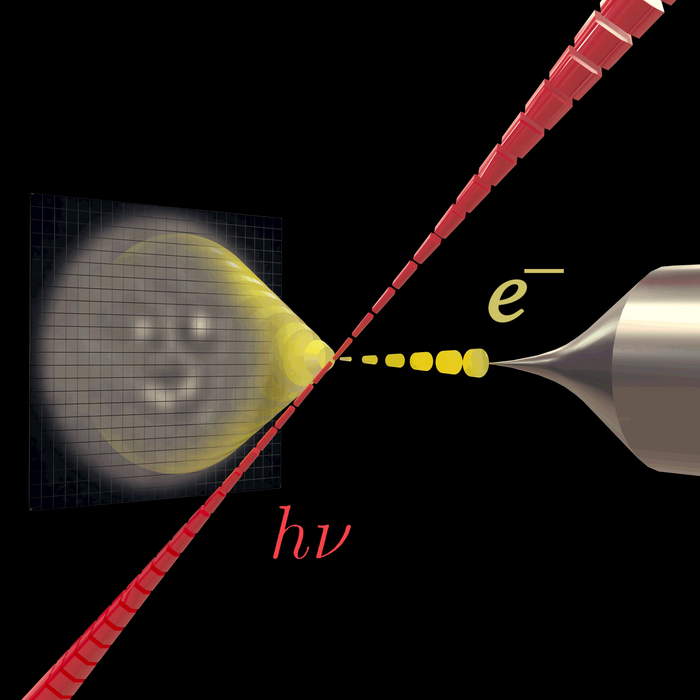
Credit: stefaneder.at, University of Vienna
A new technique that combines electron microscopy and laser technology enables programmable, arbitrary shaping of electron beams. It can potentially be used for optimizing electron optics and for adaptive electron microscopy, maximizing sensitivity while minimizing beam-induced damage. This fundamental and disruptive technology was now demonstrated by researchers at the University of Vienna, and the University of Siegen. The results are published in PRX.
When light passes through turbulent or dense material, e.g. the Earth’s atmosphere or a millimetre-thick tissue, standard imaging technologies experience significant limitations in the imaging quality. Scientists therefore place deformable mirrors in the optical path of the telescope or microscope, which cancel out the undesired effects. This so-called adaptive optics has led to many breakthroughs in astronomy and deep-tissue imaging.
However, this level of control has not yet been achieved in electron optics even though many applications in materials science and structural biology demand it. In electron optics, scientists use beams of electrons instead of light to image structures with atomic resolution. Usually, static electromagnetic fields are used to steer and focus the electron beams.
In a new study published in PRX, researchers from the University of Vienna (at the Faculty of Physics and the Max Perutz Labs) and the University of Siegen have now shown that it is possible to deflect electron beams almost arbitrarily using high-intensity, shaped light fields, which repel electrons. Kapitza and Dirac first predicted this effect in 1933, and the first experimental demonstrations (Bucksbaum et al., 1988, Freimund et al., 2001) became possible with the advent of high-intensity pulsed lasers.
The Vienna-based experiment now makes use of our ability to shape light. A laser pulse is shaped by a spatial light modulator and interacts with a counter-propagating, synchronized pulsed electron beam in a modified scanning electron microscope. This enables imprinting on demand transverse phase shifts to the electron wave, enabling unprecedented control over electron beams.
The potential of this innovative technology is demonstrated by creating convex and concave electron lenses and by generating complex electron intensity distributions. As pointed out by the lead author of the study, Marius Constantin Chirita Mihaila: “We are writing with the laser beam in the transverse phase of the electron wave. Our experiments pave the way for wavefront shaping in pulsed electron microscopes with thousands of programmable pixels. In the future, parts of your electron microscope may be made from light.”
In contrast to other competing electron-shaping technologies, the scheme is programmable, and avoids losses, inelastic scattering, and instabilities due to the degradation of material diffraction elements. Thomas Juffmann, head of the group at the University of Vienna, adds, “Our shaping technique enables aberration correction and adaptive imaging in pulsed electron microscopes. It can be used to adjust your microscope to the specimens you study to maximize sensitivity.”
DOI
10.1103/PhysRevX.12.031043
Article Title
Transverse Electron-Beam Shaping with Light
Article Publication Date
26-Sep-2022