Laughing gas is no laughing matter — nitrous oxide is a greenhouse gas with 300 times the warming potential of carbon dioxide. Scientists are racing to learn whether microorganisms send more of it into the atmosphere after wildfires.
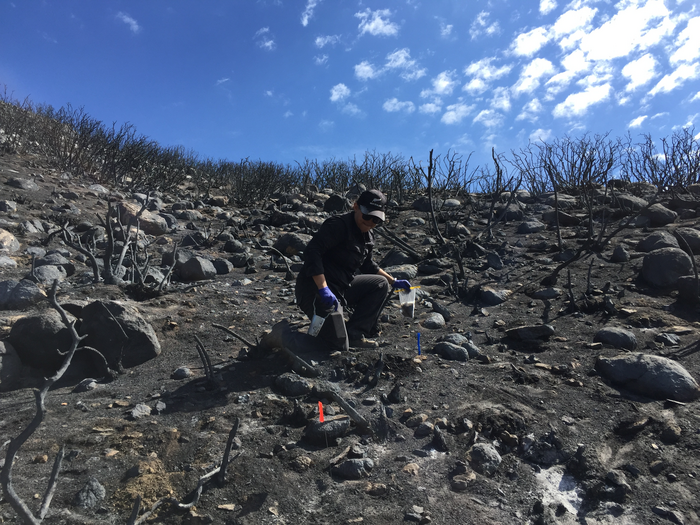
Credit: Sydney Glassman/UCR
Laughing gas is no laughing matter — nitrous oxide is a greenhouse gas with 300 times the warming potential of carbon dioxide. Scientists are racing to learn whether microorganisms send more of it into the atmosphere after wildfires.
A research team led by UC Riverside mycologist Sydney Glassman will spend the next three years answering this question, examining how bacteria, viruses, fungi and archaea work together in post-fire soils to affect nitrous oxide emissions.
Their work is supported by a new $3.1 million grant from the U.S. Department of Energy.
“Because carbon dioxide is the largest contributor to global warming, it’s easy to focus on,” Glassman said.
“Nitrogen in the form of nitrous oxide, and the microbes that regulate it, are a less well-studied aspect of the problem, but an aspect we must solve to more fully understand how the planet is changing, and how much we can expect it to keep changing,” she said.
The project is timely as wildfires are increasing in frequency, size, and severity both locally and across the globe. The fires themselves send warming gases into the atmosphere, but they also irretrievably change the soil microbiome. In the post-fire environment, ‘fire loving’ microbes that were previously undetectable take over, with unknown results.
“We suspect that because fires leave behind ash that is rich in nitrogen, the microbes left in the post-fire landscape can transform the nitrogen into nitrous oxide, transferring it into the atmosphere,” said UCR environmental scientist Pete Homyak, who is co-principal investigator of the project.
Additionally, since few or no plants remain after severe wildfires, microbes have less competition for the abundance of nitrogen.
The team of five researchers will examine the composition of post-fire soil microbiomes at different depths and across different types of landscapes including conifer forests, grasslands and chapparal, a common shrubland in Southern California. They will also create small-scale experimental fires, using soil collected from these three landscapes.
Nitrogen cycling, in which nitrogen is converted into multiple chemical forms as it moves from the atmosphere, into the soil and water, and back into the atmosphere, is driven by microbes. The project will study the multiple ways in which microbes impact atmospheric nitrogen cycling.
“Microbes are an important aspect of what’s happening with our air quality and our climate, but they’ve been hard to study because advanced genomic and computational techniques are required. That’s what this project is designed to do,” Glassman said.
Ultimately, the team hopes that data generated from this project will help scientists better model the effect of increased wildfires on atmospheric nitrous oxide, which in turn affects climate warming and sea level rise.
“We care a lot about wildfires when they are burning — smoke, ash, and the fires themselves are of great concern. Once they stop burning, some assume that is the end of the fire,” Homyak said. “In reality it may take many years for post-fire environments to recover, while communities of microorganisms are affecting the environment in ways we’re about to discover.”