• HOME
  • NEWS
  • EXPLORE
    • CAREER
      • Companies
      • Jobs
    • EVENTS
    • iGEM
      • News
      • Team
    • PHOTOS
    • VIDEO
    • WIKI
  • BLOG
  • COMMUNITY
    • FACEBOOK
    • INSTAGRAM
    • TWITTER
Tuesday, October 6, 2026
BIOENGINEER.ORG
No Result
View All Result
  • Login
  • HOME
  • NEWS
  • EXPLORE
    • CAREER
      • Companies
      • Jobs
        • Lecturer
        • PhD Studentship
        • Postdoc
        • Research Assistant
    • EVENTS
    • iGEM
      • News
      • Team
    • PHOTOS
    • VIDEO
    • WIKI
  • BLOG
  • COMMUNITY
    • FACEBOOK
    • INSTAGRAM
    • TWITTER
No Result
View All Result
Bioengineer.org
No Result
View All Result
Home NEWS Science News

Herbaria prove valuable in demonstrating long-term changes in plant populations

Bioengineer by Bioengineer
January 19, 2017
in Science News
Reading Time: 2 mins read
0
Share on FacebookShare on TwitterShare on LinkedinShare on RedditShare on Telegram
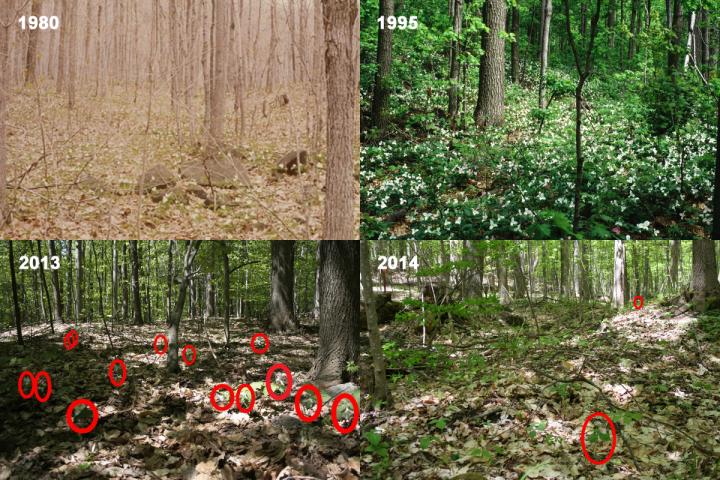
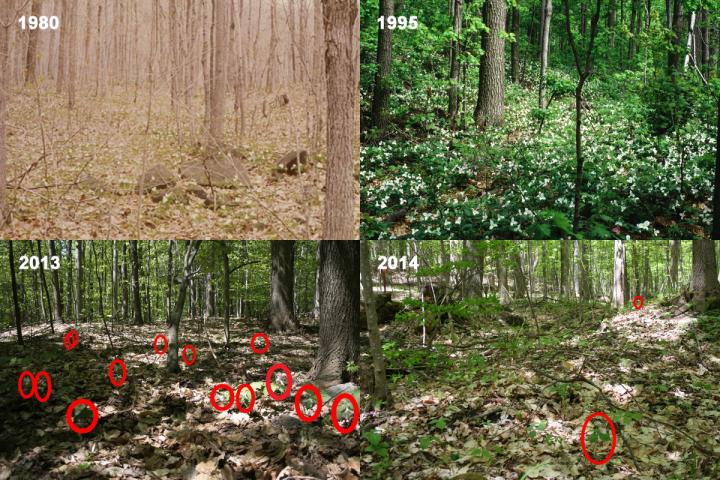
IMAGE

Credit: Claude Lavoie

A new study published today in Botany demonstrates how herbaria can be valuable resources for studying the impact over time of large herbivores on perennial plant populations.

Herbaria are collections of plants and plant parts, carefully dried and arranged on sheets of paper to accurately portray the appearance of the living organism. Herbarium specimens also give precise information on the time and place of collection, as well as other pertinent details.

The study published today used nearly 700 such specimens going back over 80 years to show that flowering white trillium plants in modern, deer-browsed areas of southern Quebec have a significantly lower leaf surface area than those in un-browsed areas and those preserved as herbarium specimens. This decrease in leaf area indicates a lower reproductive potential. Most of the herbarium specimens used were collected prior to 1980, when deer density in southern Quebec was very low. This is the first instance of herbarium collections being used to evaluate the effects of a large browsing herbivore on forb size. Such studies are usually carried out using exclosures or clipping experiments.

White trillium is a perennial forb present throughout eastern North America. It reproduces in mid to late May, when white-tailed deer will preferentially consume large plants bearing flowers or fruit, resulting in complete defoliation. Repeated browsing of this and other long-lived plant species by deer is known to decrease plant leaf area and height over time, as well as reducing the proportion of flowering plants, leading to decreased potential for survival. Severe overbrowsing can lead to local extinctions of white trillium and other plant species. A recent explosion of deer populations due to hunting restrictions, increased food supply, and reduction of natural predators is creating a serious plant conservation issue in some areas. A long-term historical perspective on the impact of browsing by large herbivores is difficult to obtain due to the local and short-term nature of most vegetation studies.

This research represents a novel use for herbaria at a time when both collecting activities and funding for collection maintenance are waning. "Our paper provides an additional example of the usefulness of these collections, not only to identify species, but also to study the impact on the environment of several disturbances," says co-author Claude Lavoie, "…herbarium specimens represent an inexpensive tool to assess the impact of large herbivores on plants. Unfortunately, this possibility is seriously hampered by the decline of herbarium specimen collecting throughout North America, and the precariousness of museum collections."

Use of collected specimens has the potential to offer continent-wide and decades-long coverage in addressing questions of long-term environmental

###

impacts on plant morphology and the health of plant populations, but depends on ongoing collecting efforts and financial support.

The paper, "Herbarium specimens as tools to assess the impact of large herbivores on plant species" by Marie-Pierre Beauvais, Stéphanie Pellerin, Jean Dubé, and Claude Lavoie was published today in Botany.

Media Contact

Rebecca Ross
[email protected]
613-791-8334
@cdnsciencepub

http://www.nrcresearchpress.com/

############

Story Source: Materials provided by Scienmag

Share12Tweet8Share2ShareShareShare2

Related Posts

Explainable AI Maps the Hottest B2B Sales Leads Before Salespeople Dial

Explainable AI Maps the Hottest B2B Sales Leads Before Salespeople Dial

October 6, 2026
Smart Threshold Model Slashes HEVC Encoding Work by Spotting Square Blocks Early

Smart Threshold Model Slashes HEVC Encoding Work by Spotting Square Blocks Early

October 6, 2026

Bacterial Immune Arsenals and the Arms Race Reshaping Phage Therapy

October 6, 2026

Alkaline Attack: How Caustic Solutions Weaken a Famous High-Entropy Alloy’s Armor

October 6, 2026
Please login to join discussion

POPULAR NEWS

  • Alloys That Shrink Their Own Grains: New PIX Mechanism Refines Metals With Heat Alone

    Alloys That Shrink Their Own Grains: New PIX Mechanism Refines Metals With Heat Alone

    29 shares
    Share 12 Tweet 7
  • Endurance Exercise Reshapes the Liver in Males and Females Through Distinct Molecular Routes

    29 shares
    Share 12 Tweet 7
  • Single Transcription Factor PU.1 Rapidly Converts Fibroblasts into Macrophage-Lineage Cells

    29 shares
    Share 12 Tweet 7
  • New Scale Measures How Ready Nurse Educators Really Are for the AI Era

    29 shares
    Share 12 Tweet 7

About

We bring you the latest biotechnology news from best research centers and universities around the world. Check our website.

Follow us

Recent News

Alloys That Shrink Their Own Grains: New PIX Mechanism Refines Metals With Heat Alone

Endurance Exercise Reshapes the Liver in Males and Females Through Distinct Molecular Routes

Single Transcription Factor PU.1 Rapidly Converts Fibroblasts into Macrophage-Lineage Cells

Subscribe to Blog via Email

Success! An email was just sent to confirm your subscription. Please find the email now and click 'Confirm' to start subscribing.

Join 85 other subscribers
  • Contact Us

Bioengineer.org © Copyright 2023 All Rights Reserved.

Welcome Back!

Login to your account below

Forgotten Password?

Retrieve your password

Please enter your username or email address to reset your password.

Log In
No Result
View All Result
  • Homepages
    • Home Page 1
    • Home Page 2
  • News
  • National
  • Business
  • Health
  • Lifestyle
  • Science

Bioengineer.org © Copyright 2023 All Rights Reserved.