Neutrophils, the most abundant type of white blood cell, are the body’s first line of defense against infection. Foreign pathogens can stress the body and activate neutrophils. When activated, neutrophils employ various weapons to protect the body. But if overactivated, these weapons can damage the body’s own tissues. Lung tissue is saturated with blood vessels, making them very susceptible to neutrophil attacks. If severe enough, acute lung injuries can lead to acute respiratory distress syndrome (ARDS), the leading cause of death due to COVID-19.
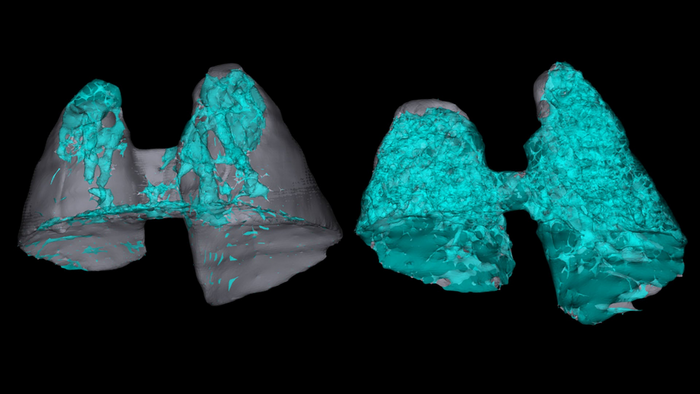
Credit: Tonks lab/CSHL, 2022
Neutrophils, the most abundant type of white blood cell, are the body’s first line of defense against infection. Foreign pathogens can stress the body and activate neutrophils. When activated, neutrophils employ various weapons to protect the body. But if overactivated, these weapons can damage the body’s own tissues. Lung tissue is saturated with blood vessels, making them very susceptible to neutrophil attacks. If severe enough, acute lung injuries can lead to acute respiratory distress syndrome (ARDS), the leading cause of death due to COVID-19.
Nicholas Tonks, Caryl Boies professor of cancer research at Cold Spring Harbor Laboratory (CSHL), and his team have found a drug candidate that can prevent lethal lung inflammation in mice by inhibiting a protein called PTP1B. Their discovery may help develop better treatments for severe inflammatory conditions like sepsis and COVID-19.
“When you think about COVID-19, acute lung injury and ARDS underlie the fatal aspects of the disease,” Tonks says. “And so, when the pandemic took hold, we were wondering whether there was anything we could do to help, to provide an understanding of this aspect of the disease and suggest ways it could be treated.”
Tonks’ graduate student Dongyan Song investigated whether using a PTP1B inhibitor drug candidate could dampen the lethal consequences of overactive neutrophils in mice. She found that pretreating mice with the PTP1B inhibitor reduced lung tissue damage. When untreated, less than half of the mice survived acute lung injuries and ARDS. But when pretreated, they all survived.
The researchers exploited a natural process, called neutrophil aging, that the body uses to control the immune cell’s lifespan. As they age, neutrophils become less dangerous. Tonks’ team discovered PTP1B inhibition speeds up neutrophil aging. “An aged neutrophil is like a soldier without a weapon,” Song explains. “So regardless of how many neutrophils flood an area, they won’t be able to do serious damage.”
This project was part of a program of COVID-related research at CSHL. Tonks says collaborations with CSHL Professor Mikala Egeblad, postdoc Jose M. Adrover, and CSHL Research Associate Professor Scott Lyons were essential to this discovery. Going forward, he and Song are working to increase the understanding of how PTP1B inhibitors affect the immune system. Tonks hopes his lab’s continued research leads to new treatments and preventative measures for various inflammatory diseases. His lab is currently working with DepYmed, Inc. to take PTP1B inhibitor drug candidates into clinical trials.
Tonks’ lab studies signal transduction, the process that controls how cells respond to signals from their environment. In particular, they focus on the PTP protein family, which Tonks discovered over 30 years ago. Since then, he’s sought to develop small molecule drug candidates that target these proteins, which can provide new approaches for treating major human diseases including cancer and metabolic and neurodegenerative diseases.
Journal
JCI Insight
DOI
10.1172/jci.insight.158199
Article Title
PTP1B inhibitors protect against acute lung injury and regulate CXCR4 signaling in neutrophils
Article Publication Date
22-Jul-2022