Many farmers battled extreme drought and heatwave conditions this year. The social and economic impacts of drought are nothing new. In fact, as Korea’s Joseon dynasty (1392-1910) was agrarian and highly reliant on the rice crops, the country was particularly sensitive to both droughts and torrential rains, making great efforts to minimize the damage.
Credit: POSTECH
Many farmers battled extreme drought and heatwave conditions this year. The social and economic impacts of drought are nothing new. In fact, as Korea’s Joseon dynasty (1392-1910) was agrarian and highly reliant on the rice crops, the country was particularly sensitive to both droughts and torrential rains, making great efforts to minimize the damage.
Professor Jonghun Kam (Environmental Science and Engineering) at POSTECH and Chang-Kyun Park, researcher at the Institute of Environment and Energy Technology, have developed a self-calibrating effective drought index (scEDI) through joint research. This new index enabled them to explore 250 years of drought data, starting from late Joseon dynasty to date, comparing and analyzing precipitation records.
The EDI, a typical tool to determine the severity of droughts, is designed to monitor and characterize drought conditions on a daily scale. The index uses the last 30 years of daily precipitation records. In other words, the reference period determines EDI values, making it difficult to compare values over a long record period.
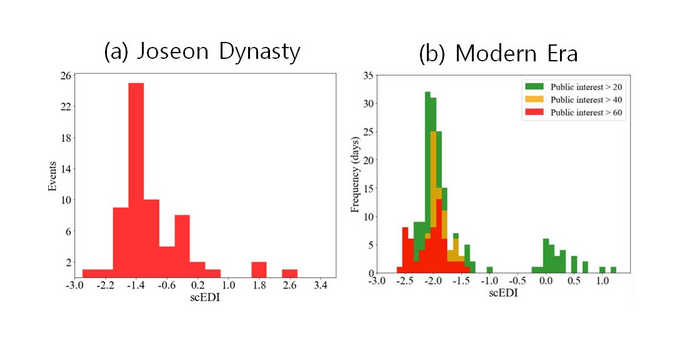
Professor Kam’s research team is the first to propose a self-calibrating EDI and use it to analyze the daily precipitation observed in Seoul from year 1777 through 2020. The scEDI that automatically calibrates the index behavior over time can maintain consistency in comparison by evaluating droughts of the same intensity and frequency.
Notably, this research employed the historical records of the Annals of the Joseon Dynasty (Joseon Wangjo Sillok) and daily precipitation data measured with Joseon’s rain gauge (chukwookee). The study demonstrated the value of unprecedentedly meticulous records left by the Koreans from that period.
The comparison between the records from Joseon era and the online search results of today implies that our predecessors were more sensitive to drought. Most drought damage records and spikes of public interest in droughts coincide with when droughts are moderate (-1.4 of scEDI) and severe (-2.0), respectively.
The findings infer that socioeconomic drought impacts hinge on the socioeconomic structure. As a valuable tool to quantitatively assess drought impacts, the scEDI has the potential to identify droughts with social consequences in advance.
Professor Kam explained, “The scEDI proposed in this study features automatic calibration corresponding to the climate of the reference period, enabling temporal detection and comparison of droughts (in terms of severity, duration, and intensity). This suggests a new research methodology for social droughts, which have been difficult to study in comparison with other drought-related categories: meteorological, agricultural, and hydrological.” He added, “Understanding both the social impacts of droughts and how they have been addressed will provide the Korean public with action plans to be prepared for future droughts in advance.”
Recently published in the Journal of Hydrology, the study was supported by the National Research Foundation of Korea (Sejong Science Fellowship Program and Mid-career Researcher Program) and the National Disaster Management Research Institute (Cooperative Research Method and Safety Management Technology in National Disaster).
Journal
Journal of Hydrology
DOI
10.1016/j.jhydrol.2022.128357
Article Title
A self-calibrating effective drought index (scEDI): Evaluation against social drought impact records over the Korean Peninsula (1777–2020)
Article Publication Date
28-Aug-2022