• HOME
  • NEWS
  • EXPLORE
    • CAREER
      • Companies
      • Jobs
    • EVENTS
    • iGEM
      • News
      • Team
    • PHOTOS
    • VIDEO
    • WIKI
  • BLOG
  • COMMUNITY
    • FACEBOOK
    • INSTAGRAM
    • TWITTER
Saturday, February 7, 2026
BIOENGINEER.ORG
No Result
View All Result
  • Login
  • HOME
  • NEWS
  • EXPLORE
    • CAREER
      • Companies
      • Jobs
        • Lecturer
        • PhD Studentship
        • Postdoc
        • Research Assistant
    • EVENTS
    • iGEM
      • News
      • Team
    • PHOTOS
    • VIDEO
    • WIKI
  • BLOG
  • COMMUNITY
    • FACEBOOK
    • INSTAGRAM
    • TWITTER
  • HOME
  • NEWS
  • EXPLORE
    • CAREER
      • Companies
      • Jobs
        • Lecturer
        • PhD Studentship
        • Postdoc
        • Research Assistant
    • EVENTS
    • iGEM
      • News
      • Team
    • PHOTOS
    • VIDEO
    • WIKI
  • BLOG
  • COMMUNITY
    • FACEBOOK
    • INSTAGRAM
    • TWITTER
No Result
View All Result
Bioengineer.org
No Result
View All Result
Home NEWS Science News Biology

Aged neurons generated directly from skin more accurately model Parkinson’s disease

Bioengineer by Bioengineer
September 22, 2022
in Biology
Reading Time: 2 mins read
0
Induced dopaminergic neurons
Share on FacebookShare on TwitterShare on LinkedinShare on RedditShare on Telegram

The possibility to make virtually all cell types of the human body from induced pluripotent stem cells (iPSCs), which are embryonic-like cells generated from a patient’s skin in a process called reprogramming, has opened new avenues for disease modelling in the lab. However, one shortcoming of this technique is that the donor age-specific cellular features are erased during reprogramming, so that cells made from iPSCs typically resemble cells in the human embryo or fetus rather than cells in the adult or aged human individual. However, neurodegenerative diseases like Parkinson’s disease (PD) mainly affect older individuals and are therefore difficult to model with PSCs-derived neurons, which lack many defining features of aged neurons.
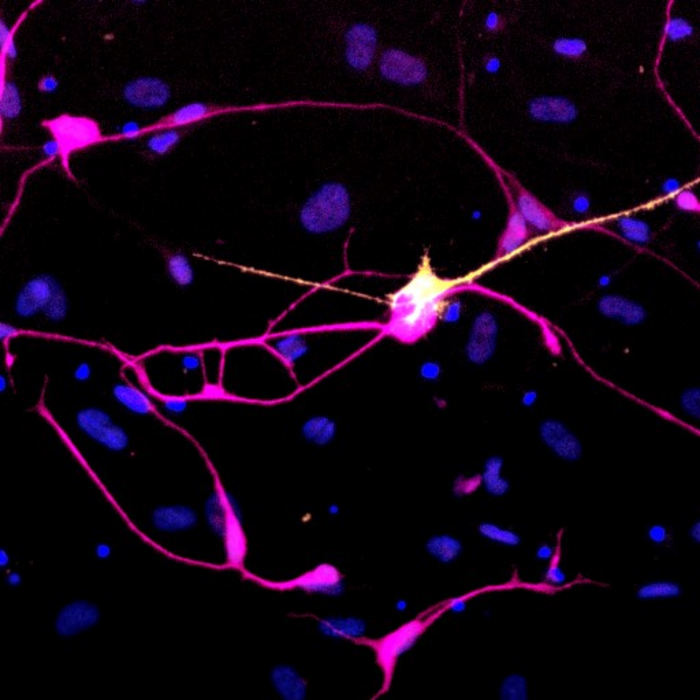
Induced dopaminergic neurons

Credit: Janelle Drouin-Ouellet, University of Montreal, Canada

The possibility to make virtually all cell types of the human body from induced pluripotent stem cells (iPSCs), which are embryonic-like cells generated from a patient’s skin in a process called reprogramming, has opened new avenues for disease modelling in the lab. However, one shortcoming of this technique is that the donor age-specific cellular features are erased during reprogramming, so that cells made from iPSCs typically resemble cells in the human embryo or fetus rather than cells in the adult or aged human individual. However, neurodegenerative diseases like Parkinson’s disease (PD) mainly affect older individuals and are therefore difficult to model with PSCs-derived neurons, which lack many defining features of aged neurons.

According to a recent report from Janelle Drouin-Ouellet (University of Montreal, Canada), Malin Parmar (University of Lund, Sweden) and colleagues in the journal Stem Cell Reports, one way of preserving the aged characteristics of neurons is to make them directly from the patient’s skin, without an iPSC intermediate. The researchers succeeded in turning skin cells from PD patients into so-called dopaminergic (DA) neurons, which are the type of neurons progressively lost in PD, by introducing a specific combination of neural-inducing genes into the skin cells. In contrast to the PD cells generated from iPS cells, this process of generating DA neurons directly from the skin cells preserved the aged genetic, epigenetic, and metabolic characteristics of the donor age. When compared to aged DA neurons from healthy skin donors, neurons from PD patients featured PD-specific cellular defects, which now could be modelled for the first time from sporadic PD patients which lack a known genetic mutation. With this new tool, the researchers hope to model PD-related neuronal defects from a much larger cohort of PD patients with the aim to identify identity causes of the disease as well as potential future therapies.


Journal

Stem Cell Reports

DOI

10.1016/j.stemcr.2022.08.010

Article Title

Age-related pathological impairments in directly reprogrammed dopaminergic neurons derived from patients with idiopathic Parkinson’s disease

Article Publication Date

22-Sep-2022

Share12Tweet8Share2ShareShareShare2

Related Posts

Florida Cane Toad: Complex Spread and Selective Evolution

Florida Cane Toad: Complex Spread and Selective Evolution

February 7, 2026
New Study Uncovers Mechanism Behind Burn Pit Particulate Matter–Induced Lung Inflammation

New Study Uncovers Mechanism Behind Burn Pit Particulate Matter–Induced Lung Inflammation

February 6, 2026

DeepBlastoid: Advancing Automated and Efficient Evaluation of Human Blastoids with Deep Learning

February 6, 2026

Navigating the Gut: The Role of Formic Acid in the Microbiome

February 6, 2026

POPULAR NEWS

  • Robotic Ureteral Reconstruction: A Novel Approach

    Robotic Ureteral Reconstruction: A Novel Approach

    82 shares
    Share 33 Tweet 21
  • Digital Privacy: Health Data Control in Incarceration

    63 shares
    Share 25 Tweet 16
  • Study Reveals Lipid Accumulation in ME/CFS Cells

    57 shares
    Share 23 Tweet 14
  • Breakthrough in RNA Research Accelerates Medical Innovations Timeline

    53 shares
    Share 21 Tweet 13

About

We bring you the latest biotechnology news from best research centers and universities around the world. Check our website.

Follow us

Recent News

Menopause Care: Insights from Workforce Review and Consultation

LRRK2R1627P Mutation Boosts Gut Inflammation, α-Synuclein

3D Gut-Brain-Vascular Model Reveals Disease Links

Subscribe to Blog via Email

Enter your email address to subscribe to this blog and receive notifications of new posts by email.

Join 73 other subscribers
  • Contact Us

Bioengineer.org © Copyright 2023 All Rights Reserved.

Welcome Back!

Login to your account below

Forgotten Password?

Retrieve your password

Please enter your username or email address to reset your password.

Log In
No Result
View All Result
  • Homepages
    • Home Page 1
    • Home Page 2
  • News
  • National
  • Business
  • Health
  • Lifestyle
  • Science

Bioengineer.org © Copyright 2023 All Rights Reserved.