• HOME
  • NEWS
  • EXPLORE
    • CAREER
      • Companies
      • Jobs
    • EVENTS
    • iGEM
      • News
      • Team
    • PHOTOS
    • VIDEO
    • WIKI
  • BLOG
  • COMMUNITY
    • FACEBOOK
    • INSTAGRAM
    • TWITTER
Saturday, February 7, 2026
BIOENGINEER.ORG
No Result
View All Result
  • Login
  • HOME
  • NEWS
  • EXPLORE
    • CAREER
      • Companies
      • Jobs
        • Lecturer
        • PhD Studentship
        • Postdoc
        • Research Assistant
    • EVENTS
    • iGEM
      • News
      • Team
    • PHOTOS
    • VIDEO
    • WIKI
  • BLOG
  • COMMUNITY
    • FACEBOOK
    • INSTAGRAM
    • TWITTER
  • HOME
  • NEWS
  • EXPLORE
    • CAREER
      • Companies
      • Jobs
        • Lecturer
        • PhD Studentship
        • Postdoc
        • Research Assistant
    • EVENTS
    • iGEM
      • News
      • Team
    • PHOTOS
    • VIDEO
    • WIKI
  • BLOG
  • COMMUNITY
    • FACEBOOK
    • INSTAGRAM
    • TWITTER
No Result
View All Result
Bioengineer.org
No Result
View All Result
Home NEWS Science News Biology

Neural network speeds holographic image reconstruction for biological samples

Bioengineer by Bioengineer
September 21, 2022
in Biology
Reading Time: 3 mins read
0
New end-to-end neural network called Fourier Imager Network (FIN) for rapid phase recovery and hologram reconstruction that achieves superior generalization to unseen sample types over the existing deep learning methods.
Share on FacebookShare on TwitterShare on LinkedinShare on RedditShare on Telegram

ROCHESTER – Researchers have developed a new end-to-end neural network that can speed up the reconstruction of holographic images. Unlike other deep learning techniques, the approach can be used on samples not encountered during training, making it particularly useful for label-free holographic biomedical imaging.
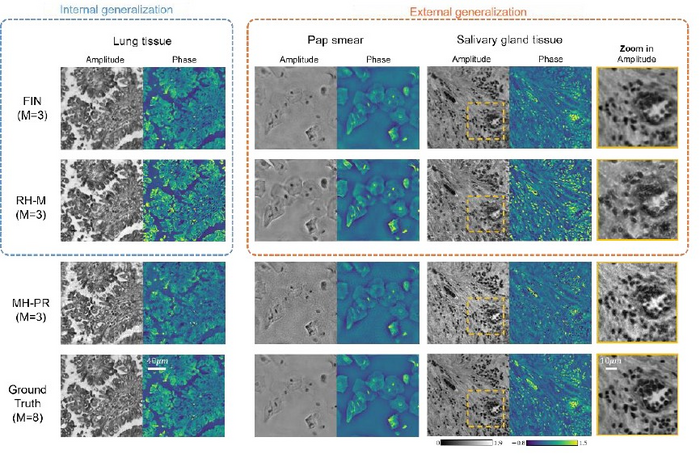
New end-to-end neural network called Fourier Imager Network (FIN) for rapid phase recovery and hologram reconstruction that achieves superior generalization to unseen sample types over the existing deep learning methods.

Credit: Hanlong Chen, UCLA

ROCHESTER – Researchers have developed a new end-to-end neural network that can speed up the reconstruction of holographic images. Unlike other deep learning techniques, the approach can be used on samples not encountered during training, making it particularly useful for label-free holographic biomedical imaging.

“With this framework, a well-trained neural network can be distributed anywhere, without finetuning, and perform rapid and high-quality holographic imaging of various samples,” explained research lead Hanlong Chen, University of California, Los Angeles (UCLA).

Hanlong Chen and Aydogan Ozcan will present the research at the Frontiers in Optics + Laser Science Conference (FiO LS) meeting being held in Rochester, New York and online 17 – 20 October 2022. The presentation is scheduled for Monday, 17 October at 16:30 EDT (UTC – 04:00).

A generalizable approach

Although various neural networks have been developed to achieve the data-heavy task of hologram reconstruction for biological research and biomedical applications, most of them are designed to be very specific. This means that they may not perform well if used with samples that differ from those initially used to train the network.

To solve this problem, Chen and colleagues developed an end-to-end neural network called Fourier Imager Network (FIN). This type of neural network is trained using a single model, bypassing some of the steps usually used by other deep learning methods. End-to-end neural networks are also faster and potentially more generalizable to a wide variety of samples.

Faster, more accurate results
The FIN framework takes a sequence of intensity-only raw holograms captured at different sample-to-sensor distances with a lens-free in-line holographic microscope and creates reconstructed images of the samples. To test the new approach, the researchers trained the network using lung tissue sections. They then used FIN to reconstruct holographic images of human salivary gland tissue and Pap smear samples not seen by the network during training.

FIN worked well on these new types of samples and delivered more accurately reconstructed images than an iterative algorithm and a state-of-the-art deep learning model. It also showed an approximately 50-fold improved speed compared to the deep learning model. The researchers say that these results demonstrate the strong external generalization of FIN while also showing the immense potential of building broadly generalizable deep neural networks for various microscopy and computational imaging tasks.

Chen added, “Our next step is to investigate autofocusing while retaining the benefits of our approach, such as superb image quality, unprecedented generalization to new types of samples, and enhanced computational speed, making holographic imaging possible with low-resource devices.”

About FiO+LS

Frontiers in Optics + Laser Science will be presented in a hybrid conference format comprised of in-person and virtual participation options. The meeting unites Optica (formerly OSA) and American Physical Society (APS) communities for quality, cutting-edge presentations, fascinating invited speakers and a variety of special events. The exhibit features leading optics and photonics companies and technology products. More information at https://www.frontiersinoptics.com.

Media Contact
[email protected]



Share12Tweet8Share2ShareShareShare2

Related Posts

Florida Cane Toad: Complex Spread and Selective Evolution

Florida Cane Toad: Complex Spread and Selective Evolution

February 7, 2026
New Study Uncovers Mechanism Behind Burn Pit Particulate Matter–Induced Lung Inflammation

New Study Uncovers Mechanism Behind Burn Pit Particulate Matter–Induced Lung Inflammation

February 6, 2026

DeepBlastoid: Advancing Automated and Efficient Evaluation of Human Blastoids with Deep Learning

February 6, 2026

Navigating the Gut: The Role of Formic Acid in the Microbiome

February 6, 2026

POPULAR NEWS

  • Robotic Ureteral Reconstruction: A Novel Approach

    Robotic Ureteral Reconstruction: A Novel Approach

    82 shares
    Share 33 Tweet 21
  • Digital Privacy: Health Data Control in Incarceration

    63 shares
    Share 25 Tweet 16
  • Study Reveals Lipid Accumulation in ME/CFS Cells

    57 shares
    Share 23 Tweet 14
  • Breakthrough in RNA Research Accelerates Medical Innovations Timeline

    53 shares
    Share 21 Tweet 13

About

We bring you the latest biotechnology news from best research centers and universities around the world. Check our website.

Follow us

Recent News

Personalized Guide to Understanding and Reducing Chemicals

Inflammasome Protein ASC Drives Pancreatic Cancer Metabolism

Phage-Antibiotic Combo Beats Resistant Peritoneal Infection

Subscribe to Blog via Email

Enter your email address to subscribe to this blog and receive notifications of new posts by email.

Join 73 other subscribers
  • Contact Us

Bioengineer.org © Copyright 2023 All Rights Reserved.

Welcome Back!

Login to your account below

Forgotten Password?

Retrieve your password

Please enter your username or email address to reset your password.

Log In
No Result
View All Result
  • Homepages
    • Home Page 1
    • Home Page 2
  • News
  • National
  • Business
  • Health
  • Lifestyle
  • Science

Bioengineer.org © Copyright 2023 All Rights Reserved.