Credit: ARS-USDA
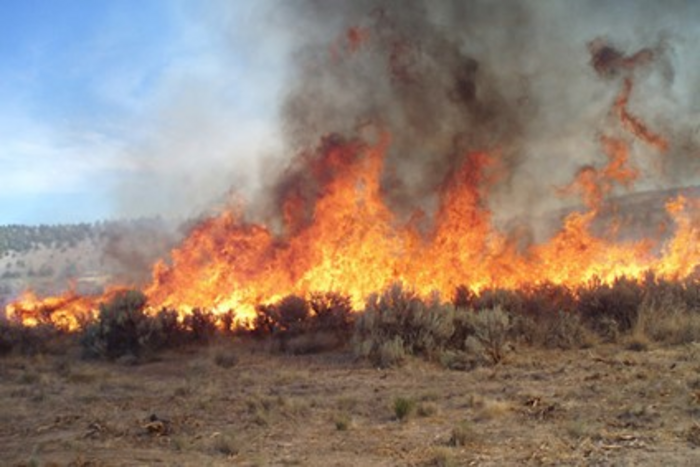
BURNS, OREGON, September 21, 2022—Scientists with the U.S. Department of Agriculture’s Agricultural Research Service (ARS) and the University of Montana have developed a way to forecast which of the Great Basin’s more than 60 million acres have the highest probability of a large rangeland fire. The forecasts come from a model developed by the researchers that combines measures of accumulated annual and perennial grass vegetation that is potential fire fuel with recent weather and climate data. When integrated, this information can be translated into maps showing the likelihood of a large wildfire—greater than 1,000 acres—across the Great Basin. These forecasts also can be scaled down to predict fire risk for counties or even single pastures. Great Basin rangeland fire probability maps for the rangeland fire season, roughly June through September, are posted on the Rangeland Analysis Platform. Two new research articles discussing details and utility of the new model are part of a special issue of Rangeland Ecology & Management. The first paper used vegetation data from the Rangeland Analysis Platform alongside historical fire data from the Monitoring Trends in Burn Severity dataset to build fire-prediction models for the Great Basin using 32 years of historical weather, vegetation, and fire data. The second paper extends the fire probability work from analysis into how practitioners can use this information to make decisions for the fire season. “Accurate forecasting of rangeland fires depends, in large part, on our ability to quantify the buildup of grassy fuels from the previous year,” explained rangeland scientist Chad S. Boyd with the ARS Range and Meadow Forage Management Research Unit in Burns, Oregon, and a co-leader in developing the model. Forest fires commonly only need an ignition event, such as a lightning strike, at most forest locations because they generally have enough vegetative fuels to burn every year. “But with rangeland fires, whether there is enough fuel to feed a large-scale fire really varies from place to place and year to year across the Great Basin,” Boyd added. Until recently, rangeland fire forecasting was limited by not having accurate measurements of how much annual and perennial grasses and forbs were produced each year. But satellite technology and remote sensing have made precise data readily accessible. Joe T. Smith, a research scientist with the University of Montana and model designer co-lead, said, “I was a little surprised that accumulation of herbaceous plants from the previous growing season was the best predictor of large range fires. This gives new emphasis to fighting the spread of fast-growing invasive annual grasses like cheatgrass in the Great Basin.” While woody shrubs and trees like juniper or pinyon-pine don’t really increase the odds of a large fire occurring, their place in the fire landscape still matters. Shrubs burn hotter, causing more extreme fire behavior that puts lives and property at risk and makes wildfires difficult to suppress. Unlike weather and topography, which are major influences over rangeland fires, people can directly and preemptively manage available fuel. These new fire probability maps will help land managers prioritize where it makes the most sense to invest in fuel management. “The maps can be used alongside other planning tools to decide where to focus limited resources before the fire season begins,” Boyd explained. “They also can help target annual efforts to reduce fine fuels like grasses, which can lessen the impacts of fire on the region’s wildlife and working lands.” For more information about the forecasting large rangeland in the Great Basin, check out https://www.sagegrouseinitiative.com/ask-an-expert-getting-ahead-of-large-rangeland-fires-in-the-great-basin/. The Agricultural Research Service is the U.S. Department of Agriculture’s chief scientific in-house research agency. Daily, ARS focuses on solutions to agricultural problems affecting America. Each dollar invested in U.S. agricultural research results in $20 of economic impact. |
Journal
Rangeland Ecology & Management
DOI
10.1016/j.rama.2022.07.005
Method of Research
Data/statistical analysis
Subject of Research
Not applicable
Article Title
Where There’s Smoke, There’s Fuel: Dynamic Vegetation Data Improve Predictions of Wildfire Hazard in the Great Basin
Article Publication Date
21-Sep-2022