UPTON, NY —James (Daniel) Brandenburg, a Goldhaber Distinguished Fellow uncovering clues about the makeup of visible matter at the U.S. Department of Energy’s (DOE) Brookhaven National Laboratory, has been named a 2022 Blavatnik Regional Awards for Young Scientists finalist.
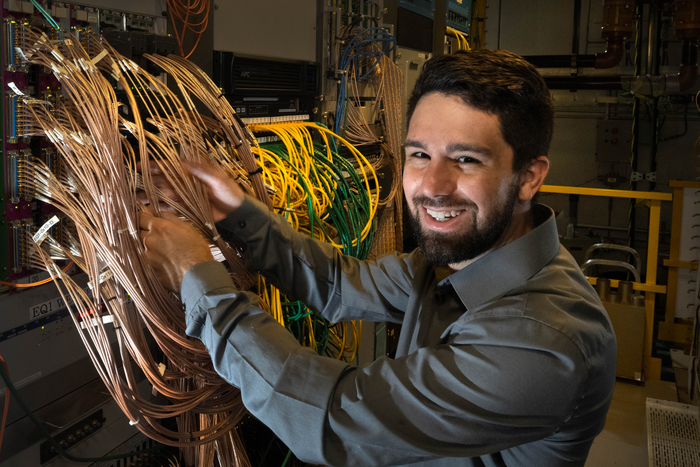
Credit: Brookhaven National Laboratory
UPTON, NY —James (Daniel) Brandenburg, a Goldhaber Distinguished Fellow uncovering clues about the makeup of visible matter at the U.S. Department of Energy’s (DOE) Brookhaven National Laboratory, has been named a 2022 Blavatnik Regional Awards for Young Scientists finalist.
The annual awards announced by the Blavatnik Family Foundation and the New York Academy of Sciences (NYAS) honor postdoctoral scientists from academic research institutions across New York, New Jersey, and Connecticut. Brandenburg will be honored at the 2022 NYAS Gala on November 14 and receive a $10,000 prize.
Among his achievements in experimental high-energy nuclear physics, Brandenburg is being recognized for his role in research that produced evidence of processes that had been predicted by scientists more than 80 years ago.
“Physicists have tried to convert light into matter for almost a century—to achieve the concept immortalized in Einstein’s famous equation, E=mc2,” Brandenburg said. “I found an unlikely approach with near misses in an atom smasher to finally make it possible.”
Brandenburg is a lead author on the recent discovery that demonstrated that pairs of electrons and positrons—particles of matter and antimatter—can be created directly by colliding particles of light, or “real photons.” This occurrence was predicted in 1934 by physicists Gregory Breit and John A. Wheeler, but the capabilities to demonstrate it didn’t exist at the time.
Fast forward to the Relativistic Heavy Ion Collider (RHIC)—a DOE Office of Science user facility for nuclear physics research at Brookhaven Lab. At RHIC, physicists collide particles at nearly the speed of light to reveal the properties of the building blocks of visible matter. By analyzing data captured by RHIC’s STAR detector, Brandenburg observed how matter is produced when photon “clouds” surrounding gold ions collide as the particles pass closely by one another while speeding in opposite directions.
Brandenburg also played a role in other major observations, including evidence of the birefringence effects in a vacuum. Scientists theorized decades ago that a vacuum of empty space could be polarized by a powerful magnetic field. Such a polarized field would deflect—or bend—the paths of photons in a way that depends on the photons’ own polarization. At RHIC, scientists measured how the polarization of the light affected whether the light was “absorbed” by the magnetic field.
Brandenburg joined Brookhaven Lab in 2018 as a postdoctoral research associate with Center for Frontiers in Nuclear Science. Since then, he’s developed software for the suite of detectors in the ongoing STAR forward upgrade project.
In 2020, Brandenburg was selected as a Goldhaber Distinguished Fellow—a prestigious fellowship award to scientists with exceptional talent and credentials who have a strong desire for independent research at the frontiers of their fields. He earned a bachelor’s degree in physics from the University of Florida and both his master’s degree and Ph.D. in heavy ion physics from Rice University. He received Elsevier’s Young Science Award for Best Experimental Talk at QuarkMatter 2019.
Brookhaven’s nuclear physics research at RHIC is supported by the DOE Office of Science (NP).
Brookhaven National Laboratory is supported by the Office of Science of the U.S. Department of Energy. The Office of Science is the single largest supporter of basic research in the physical sciences in the United States and is working to address some of the most pressing challenges of our time. For more information, please visit science.energy.gov.
Follow @BrookhavenLab on Twitter or find us on Facebook.
Related Links
- Brookhaven Lab press release: “Collisions of Light Produce Matter/Antimatter from Pure Energy”
- Scientific paper: “Measurement of e+e− Momentum and Angular Distributions from Linearly Polarized Photon Collisions”
- Scientific paper: “Mapping the electromagnetic fields of heavy-ion collisions with the Breit-Wheeler process”
- Scientific paper: “Initial transverse-momentum broadening of Breit-Wheeler process in relativistic heavy-ion collisions”