• HOME
  • NEWS
  • EXPLORE
    • CAREER
      • Companies
      • Jobs
    • EVENTS
    • iGEM
      • News
      • Team
    • PHOTOS
    • VIDEO
    • WIKI
  • BLOG
  • COMMUNITY
    • FACEBOOK
    • INSTAGRAM
    • TWITTER
Saturday, February 7, 2026
BIOENGINEER.ORG
No Result
View All Result
  • Login
  • HOME
  • NEWS
  • EXPLORE
    • CAREER
      • Companies
      • Jobs
        • Lecturer
        • PhD Studentship
        • Postdoc
        • Research Assistant
    • EVENTS
    • iGEM
      • News
      • Team
    • PHOTOS
    • VIDEO
    • WIKI
  • BLOG
  • COMMUNITY
    • FACEBOOK
    • INSTAGRAM
    • TWITTER
  • HOME
  • NEWS
  • EXPLORE
    • CAREER
      • Companies
      • Jobs
        • Lecturer
        • PhD Studentship
        • Postdoc
        • Research Assistant
    • EVENTS
    • iGEM
      • News
      • Team
    • PHOTOS
    • VIDEO
    • WIKI
  • BLOG
  • COMMUNITY
    • FACEBOOK
    • INSTAGRAM
    • TWITTER
No Result
View All Result
Bioengineer.org
No Result
View All Result
Home NEWS Science News Chemistry

Titanium hosts record high superconductivity for elements superconductors

Bioengineer by Bioengineer
September 19, 2022
in Chemistry
Reading Time: 2 mins read
0
Titanium Breaks Record of Tc for Element Superconductors
Share on FacebookShare on TwitterShare on LinkedinShare on RedditShare on Telegram

    Element superconductors are important either for superconducting mechanism studies or for potential applications because of the single composition. However element superconductor (SC) usually show very low transition temperature (Tc) typically below 10K. Recently Prof. Changqing Jin’s team at IOPCAS discovered Ti metal to be superconductive with Tc above 26K at high pressures: the record high for element superconductors so far.
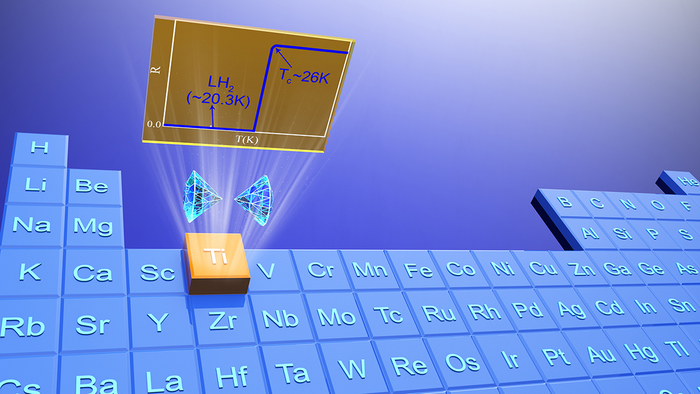
Titanium Breaks Record of Tc for Element Superconductors

Credit: Changqing JIN

    Element superconductors are important either for superconducting mechanism studies or for potential applications because of the single composition. However element superconductor (SC) usually show very low transition temperature (Tc) typically below 10K. Recently Prof. Changqing Jin’s team at IOPCAS discovered Ti metal to be superconductive with Tc above 26K at high pressures: the record high for element superconductors so far.

    They found that Ti metal keeps superconductive with Tc above 20 K in a wide pressure range from 150 to 310 GPa while maximum 26.2 K Tc is achieved at 248 GPa. The 310 GPa is also the highest pressure that superconductivity can sustain for all known superconductors. They indicated that 4s orbital derived bands are moved up to Fermi level by pressure that causes the density of state near Fermi level is controlled by 3d electrons at high pressures. “The high temperature superconductivity is proposed to be closely related to the 3d electrons that usually demonstrate electron correlation interaction.”addressed Changqing JIN. They also estimated the upper critical magnetic field “the Hc2 is ~30 Tesla that corresponds to a GL coherent length ~32 Å.” commented Prof. Xiancheng Wang who is the coauthor of the paper. Both Tc and upper critical magnetic field of Ti SC at high pressure are notably doubled higher than those of widely used superconducting NbTi alloy (Tc~9.6 K,Hc2~ 15 Tesla), promising for potential applications at extreme environments. From the discovery it seems high Tc SC can be achieved in elemental metals or compounds with simple components via the joint of electron phonon coupling and electron correlations, and such simple materials are more adaptive and suitable for applications in diverse and demanding implementation settings. The titanium (Ti) metal has been widely used in aerospace, ocean, deep earth environments due to its unique properties of light weight, high strength and corrosion resistance. The record high Tc superconductivity at high pressure marks Ti one more excellent trait. It can be of potential applications at extreme conductions.

   The work has been published in Nature Communication 13, 5411(2022) recently. The work is supported by NSF, MOST and CAS of China through research projects.


Journal

Nature Communications

DOI

10.1038/s41467-022-33077-3

Method of Research

Experimental study

Subject of Research

Not applicable

Article Title

Record High Temperature Elemental Superconductivity Achieved inTitanium

Article Publication Date

19-Sep-2022

Share12Tweet8Share2ShareShareShare2

Related Posts

blank

Breakthrough in Environmental Cleanup: Scientists Develop Solar-Activated Biochar for Faster Remediation

February 7, 2026
blank

Cutting Costs: Making Hydrogen Fuel Cells More Affordable

February 6, 2026

Scientists Develop Hand-Held “Levitating” Time Crystals

February 6, 2026

Observing a Key Green-Energy Catalyst Dissolve Atom by Atom

February 6, 2026

POPULAR NEWS

  • Robotic Ureteral Reconstruction: A Novel Approach

    Robotic Ureteral Reconstruction: A Novel Approach

    82 shares
    Share 33 Tweet 21
  • Digital Privacy: Health Data Control in Incarceration

    63 shares
    Share 25 Tweet 16
  • Study Reveals Lipid Accumulation in ME/CFS Cells

    57 shares
    Share 23 Tweet 14
  • Breakthrough in RNA Research Accelerates Medical Innovations Timeline

    53 shares
    Share 21 Tweet 13

About

We bring you the latest biotechnology news from best research centers and universities around the world. Check our website.

Follow us

Recent News

Evaluating Pediatric Emergency Care Quality in Ethiopia

TPMT Expression Predictions Linked to Azathioprine Side Effects

Improving Dementia Care with Enhanced Activity Kits

Subscribe to Blog via Email

Enter your email address to subscribe to this blog and receive notifications of new posts by email.

Join 73 other subscribers
  • Contact Us

Bioengineer.org © Copyright 2023 All Rights Reserved.

Welcome Back!

Login to your account below

Forgotten Password?

Retrieve your password

Please enter your username or email address to reset your password.

Log In
No Result
View All Result
  • Homepages
    • Home Page 1
    • Home Page 2
  • News
  • National
  • Business
  • Health
  • Lifestyle
  • Science

Bioengineer.org © Copyright 2023 All Rights Reserved.