

• HOME
  • NEWS
  • EXPLORE
    • CAREER
      • Companies
      • Jobs
    • EVENTS
    • iGEM
      • News
      • Team
    • PHOTOS
    • VIDEO
    • WIKI
  • BLOG
  • COMMUNITY
    • FACEBOOK
    • INSTAGRAM
    • TWITTER
Saturday, February 7, 2026
BIOENGINEER.ORG
No Result
View All Result
  • Login
  • HOME
  • NEWS
  • EXPLORE
    • CAREER
      • Companies
      • Jobs
        • Lecturer
        • PhD Studentship
        • Postdoc
        • Research Assistant
    • EVENTS
    • iGEM
      • News
      • Team
    • PHOTOS
    • VIDEO
    • WIKI
  • BLOG
  • COMMUNITY
    • FACEBOOK
    • INSTAGRAM
    • TWITTER
  • HOME
  • NEWS
  • EXPLORE
    • CAREER
      • Companies
      • Jobs
        • Lecturer
        • PhD Studentship
        • Postdoc
        • Research Assistant
    • EVENTS
    • iGEM
      • News
      • Team
    • PHOTOS
    • VIDEO
    • WIKI
  • BLOG
  • COMMUNITY
    • FACEBOOK
    • INSTAGRAM
    • TWITTER
No Result
View All Result
Bioengineer.org
No Result
View All Result
Home NEWS Science News

Summer is the season of caution: Extreme heat events mean higher risk for diabetics

Bioengineer by Bioengineer
September 12, 2022
in Science News
Reading Time: 2 mins read
0
The non-linear associations between ambient temperature and hospitalization for hyperglycemic emergencies and hypoglycemic emergency over 0-3 lag days in Japan, 2012-2019
Share on FacebookShare on TwitterShare on LinkedinShare on RedditShare on Telegram

In extreme heat events, people with diabetes had a greater risk of being hospitalized for complications related to hypo- or hyperglycemia (i.e., low or high blood glucose levels)
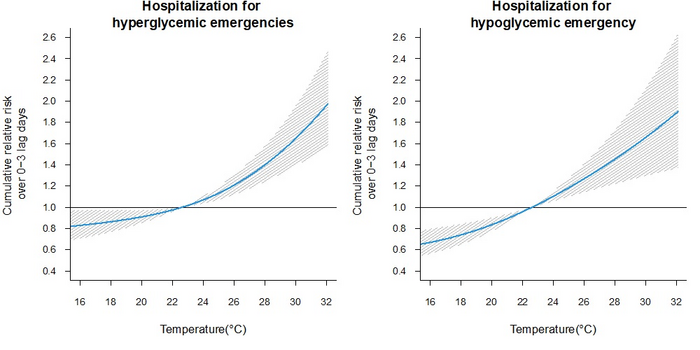
The non-linear associations between ambient temperature and hospitalization for hyperglycemic emergencies and hypoglycemic emergency over 0-3 lag days in Japan, 2012-2019

Credit: Department of Global Health Promotion, TMDU

In extreme heat events, people with diabetes had a greater risk of being hospitalized for complications related to hypo- or hyperglycemia (i.e., low or high blood glucose levels)

Tokyo, Japan—The global effects of climate change have been demonstrated to extend beyond the environment to many other areas including human health, particularly with respect to different health conditions. People with diabetes are at higher risk of requiring hospitalization during a series of unusually hot days (termed ‘extreme heat events’), as the body is more likely to become dehydrated and have difficulty balancing the concentration of components in the blood. Now, researchers in Japan have revealed an additional risk for people with this condition by identifying a link between extreme heat events and the likelihood of hypo- and hyperglycemia–related emergency hospitalizations.

“It is important that the physiological implications of extreme heat on individuals with metabolic disorders, such as diabetes, are well understood,” explains first author Keitaro Miyamura of Tokyo Medical and Dental University (TMDU). “This can be accomplished by examining outcomes in relation to extreme heat events and using a sophisticated model that accounts for the fact that ultimate effects may occur after heat events.” 

To do this, the research team applied a distributed lag non-linear model (a model for estimating exposure-time-response function) to a dataset consisting of nationwide data for hypo- and hyperglycemia–related emergency hospital admissions from 2012–2019, as well as ambient temperature data from weather stations in each prefecture. Relative risk was determined for 2 levels of heat events (standard and extreme). “Relative risks for standard and extreme heat effect on emergency hospitalization for hypoglycemia were found to be 1.33 and 1.65, respectively, and similar risks were found for hyperglycemia. In most regions, the higher the temperature, the higher the relative risk,” says lead author Takeo Fujiwara.

The model, which took into account a time delay of up to 3 days, showed that the impacts of climate change on health may not always be obvious. These findings will contribute to providing policymakers with information about subtle or latent health effects that may need to be taken into consideration in environmental or health care policies. This is particularly important since the effects of climate change will only increase in the foreseeable future.

###

The article, “Association between heat exposure and hospitalization for diabetic ketoacidosis, hyperosmolar hyperglycemic state, and hypoglycemia in Japan,” was published in Environment International at DOI: 10.1016/j.envint.2022.107410


Journal

Environment International

DOI

10.1016/j.envint.2022.107410

Article Title

Association between heat exposure and hospitalization for diabetic ketoacidosis, hyperosmolar hyperglycemic state, and hypoglycemia in Japan

Share12Tweet8Share2ShareShareShare2

Related Posts

Phage-Antibiotic Combo Beats Resistant Peritoneal Infection

February 7, 2026

Boosting Remote Healthcare: Stepped-Wedge Trial Insights

February 7, 2026

Barriers and Boosters of Seniors’ Physical Activity in Karachi

February 7, 2026

Evaluating Pediatric Emergency Care Quality in Ethiopia

February 7, 2026

POPULAR NEWS

  • Robotic Ureteral Reconstruction: A Novel Approach

    Robotic Ureteral Reconstruction: A Novel Approach

    82 shares
    Share 33 Tweet 21
  • Digital Privacy: Health Data Control in Incarceration

    63 shares
    Share 25 Tweet 16
  • Study Reveals Lipid Accumulation in ME/CFS Cells

    57 shares
    Share 23 Tweet 14
  • Breakthrough in RNA Research Accelerates Medical Innovations Timeline

    53 shares
    Share 21 Tweet 13

About

We bring you the latest biotechnology news from best research centers and universities around the world. Check our website.

Follow us

Recent News

Phage-Antibiotic Combo Beats Resistant Peritoneal Infection

Boosting Remote Healthcare: Stepped-Wedge Trial Insights

Barriers and Boosters of Seniors’ Physical Activity in Karachi

Subscribe to Blog via Email

Enter your email address to subscribe to this blog and receive notifications of new posts by email.

Join 73 other subscribers
  • Contact Us

Bioengineer.org © Copyright 2023 All Rights Reserved.

Welcome Back!

Login to your account below

Forgotten Password?

Retrieve your password

Please enter your username or email address to reset your password.

Log In
No Result
View All Result
  • Homepages
    • Home Page 1
    • Home Page 2
  • News
  • National
  • Business
  • Health
  • Lifestyle
  • Science

Bioengineer.org © Copyright 2023 All Rights Reserved.
