Researchers at Aalto University have developed a bio-based adhesive that can replace formaldehyde-containing adhesives in wood construction. The main raw material in the new adhesive is lignin, a structural component of wood and a by-product of the pulp industry that is usually burned after wood is processed. As an alternative to formaldehyde, lignin offers a healthier and more carbon-friendly way to use wood in construction.
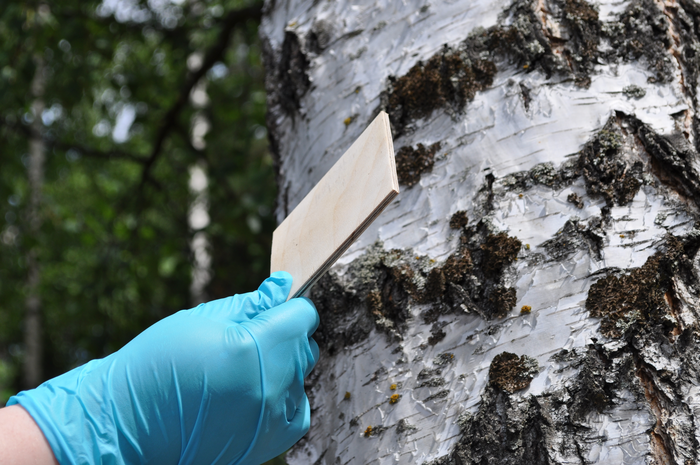
Credit: Aalto Univeristy
Researchers at Aalto University have developed a bio-based adhesive that can replace formaldehyde-containing adhesives in wood construction. The main raw material in the new adhesive is lignin, a structural component of wood and a by-product of the pulp industry that is usually burned after wood is processed. As an alternative to formaldehyde, lignin offers a healthier and more carbon-friendly way to use wood in construction.
The carbon footprint of timber construction is significantly lower than concrete construction, and timber construction has often been viewed as better for the health of human occupants as well. However, wood panels still use adhesives made from fossil raw materials. They contain formaldehyde, which can be harmful to health, especially for those working in the adhesive manufacturing process. People living in or visiting buildings can also be exposed to toxic formaldehyde from wood panels.
Lignin, on the other hand, comes from wood itself. It binds cellulose and hemicellulose together and gives wood its tough, strong structure. Lignin accounts for about a quarter of the weight of wood and is produced in huge quantities in the pulp and bioprocessing industry. Only two to five percent of the lignin produced is used, and the rest is burned in factories for energy.
Previously, lengthy and chemical-intensive pre-treatments have been necessary to use lignin in formaldehyde-free adhesives. The adhesive developed by Aalto University researchers can use purified kraft lignin and the chemical reaction to make the adhesive takes a few minutes instead of up to 10 hours. No additional heating of the raw material is needed, which reduces energy consumption. The only by-products of the process are salt and sodium hydroxide, or lye.
Monika Österberg, professor at the Aalto University School of Chemical Engineering, stresses that this is an important development for both the environment and industry. ‘Using lignin as a material can reduce carbon dioxide emissions and increase the processing value of forests. This is why research on lignin is an important priority for us at Aalto University.’
Doctoral researcher Alexander Henn explains that glued wood panels such as plywood and chipboard are increasingly used for walls, ceilings and flooring. ‘Therefore, it is important to overcome the disadvantages of wood-based panel adhesives and develop the new innovation into a commercial product. This would enable a shift towards more wood-based construction, as a strong and heat-resistant adhesive made from natural materials makes construction truly ecological and safe.’
The innovation is a major step forward for the forestry and glue industries, as the lignin content of previous adhesives has been relatively low (around 20-50 percent), while the new Aalto University innovation has a lignin content of over 90 percent. The adhesive is strong and non-toxic, and protects surfaces from fire, so it can even be used as a flame retardant.
According to the researchers, lignin can also be used as a raw material for applications such as coatings and composites. Research work will continue in the laboratory, and various commercialization opportunities are likely to be explored in collaboration with LignoSphere Oy, a spin-off from Aalto University.
This research was published in August 2022 in the journal Green Chemistry.
DOI
10.1039/D2GC01637K