• HOME
  • NEWS
  • EXPLORE
    • CAREER
      • Companies
      • Jobs
    • EVENTS
    • iGEM
      • News
      • Team
    • PHOTOS
    • VIDEO
    • WIKI
  • BLOG
  • COMMUNITY
    • FACEBOOK
    • INSTAGRAM
    • TWITTER
Tuesday, May 5, 2026
BIOENGINEER.ORG
No Result
View All Result
  • Login
  • HOME
  • NEWS
  • EXPLORE
    • CAREER
      • Companies
      • Jobs
        • Lecturer
        • PhD Studentship
        • Postdoc
        • Research Assistant
    • EVENTS
    • iGEM
      • News
      • Team
    • PHOTOS
    • VIDEO
    • WIKI
  • BLOG
  • COMMUNITY
    • FACEBOOK
    • INSTAGRAM
    • TWITTER
  • HOME
  • NEWS
  • EXPLORE
    • CAREER
      • Companies
      • Jobs
        • Lecturer
        • PhD Studentship
        • Postdoc
        • Research Assistant
    • EVENTS
    • iGEM
      • News
      • Team
    • PHOTOS
    • VIDEO
    • WIKI
  • BLOG
  • COMMUNITY
    • FACEBOOK
    • INSTAGRAM
    • TWITTER
No Result
View All Result
Bioengineer.org
No Result
View All Result
Home NEWS Science News Chemistry

High performance solid-state thermoelectric energy conversion via inorganic metal halide perovskites under tailored mechanical deformation

Bioengineer by Bioengineer
August 22, 2022
in Chemistry
Reading Time: 2 mins read
0
High performance solid-state thermoelectric energy conversion via inorganic metal halide perovskites under tailored mechanical deformation
Share on FacebookShare on TwitterShare on LinkedinShare on RedditShare on Telegram

Solid-state thermoelectric energy conversion devices attract broad research interests because they show great promises in waste heat recycling, space power generation, deep water power generation, and temperature control, but the search for the essential thermoelectric materials with high performance remains challenging.
High performance solid-state thermoelectric energy conversion via inorganic metal halide perovskites under tailored mechanical deformation

Credit: HIGHER EDUCATION PRESS LIMITED COMPANY

Solid-state thermoelectric energy conversion devices attract broad research interests because they show great promises in waste heat recycling, space power generation, deep water power generation, and temperature control, but the search for the essential thermoelectric materials with high performance remains challenging.

A research group of Lingling Zhao from Southeast University and Shangchao Lin from Shanghai Jiao Tong University just investigated inorganic metal halide perovskites CsPb(I1–xBrx)3 under mechanical deformation systematically using the first-principle calculations and the Boltzmann transport theory. They demonstrate that intrinsic strains can be introduced into thermoelectric devices under mechanical deformation, which opens up a new technical approach for improving the stability and thermoelectric performance of perovskite materials.

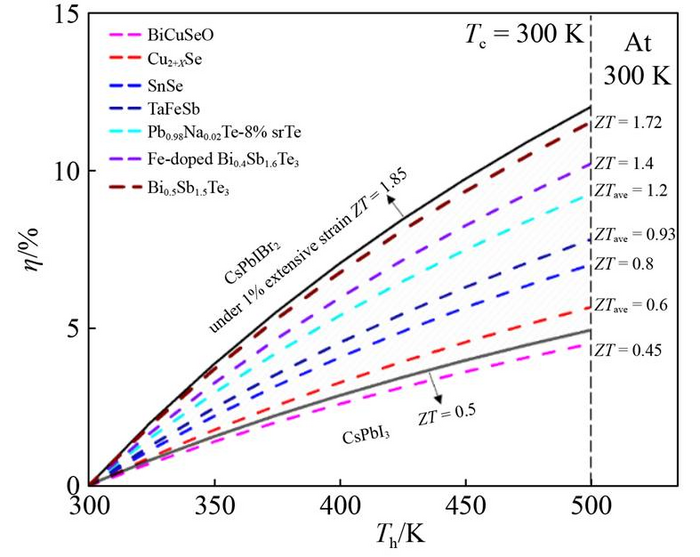
Halogen mixing and mechanical deformation are efficient methods to tailor the electronic structures and charge transport properties in CsPb(I1–xBrx)3 synergistically. The strain effect is related to the energy level shift of the electronic band structure CBM of perovskite. The power generation efficiency of the thermoelectric device can reach as high as approximately 12% using mixed halide perovskites under tailored mechanical deformation when the heat-source is at 500 K and the cold side is maintained at 300 K, surpassing the performance of many existing bulk thermoelectric materials.

This study can provide theoretical guidance for the transport performance regulation of perovskite and the performance improvement of thermoelectric devices.


Journal

Frontiers in Energy

DOI

10.1007/s11708-022-0831-y

Method of Research

Experimental study

Subject of Research

Not applicable

Article Title

High performance solid-state thermoelectric energy conversion via inorganic metal halide perovskites under tailored mechanical deformation

Article Publication Date

19-Jul-2022

Share12Tweet8Share2ShareShareShare2

Related Posts

How Lasers Quickly Magnetize Fusion Plasmas: A Breakthrough in Fusion Science — Chemistry

How Lasers Quickly Magnetize Fusion Plasmas: A Breakthrough in Fusion Science

May 5, 2026
CityUHK Physicist Uncovers How Magnetic Fields Reactivate Superconductivity in Nickelates — Chemistry

CityUHK Physicist Uncovers How Magnetic Fields Reactivate Superconductivity in Nickelates

May 5, 2026

Quantum Algorithms Revolutionize Surface Coating Technologies

May 5, 2026

Here’s a rewritten version of the headline for a science magazine post: “A Simple Model Explaining How AI Learns” Or, if you want it a bit more engaging: “Understanding AI Learning Through a Toy Model” Let me know if you want it shorter, more technical, or more casual!

May 5, 2026

POPULAR NEWS

  • Research Indicates Potential Connection Between Prenatal Medication Exposure and Elevated Autism Risk

    835 shares
    Share 334 Tweet 209
  • New Study Reveals Plants Can Detect the Sound of Rain

    720 shares
    Share 288 Tweet 180
  • Scientists Investigate Possible Connection Between COVID-19 and Increased Lung Cancer Risk

    67 shares
    Share 27 Tweet 17
  • Salmonella Haem Blocks Macrophages, Boosts Infection

    61 shares
    Share 24 Tweet 15

About

We bring you the latest biotechnology news from best research centers and universities around the world. Check our website.

Follow us

Recent News

Multi-Trait Scores Boost Atrial Fibrillation Prediction

How Lasers Quickly Magnetize Fusion Plasmas: A Breakthrough in Fusion Science

CityUHK Physicist Uncovers How Magnetic Fields Reactivate Superconductivity in Nickelates

Subscribe to Blog via Email

Enter your email address to subscribe to this blog and receive notifications of new posts by email.

Join 82 other subscribers
  • Contact Us

Bioengineer.org © Copyright 2023 All Rights Reserved.

Welcome Back!

Login to your account below

Forgotten Password?

Retrieve your password

Please enter your username or email address to reset your password.

Log In
No Result
View All Result
  • Homepages
    • Home Page 1
    • Home Page 2
  • News
  • National
  • Business
  • Health
  • Lifestyle
  • Science

Bioengineer.org © Copyright 2023 All Rights Reserved.