BIRMINGHAM, Ala. – The National Institutes of Health has awarded a five-year, $11.2 million program project grant, or PPG, to Jianyi “Jay” Zhang, M.D., Ph.D., and colleagues to study how to restore the dead tissue from a heart attack, through the growth of new heart muscle cells.
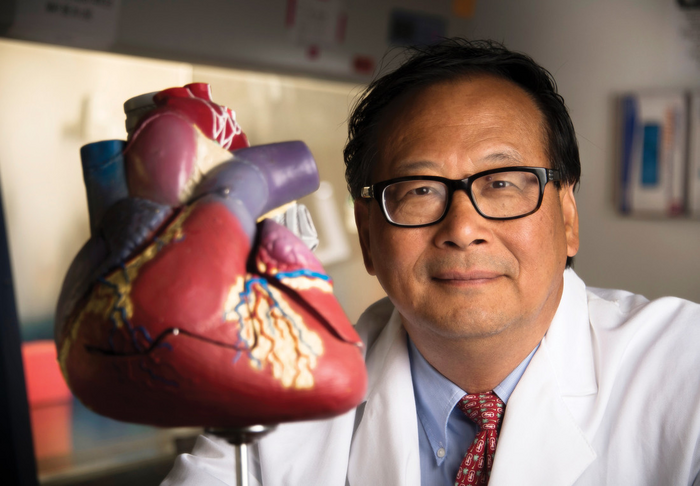
Credit: UAB
BIRMINGHAM, Ala. – The National Institutes of Health has awarded a five-year, $11.2 million program project grant, or PPG, to Jianyi “Jay” Zhang, M.D., Ph.D., and colleagues to study how to restore the dead tissue from a heart attack, through the growth of new heart muscle cells.
That is a challenge because mammalian hearts show almost no ability to grow new heart muscle cells, called cardiomyocytes, after birth. After a heart attack from a blocked artery, the dead tissue is not repaired with new cardiomyocytes. Instead, it is replaced with scar tissue that weakens the pumping power of the heart and often leads to heart failure.
A surprising discovery by Zhang and colleagues — an experimental procedure that allowed heart muscle cell growth to be extended past birth — opened the door to the new research.
“Recent preliminary studies from our laboratories using neonatal pigs have shown that, when a myocardial infarction is induced on postnatal day 1, or P1, cardiomyocytes reenter the cell cycle, proliferate and completely restore cardiac function with little scarring,” said Zhang, chair of University of Alabama at Birmingham Department of Biomedical Engineering. “Furthermore, we have found that these neonatal hearts with the P1 injury have a very active and prolonged cardiomyocyte proliferative machinery, and consequently a second left anterior descending artery ligation injury at P28 produced no visible infarct, four weeks following injury.
“This was a remarkable result, as it demonstrated, for the first time, that a heart of a large mammal could remuscularize infarcted heart tissue by cardiomyocyte proliferation.”
The researchers at UAB and two other universities now plan to build on this discovery through three projects. Together, the projects aim to find key pathways that allow reprogramming of adult heart muscle cells and endothelial cells, so they reenter the cell cycle and proliferate in response to a heart attack.
The first project will be led by Zhang. Its goals are first to identify the cardiomyocyte cell-cycle regulators; and second, by using the novel biotechnologies developed in Zhang’s lab, to target these regulators for the purpose of making the cardiomyocytes reenter the cell cycle and proliferate, thereby remuscularizing the tissue injured during a heart attack. The findings from the large-mammal cardiac muscle regeneration will have unprecedented clinically relevant dimensions. In addition, the first project will also generate novel muscle patches made from layers of proliferating human induced pluripotent stem cells, which have activated cell-cycle regulators, and layers of other cardiac cells. Later experiments will test whether the identified factors and the patches can remuscularize the hearts of adult pigs after a heart attack.
The second project, led by Daniel J. Garry, M.D., Ph.D., University of Minnesota Medical School, will investigate whether certain effectors of the Sonic Hedgehog developmental pathway — which have already been shown to induce proliferation in cultured cardiomyocytes — will also be able to promote cardiomyocyte proliferation in the injured hearts of adult mice and pigs.
The third project, led by Hesham Sadek, M.D., Ph.D., University of Texas Southwestern Medical Center, Dallas, looks at the intriguing hypothesis that selective utilization of proline metabolism promotes the survival of heart ventricular myocytes and proliferation under conditions of low oxygen. That hypothesis stems from the observations that that the mammalian cell-cycle arrest in heart muscle cells is partially induced by the increase in oxygen metabolism that occurs after birth, and that severe systemic hypoxia upregulates proline metabolism and induces cardiomyocyte proliferation in adult mice.
In addition to the three projects, the grant will also fund an administrative core and a large animal core at UAB, and a bioinformatics core at the University of Minnesota Medical School.
The multi-institution National Heart, Lung, and Blood Institute grant is titled, “Mechanisms that govern cardiomyocyte proliferation and remuscularization following ventricular injury.”
At UAB, Biomedical Engineering is a joint department of the Marnix E. Heersink School of Medicine and the UAB School of Engineering, and Zhang holds the T. Michael and Gillian Goodrich Endowed Chair of Engineering Leadership. Since Zhang came to UAB in 2015, the Department of Biomedical Engineering has grown to rank fourth nationally in NIH research funding.