• HOME
  • NEWS
  • EXPLORE
    • CAREER
      • Companies
      • Jobs
    • EVENTS
    • iGEM
      • News
      • Team
    • PHOTOS
    • VIDEO
    • WIKI
  • BLOG
  • COMMUNITY
    • FACEBOOK
    • INSTAGRAM
    • TWITTER
Saturday, February 7, 2026
BIOENGINEER.ORG
No Result
View All Result
  • Login
  • HOME
  • NEWS
  • EXPLORE
    • CAREER
      • Companies
      • Jobs
        • Lecturer
        • PhD Studentship
        • Postdoc
        • Research Assistant
    • EVENTS
    • iGEM
      • News
      • Team
    • PHOTOS
    • VIDEO
    • WIKI
  • BLOG
  • COMMUNITY
    • FACEBOOK
    • INSTAGRAM
    • TWITTER
  • HOME
  • NEWS
  • EXPLORE
    • CAREER
      • Companies
      • Jobs
        • Lecturer
        • PhD Studentship
        • Postdoc
        • Research Assistant
    • EVENTS
    • iGEM
      • News
      • Team
    • PHOTOS
    • VIDEO
    • WIKI
  • BLOG
  • COMMUNITY
    • FACEBOOK
    • INSTAGRAM
    • TWITTER
No Result
View All Result
Bioengineer.org
No Result
View All Result
Home NEWS Science News Biology

Weird and wonderful world of fungi shaped by evolutionary bursts, study finds

Bioengineer by Bioengineer
August 15, 2022
in Biology
Reading Time: 2 mins read
0
Image
Share on FacebookShare on TwitterShare on LinkedinShare on RedditShare on Telegram

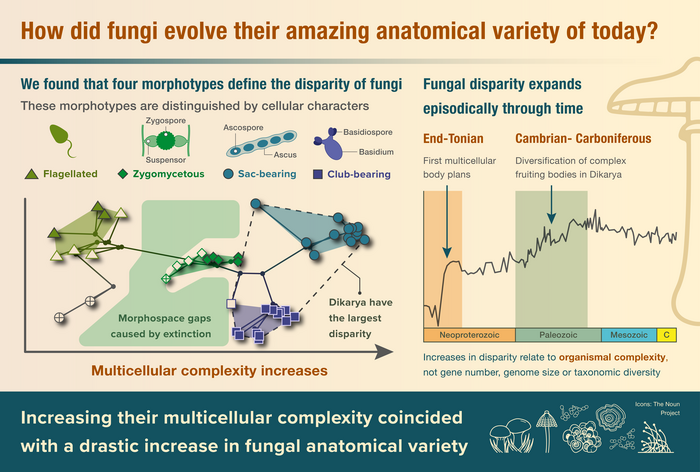
Scientists at the University of Bristol have discovered that the vast anatomical variety of fungi stems from evolutionary increases in multicellular complexity.
Image

Credit: Thomas Smith

Scientists at the University of Bristol have discovered that the vast anatomical variety of fungi stems from evolutionary increases in multicellular complexity.

Most people recognise that fungi come in an assortment of shapes and sizes. However, these differences, often referred to as the disparity of a group, had never been analysed collectively.

Researcher Thomas Smith, who conducted the study while at Bristol’s School of Earth Sciences, explained: “Prior to our analyses, we didn’t know how this variety was distributed across the different types of fungi. Which groups are the most varied when considering all parts of the fungal body plan? Which are the least? How has this variety accumulated and diminished through time? What has shaped these patterns in disparity? These are the questions we sought to answer.”

What they found was that fungal disparity has evolved episodically through time, and that the evolution of multicellularity in different fungi appears to open the door for greater morphological variety. They saw increases in disparity associated with both the emergence of the first multicellular fungi, and then the evolution of complex fruiting bodies such as mushrooms and saddles in dikaryotic species. These fungi are defined by the inclusion of a dikaryon, a cell with two separate nuclei, in their life cycles.  

The main implication is that these results align with those of analyses of animal disparity. Both kingdoms present clumpy distributions of anatomical variety which have evolved intermittently through time.

Mr Smith said: “The world of fungi is defined by bright colours, strange shapes, and stranger anatomies. Our analyses demonstrate that this breath-taking anatomical variety has evolved in bursts, driven by evolutionary increases in multicellular complexity.”

The next step is to combine the datasets characterising the disparity of these two kingdoms and keep expanding the taxonomic net, starting with plants and algae. Nevertheless, this fungal dataset brings the team one step closer to characterising, visualising, and analysing the disparity of all multicellular life.

Paper:

‘Evolution of fungal phenotypic disparity’ by Thomas Smith and Professor Philip Donoghue in Nature Ecology and Evolution paper.


Journal

Nature Ecology & Evolution

Method of Research

Computational simulation/modeling

Subject of Research

Cells

Article Title

Evolution of fungal phenotypic disparity

Article Publication Date

15-Aug-2022

Share12Tweet8Share2ShareShareShare2

Related Posts

Florida Cane Toad: Complex Spread and Selective Evolution

Florida Cane Toad: Complex Spread and Selective Evolution

February 7, 2026
New Study Uncovers Mechanism Behind Burn Pit Particulate Matter–Induced Lung Inflammation

New Study Uncovers Mechanism Behind Burn Pit Particulate Matter–Induced Lung Inflammation

February 6, 2026

DeepBlastoid: Advancing Automated and Efficient Evaluation of Human Blastoids with Deep Learning

February 6, 2026

Navigating the Gut: The Role of Formic Acid in the Microbiome

February 6, 2026

POPULAR NEWS

  • Robotic Ureteral Reconstruction: A Novel Approach

    Robotic Ureteral Reconstruction: A Novel Approach

    82 shares
    Share 33 Tweet 21
  • Digital Privacy: Health Data Control in Incarceration

    63 shares
    Share 25 Tweet 16
  • Study Reveals Lipid Accumulation in ME/CFS Cells

    57 shares
    Share 23 Tweet 14
  • Breakthrough in RNA Research Accelerates Medical Innovations Timeline

    53 shares
    Share 21 Tweet 13

About

We bring you the latest biotechnology news from best research centers and universities around the world. Check our website.

Follow us

Recent News

Phage-Antibiotic Combo Beats Resistant Peritoneal Infection

Boosting Remote Healthcare: Stepped-Wedge Trial Insights

Barriers and Boosters of Seniors’ Physical Activity in Karachi

Subscribe to Blog via Email

Enter your email address to subscribe to this blog and receive notifications of new posts by email.

Join 73 other subscribers
  • Contact Us

Bioengineer.org © Copyright 2023 All Rights Reserved.

Welcome Back!

Login to your account below

Forgotten Password?

Retrieve your password

Please enter your username or email address to reset your password.

Log In
No Result
View All Result
  • Homepages
    • Home Page 1
    • Home Page 2
  • News
  • National
  • Business
  • Health
  • Lifestyle
  • Science

Bioengineer.org © Copyright 2023 All Rights Reserved.