• HOME
  • NEWS
  • EXPLORE
    • CAREER
      • Companies
      • Jobs
    • EVENTS
    • iGEM
      • News
      • Team
    • PHOTOS
    • VIDEO
    • WIKI
  • BLOG
  • COMMUNITY
    • FACEBOOK
    • INSTAGRAM
    • TWITTER
Saturday, February 7, 2026
BIOENGINEER.ORG
No Result
View All Result
  • Login
  • HOME
  • NEWS
  • EXPLORE
    • CAREER
      • Companies
      • Jobs
        • Lecturer
        • PhD Studentship
        • Postdoc
        • Research Assistant
    • EVENTS
    • iGEM
      • News
      • Team
    • PHOTOS
    • VIDEO
    • WIKI
  • BLOG
  • COMMUNITY
    • FACEBOOK
    • INSTAGRAM
    • TWITTER
  • HOME
  • NEWS
  • EXPLORE
    • CAREER
      • Companies
      • Jobs
        • Lecturer
        • PhD Studentship
        • Postdoc
        • Research Assistant
    • EVENTS
    • iGEM
      • News
      • Team
    • PHOTOS
    • VIDEO
    • WIKI
  • BLOG
  • COMMUNITY
    • FACEBOOK
    • INSTAGRAM
    • TWITTER
No Result
View All Result
Bioengineer.org
No Result
View All Result
Home NEWS Science News Biology

Using sound and bubbles to make bandages stickier and longer lasting

Bioengineer by Bioengineer
August 12, 2022
in Biology
Reading Time: 2 mins read
0
Adhesive hydrogel
Share on FacebookShare on TwitterShare on LinkedinShare on RedditShare on Telegram

Researchers have discovered that they can control the stickiness of adhesive bandages using ultrasound waves and bubbles. This breakthrough could lead to new advances in medical adhesives, especially in cases where adhesives are difficult to apply such as on wet skin.
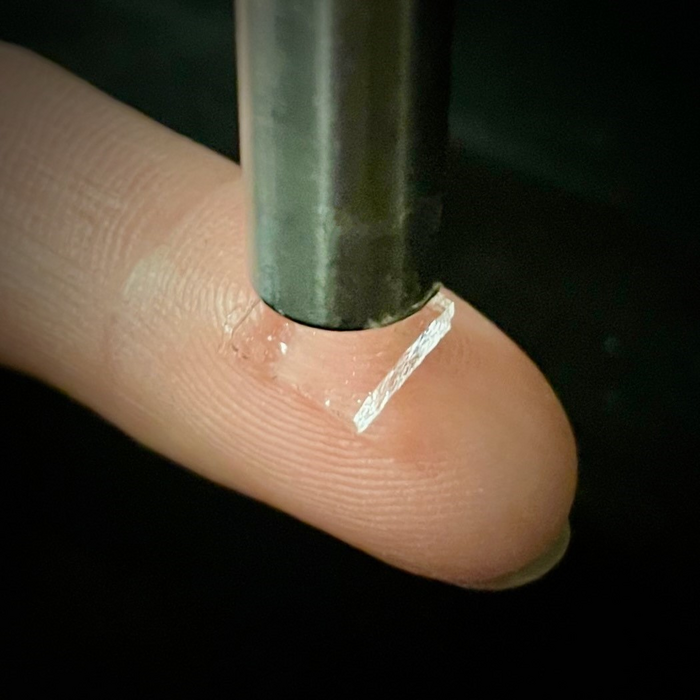
Adhesive hydrogel

Credit: Ran Huo and Jianyu Li

Researchers have discovered that they can control the stickiness of adhesive bandages using ultrasound waves and bubbles. This breakthrough could lead to new advances in medical adhesives, especially in cases where adhesives are difficult to apply such as on wet skin.

“Bandages, glues, and stickers are common bioadhesives that are used at home or in clinics. However, they don’t usually adhere well on wet skin. It’s also challenging to control where they are applied and the strength and duration of the formed adhesion,” says McGill University Professor Jianyu Li, who led the research team of engineers, physicists, chemists, and clinicians.

“We were surprised to find that by simply playing around with ultrasonic intensity, we can control very precisely the stickiness of adhesive bandages on many tissues,” says lead author Zhenwei Ma, a former student of Professor Li and now a Killam Postdoctoral Fellow at the University of British Columbia.

Ultrasound induced bubbles control stickiness

In collaboration with physicists Professor Outi Supponen and Claire Bourquard from the Institute of Fluid Dynamics at ETH Zurich, the team experimented with ultrasound induced microbubbles to make adhesives stickier. “The ultrasound induces many microbubbles, which transiently push the adhesives into the skin for stronger bioadhesion,” says Professor Supponen. “We can even use theoretical modeling to estimate exactly where the adhesion will happen.”

Their study, published in the journal Science, shows that the adhesives are compatible with living tissue in rats. The adhesives can also potentially be used to deliver drugs through the skin. “This paradigm-shifting technology will have great implications in many branches of medicine,” says University of British Columbia Professor Zu-hua Gao. “We’re very excited to translate this technology for applications in clinics for tissue repair, cancer therapy, and precision medicine.”

“By merging mechanics, materials and biomedical engineering, we envision the broad impact of our bioadhesive technology in wearable devices, wound management, and regenerative medicine,” says Professor Li, who is also a Canada Research Chair in Biomaterials and Musculoskeletal Health.

About this study

“Controlled tough bioadhesion mediated by ultrasound” by Jianyu Li et al. was published by Science.

DOI: https://doi.org/10.1126/science.abn8699


Journal

Science

DOI

10.1126/science.abn8699

Method of Research

Experimental study

Subject of Research

Animal tissue samples

Article Title

Controlled tough bioadhesion mediated by ultrasound

Article Publication Date

12-Aug-2022

Share12Tweet8Share2ShareShareShare2

Related Posts

Florida Cane Toad: Complex Spread and Selective Evolution

Florida Cane Toad: Complex Spread and Selective Evolution

February 7, 2026
New Study Uncovers Mechanism Behind Burn Pit Particulate Matter–Induced Lung Inflammation

New Study Uncovers Mechanism Behind Burn Pit Particulate Matter–Induced Lung Inflammation

February 6, 2026

DeepBlastoid: Advancing Automated and Efficient Evaluation of Human Blastoids with Deep Learning

February 6, 2026

Navigating the Gut: The Role of Formic Acid in the Microbiome

February 6, 2026

POPULAR NEWS

  • Robotic Ureteral Reconstruction: A Novel Approach

    Robotic Ureteral Reconstruction: A Novel Approach

    82 shares
    Share 33 Tweet 21
  • Digital Privacy: Health Data Control in Incarceration

    63 shares
    Share 25 Tweet 16
  • Study Reveals Lipid Accumulation in ME/CFS Cells

    57 shares
    Share 23 Tweet 14
  • Breakthrough in RNA Research Accelerates Medical Innovations Timeline

    53 shares
    Share 21 Tweet 13

About

We bring you the latest biotechnology news from best research centers and universities around the world. Check our website.

Follow us

Recent News

Evaluating Pediatric Emergency Care Quality in Ethiopia

TPMT Expression Predictions Linked to Azathioprine Side Effects

Improving Dementia Care with Enhanced Activity Kits

Subscribe to Blog via Email

Enter your email address to subscribe to this blog and receive notifications of new posts by email.

Join 73 other subscribers
  • Contact Us

Bioengineer.org © Copyright 2023 All Rights Reserved.

Welcome Back!

Login to your account below

Forgotten Password?

Retrieve your password

Please enter your username or email address to reset your password.

Log In
No Result
View All Result
  • Homepages
    • Home Page 1
    • Home Page 2
  • News
  • National
  • Business
  • Health
  • Lifestyle
  • Science

Bioengineer.org © Copyright 2023 All Rights Reserved.