• HOME
  • NEWS
  • EXPLORE
    • CAREER
      • Companies
      • Jobs
    • EVENTS
    • iGEM
      • News
      • Team
    • PHOTOS
    • VIDEO
    • WIKI
  • BLOG
  • COMMUNITY
    • FACEBOOK
    • INSTAGRAM
    • TWITTER
Saturday, February 7, 2026
BIOENGINEER.ORG
No Result
View All Result
  • Login
  • HOME
  • NEWS
  • EXPLORE
    • CAREER
      • Companies
      • Jobs
        • Lecturer
        • PhD Studentship
        • Postdoc
        • Research Assistant
    • EVENTS
    • iGEM
      • News
      • Team
    • PHOTOS
    • VIDEO
    • WIKI
  • BLOG
  • COMMUNITY
    • FACEBOOK
    • INSTAGRAM
    • TWITTER
  • HOME
  • NEWS
  • EXPLORE
    • CAREER
      • Companies
      • Jobs
        • Lecturer
        • PhD Studentship
        • Postdoc
        • Research Assistant
    • EVENTS
    • iGEM
      • News
      • Team
    • PHOTOS
    • VIDEO
    • WIKI
  • BLOG
  • COMMUNITY
    • FACEBOOK
    • INSTAGRAM
    • TWITTER
No Result
View All Result
Bioengineer.org
No Result
View All Result
Home NEWS Science News Health

Tiny optical sensors could put an end to hospital bed sores

Bioengineer by Bioengineer
August 10, 2022
in Health
Reading Time: 2 mins read
0
Optical fibre sensors to halt bed sores
Share on FacebookShare on TwitterShare on LinkedinShare on RedditShare on Telegram

Tiny smart bed sensors embedded in hospital mattresses could put an end to painful and potentially life-threatening pressure sores, thanks to new technology developed by the University of South Australia.
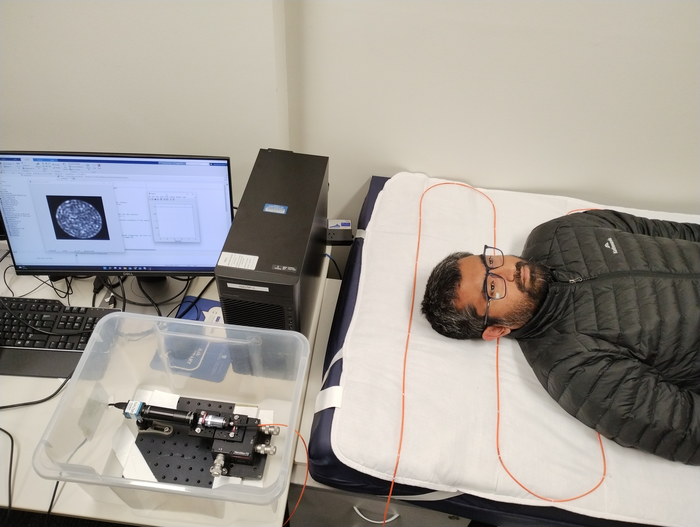
Optical fibre sensors to halt bed sores

Credit: University of South Australia

Tiny smart bed sensors embedded in hospital mattresses could put an end to painful and potentially life-threatening pressure sores, thanks to new technology developed by the University of South Australia.

UniSA scientists have designed minute optical fibre sensors, which can be attached to the upper surface of a mattress to monitor movement and record heart and respiratory rates.

The unobtrusive sensors can detect when a hospital patient turns over, leaves a bed, or just remains motionless, picking up their breathing.

Nurses can therefore be remotely alerted if a patient has not moved within a couple of hours, prompting them to adjust the patient’s position.

Lead UniSA researcher Dr Stephen Warren-Smith says the technology could “significantly relieve” the burden on hospital staff having to constantly monitor patients for pressure sores.

“Each year, millions of older people in hospitals and nursing homes experience pressure injuries, or ulcers, which take a long time to heal and can be fatal,” Dr Warren-Smith says.

“At the very least these injuries can cause severe pain, disrupt sleep, affect their mood as well as their rehabilitation, mobility and quality of life.”

Unlike the sensors that many people wear on their wrists to monitor physical activity and physiological signs, the optical fibre sensors are embedded in the same space as a person, but not on them physically.

Hospitals currently use weight-based sensors or cameras installed in the room to monitor patients, but both have limitations, Dr Warren-Smith says.

“Existing weight-based hospital sensors cannot predict when a patient leaves the bed until their feet touch the floor, leaving little time for nursing staff to respond in the event of a fall. Also, there are privacy issues with camera-based technology.”

The optical fibre sensors are sensitive enough to record heart and respiration rates and can detect whether a person is in the bed, even if they remain stationary for long periods.

“Respiration rates are often the first sign that a patient is deteriorating. This normally requires devices to be attached to the patient, either on the chest, as a mask on the face, or ventilator. These can be restrictive and sometimes inappropriate in an aged care setting.

“Monitoring vital signs continuously, unobtrusively and cheaply via the mattress-embedded sensors is a far better solution for both patient and nurse,” Dr Warren-Smith says.

The technology is explained in a recent paper published in the Journal of Biomedical Optics.


Journal

Journal of Biomedical Optics

DOI

10.1117/1.JBO.27.6.067002

Method of Research

Computational simulation/modeling

Subject of Research

Not applicable

Article Title

Multimode optical fiber specklegram smart bed sensor array

Article Publication Date

24-Jun-2022

Share12Tweet8Share2ShareShareShare2

Related Posts

Digital Health Perspectives from Baltic Sea Experts

February 7, 2026

Exploring Decision-Making in Dementia Caregivers’ Mobility

February 7, 2026

Succinate Receptor 1 Limits Blood Cell Formation, Leukemia

February 7, 2026

Palmitoylation of Tfr1 Drives Platelet Ferroptosis and Exacerbates Liver Damage in Heat Stroke

February 7, 2026

POPULAR NEWS

  • Robotic Ureteral Reconstruction: A Novel Approach

    Robotic Ureteral Reconstruction: A Novel Approach

    82 shares
    Share 33 Tweet 21
  • Digital Privacy: Health Data Control in Incarceration

    63 shares
    Share 25 Tweet 16
  • Study Reveals Lipid Accumulation in ME/CFS Cells

    57 shares
    Share 23 Tweet 14
  • Breakthrough in RNA Research Accelerates Medical Innovations Timeline

    53 shares
    Share 21 Tweet 13

About

We bring you the latest biotechnology news from best research centers and universities around the world. Check our website.

Follow us

Recent News

Digital Health Perspectives from Baltic Sea Experts

Florida Cane Toad: Complex Spread and Selective Evolution

Exploring Decision-Making in Dementia Caregivers’ Mobility

Subscribe to Blog via Email

Enter your email address to subscribe to this blog and receive notifications of new posts by email.

Join 73 other subscribers
  • Contact Us

Bioengineer.org © Copyright 2023 All Rights Reserved.

Welcome Back!

Login to your account below

Forgotten Password?

Retrieve your password

Please enter your username or email address to reset your password.

Log In
No Result
View All Result
  • Homepages
    • Home Page 1
    • Home Page 2
  • News
  • National
  • Business
  • Health
  • Lifestyle
  • Science

Bioengineer.org © Copyright 2023 All Rights Reserved.